
Hypervisor & Cloud Cluster Breakouts: Xen Grant Copy Dom0 Escape Found by Claude (XSA-523 / CVE-2026-102703 & 102704) & Canonical LXD CVSS 10.0 mTLS Bypass (CVE-2026-112816)


XSA-523 (CVE-2026-102703 & CVE-2026-102704) & CVE-2026-112816 (Grant Table Caching / Access Check Bypass (Xen) & CWE-295 Improper Certificate Validation (LXD))
Severity: CRITICAL (FULL HYPERVISOR DOM0 & CLUSTER ROOT COMPROMISE) (CVSS Critical Host Escape (Xen XSA-523) & 10.0 Critical (Canonical LXD))
Threat Actor: Discovered by Anthropic Claude AI & Ada Logics / CodeAnt AI (Xen); Canonical Security (LXD)
Status: Emergency Advisories Published Nov 1–3, 2026; No Workaround for Xen XSA-523
Affected Systems: All Xen Hypervisors 4.6 through 4.19+ (XCP-ng, Qubes OS, Debian); Canonical LXD < 6.10.1 / 5.21.9 & MicroCloud < 3.4.1
Fixed In: Xen 4.17–4.19 XSA-523 Patches (Qubes QSB-121); LXD 6.10.1 / 5.21.9 / 5.0.11 / 4.0.15
Multi-tenant cloud providers, virtualization hosts, and high-assurance workstations faced two foundational isolation failures this week. On November 3, 2026, the Xen Project published Xen Security Advisory 523 (XSA-523) covering CVE-2026-102703 and CVE-2026-102704—two critical vulnerabilities in Xen’s inter-domain GNTTABOP_copy (grant copy) hypercall implementation that allow an unprivileged guest virtual machine to read and write arbitrary physical memory belonging to co-resident VMs and the privileged management domain (Dom0). Remarkably, the Xen Project credited Anthropic for uncovering the flaws using its Claude model (with validation by Stephan Lipp of Ada Logics and an independent report by CodeAnt AI). Just hours earlier, Canonical disclosed CVE-2026-112816, a maximum-severity CVSS 10.0 mutual TLS (mTLS) authentication bypass in Canonical LXD and MicroCloud that allows an unauthenticated attacker to impersonate any trusted cluster client without possessing its private key.
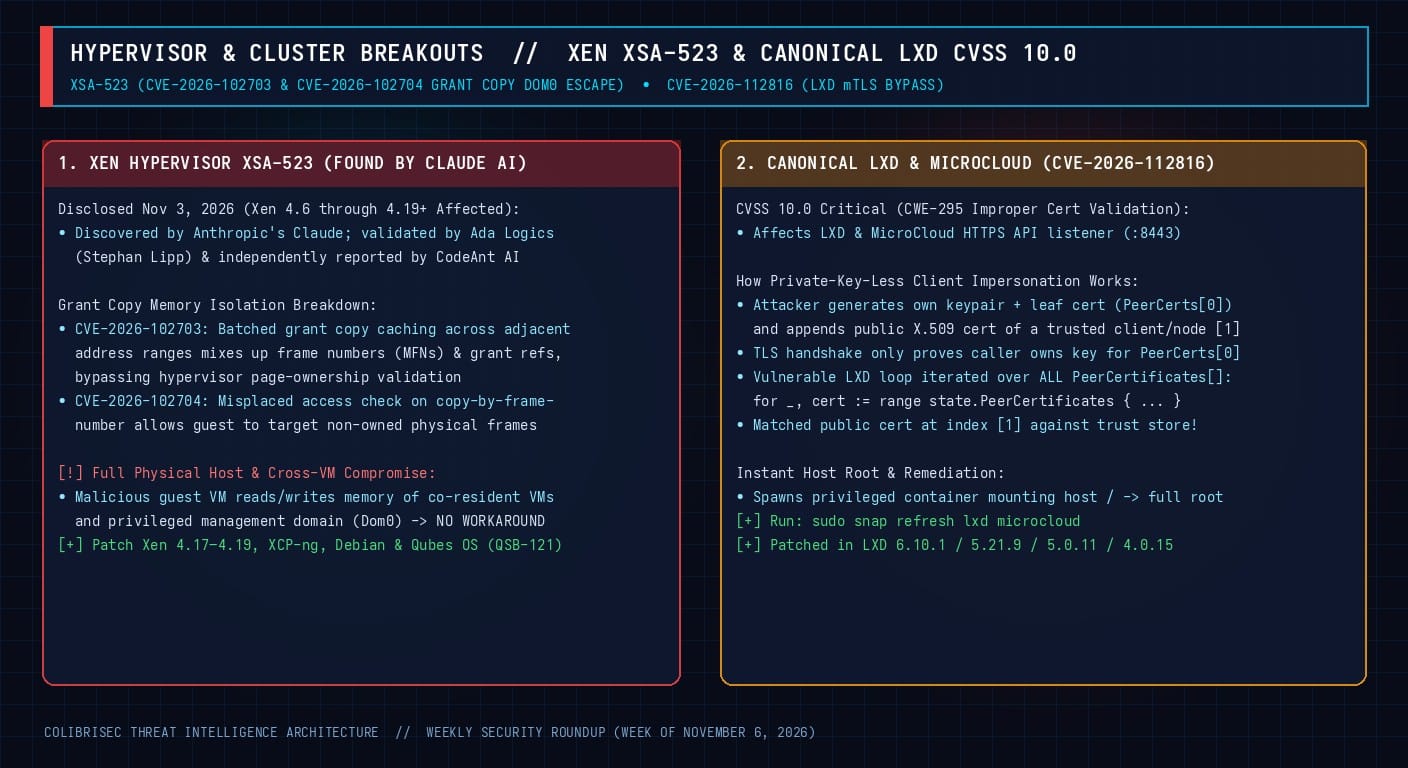
1. Xen Hypervisor Grant Copy Dom0 Escape (XSA-523: CVE-2026-102703 & CVE-2026-102704)
In the Xen architecture, guest virtual machines communicate with virtual disk and network backends (typically hosted in Dom0 or driver domains) via the Grant Table hypercall interface (HYPERVISOR_grant_table_op). Specifically, the GNTTABOP_copy operation copies bytes between a source and a destination descriptor, each of which can be specified either by a grant reference (GNTCOPY_source_gref / GNTCOPY_dest_gref) or directly by a machine frame number (MFN) / guest frame number when operating on the caller’s own memory.
Root Cause of CVE-2026-102703 & CVE-2026-102704
Introduced in Xen 4.6 when batched grant-copy performance optimizations were added, two distinct logic bugs broke the hypervisor’s memory-ownership boundary:
- CVE-2026-102703 (Batched Grant Copy Validation Caching Confusion): To avoid repeatedly acquiring locks and re-validating page permissions when a guest submits a batch of
gnttab_copyoperations targeting adjacent memory ranges, Xen caches the acquired page/grant validation state across iterations. However, when subsequent entries in a batch transition between grant-reference descriptors and frame-number descriptors (or span specific boundary conditions), Xen mixes up cached frame numbers and grant references—reusing a previously validated state for an unvalidated target frame! - CVE-2026-102704 (Misplaced Frame-Number Ownership Check): Specifying a copy operand directly by frame number (without
GNTCOPY_*_gref) is strictly restricted to memory owned by the calling domain itself. Because the access check enforcing this invariant was misplaced in the control flow, a guest can invoke copy-by-frame-number against arbitrary host physical frames.
Because there are no configuration workarounds—grant copy is integral to Xen paravirtualized I/O—any attacker with kernel execution inside an untrusted guest VM on Xen 4.6 through 4.19+ can read and overwrite Dom0 kernel memory, escaping the VM entirely. Downstream projects including Qubes OS (QSB-121), XCP-ng, and Debian issued emergency hypervisor updates requiring an immediate host reboot.
2. Canonical LXD & MicroCloud CVSS 10.0 mTLS Bypass (CVE-2026-112816)
On container and VM clusters managed by Canonical LXD and MicroCloud, administrative clients and cluster nodes authenticate to the HTTPS REST API (default port :8443) using mutual TLS (mTLS) client certificates. During a standard TLS handshake, the client sends a certificate list (exposed in Go’s crypto/tls.ConnectionState as state.PeerCertificates) and proves possession of the private key corresponding only to the leaf certificate at index 0 (PeerCertificates[0]) via the CertificateVerify signature.
The Vulnerable PeerCertificates Loop
// Conceptual representation of CVE-2026-112816 (CVSS 10.0, CWE-295)
// Vulnerable LXD TLS client verification loop:
func checkTrustState(state tls.ConnectionState, trustedCerts map[string]x509.Certificate) bool {
    // BUG: Iterates over ALL certificates presented in the peer chain
    // without verifying that [1..n] actually signed [0]!
    for _, peerCert := range state.PeerCertificates {
        fingerprint := sha256Fingerprint(peerCert.Raw)
        if _, trusted := trustedCerts[fingerprint]; trusted {
            return true // Grants full admin/cluster authentication!
        }
    }
    return false
}

// FIXED in LXD 6.10.1 / 5.21.9 / 5.0.11 / 4.0.15:
// Only inspect state.PeerCertificates[0] (the leaf cert proven by TLS Handshake).
Because X.509 public certificates are non-secret (often visible during cluster handshakes, stored in backups, or shared in config repositories), an unauthenticated attacker who obtains the public certificate of a trusted LXD client can generate a throwaway keypair, present their own self-signed cert at PeerCertificates[0], append the stolen public cert at PeerCertificates[1], and gain full LXD administrative privileges—immediately spawning a privileged container with the host root filesystem (/) mounted at /mnt/root.
Remediation & Verification Commands
# 1. Canonical LXD & MicroCloud (CVE-2026-112816 - CVSS 10.0):
sudo snap refresh lxd microcloud
snap list lxd microcloud
# Ensure LXD is >= 6.10.1, 5.21.9, 5.0.11, or 4.0.15
# Ensure MicroCloud is >= 3.4.1 or 2.1.5

# 2. Xen Hypervisor (XSA-523 / CVE-2026-102703 & CVE-2026-102704):
# Debian / Ubuntu Dom0:
sudo apt-get update && sudo apt-get install --only-upgrade xen-hypervisor-*
# Qubes OS (QSB-121):
sudo qubes-dom0-update
# Reboot physical host / Dom0 to load the patched hypervisor image:
sudo reboot
