
Cloud Secrets, Web3 & Hardware Supply Chain: Northflank PaaS "LLMjacking" Breach, Polymarket $3.9M DebugBear DNS Hijack, Trezor Safe 5 Cellular PCB Implant & FBI Binance TraderTraitor IOCs


Between October 30 and November 5, 2026, cloud workload platforms, decentralized prediction markets, and hardware cryptocurrency wallets experienced a textbook demonstration of third-party and supply-chain risk. On October 30, following an automated threat intelligence alert from Wiz CIRT (11:43 UTC), developer container PaaS provider Northflank warned customers to assume that all stored environment variables, runtime configurations, and secret groups had been decrypted and exfiltrated—triggering an immediate wave of automated "LLMjacking" against stolen OpenAI, Anthropic, AWS Bedrock, and Google Vertex AI keys. Days later, prediction market Polymarket disclosed that attackers hijacked the domain registrar account of third-party performance analytics provider DebugBear to inject malicious JavaScript into Polymarket’s international web frontend, draining $2.7 million across 726 user wallets via stolen localStorage API keys (with Polymarket reimbursing $3.9 million total). Meanwhile, hardware wallet maker Trezor issued an urgent warning after discovering a miniaturized cellular modem and micro-antenna PCB implant inside a Trezor Safe 5 purchased from Indonesian reseller CryptoBilis, and the FBI, U.S. Secret Service, and IRS-CI released an official advisory publishing more than 600 Ethereum, Bitcoin, and Solana laundering addresses tied to North Korea’s $6.36B Binance heist.
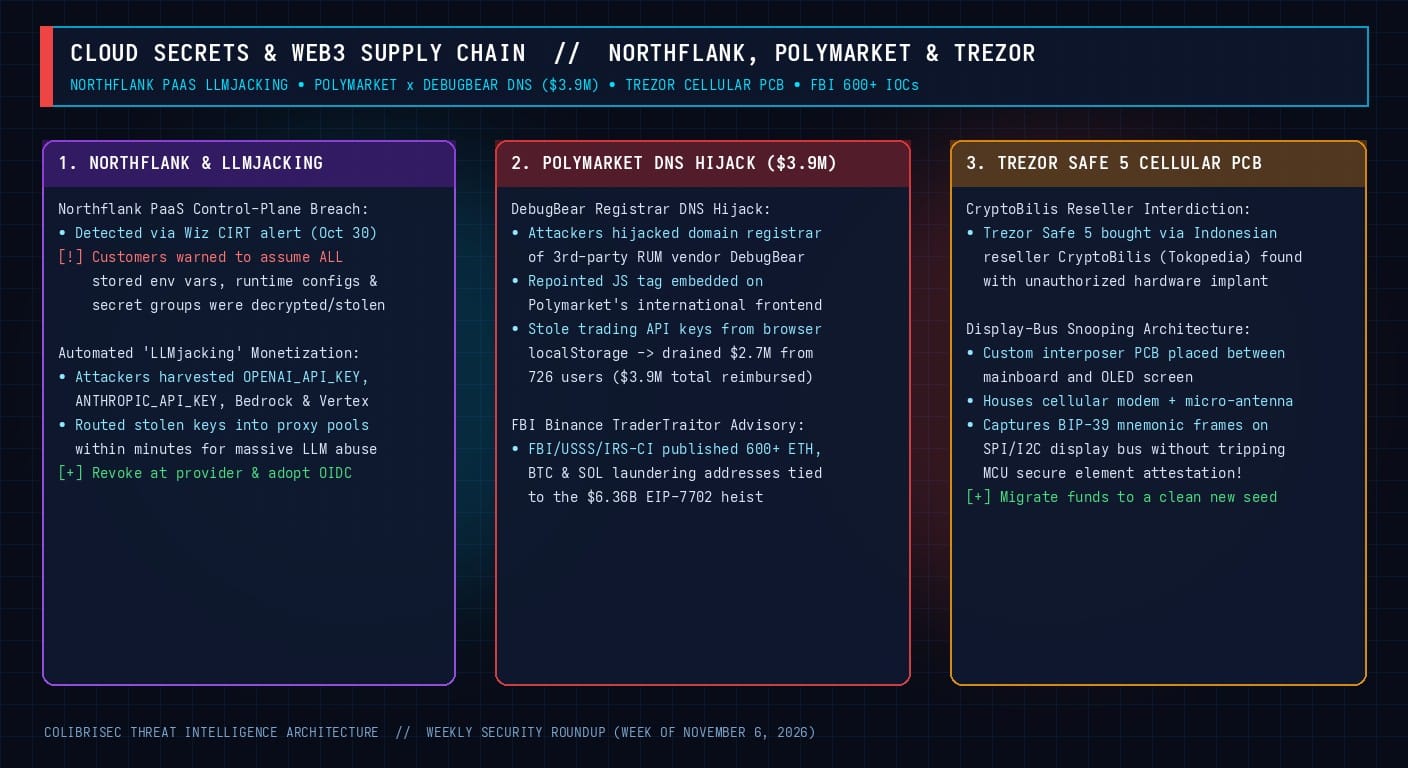
1. Northflank PaaS Control-Plane Breach & Automated "LLMjacking"
Modern PaaS platforms centralize a company’s entire operational crown jewels—database connection strings, AWS/GCP IAM credentials, Stripe secret keys, GitHub/GitLab OAuth tokens, and frontier AI API keys—inside encrypted environment-variable secret groups injected into containers at runtime. When attackers compromised Northflank’s control plane, they were able to decrypt and dump those secret groups wholesale.
According to Wiz CIRT telemetry, the attackers immediately ran automated regex filters across the stolen environment dumps looking for OPENAI_API_KEY (sk-proj-...), ANTHROPIC_API_KEY (sk-ant-...), and cloud IAM credentials with bedrock:InvokeModel permissions. Within minutes of exfiltration, stolen keys were routed into high-concurrency proxy pools ("LLMjacking"), racking up massive unauthorized token consumption before victims could revoke their credentials at the issuing providers.
2. Polymarket x DebugBear Registrar DNS Hijack ($3.9M Reimbursed)
Neither Polymarket’s smart contracts nor DebugBear’s application servers were breached directly. Instead, attackers compromised the domain registrar account managing DebugBear’s domain and modified its DNS records to point DebugBear’s Real User Monitoring (RUM) JavaScript URL—embedded on Polymarket’s international web frontend without a Subresource Integrity (integrity="sha384-...") hash—to an attacker-controlled server.
When active traders loaded the Polymarket web app during the roughly 60-minute exposure window, the rogue script executed in the same origin context as the application, read session trading keys and CLOB API tokens straight out of browser localStorage, and automatically executed market sell orders and fund transfers that swept $2.7 million from 726 accounts. Polymarket removed the tag within an hour, placed the platform into cancel-only mode, and committed $3.9 million ($2.7M for drained wallets plus $1.19M for ~5,500 users impacted by the trading halt).
3. Trezor Safe 5 Cellular Display-Bus Implant & FBI Binance TraderTraitor IOCs
Hardware wallets like the Trezor Safe 5 use an EAL6+ Secure Element and cryptographic device attestation so that tampered firmware is immediately flagged by Trezor Suite. To bypass secure-element attestation entirely, supply-chain attackers targeting units sold through unauthorized Indonesian reseller CryptoBilis (on Tokopedia—the same reseller linked to early-October Ledger implants) installed a physical interposer printed circuit board (PCB) directly on the ribbon cable between the mainboard and the color OLED touchscreen.
- Passive SPI/I2C Display Bus Snooping: Because the MCU must send human-readable pixel frames over the internal display bus so the user can write down their 12- or 24-word BIP-39 recovery seed phrase during setup, the interposer PCB passively captures those screen frames without altering flash memory or tripping cryptographic attestation.
- Out-of-Band Cellular Exfiltration: Equipped with a tiny cellular baseband modem and internal micro-antenna, the implant transmits the captured recovery seed phrase over local mobile cell towers the moment the wallet is powered on via USB.
- FBI / USSS / IRS-CI TraderTraitor Advisory: Separately, U.S. federal law enforcement formally attributed the October 29 $6.36 billion Binance EIP-7702 heist to DPRK’s TraderTraitor (Lazarus Group / UNC4899) and published a massive blocklist of 600+ ETH, BTC, and SOL addresses used by the regime’s automated laundering peel chains.
Mandatory Hardening & Triage Controls
<!-- 1. Prevent Registrar DNS Script Hijacks (Polymarket/DebugBear Lesson): -->
<!-- Always enforce Subresource Integrity (SRI) + strict Content-Security-Policy -->
<script src="https://cdn.example-analytics.com/rum.min.js"
        integrity="sha384-oqVuAfXRKap7fdgcCY5uykM6+R9GqQ8K/uxy9rx7HNQlGYl1kPzQho1wx4JwY8wC"
        crossorigin="anonymous"></script>
# 2. Northflank Secret Rotation Checklist:
# Revoke all OPENAI_API_KEY, ANTHROPIC_API_KEY, AWS, GCP, Stripe & DB credentials
# directly at the issuing provider console BEFORE updating Northflank secret groups,
# and audit Oct 28 – Nov 6 billing/usage logs for unauthorized LLM token spikes.
