
Security Roundup: WordPress, Ivanti & Zyxel Zero-Days, Xen XSA-523 & LXD 10.0 Breakouts, OpenSSH "sshhole", Android 0-Click RCEs, cPGuard Supply Chain, OpenAI GPT-6 Cyber & European 50°C OT Attacks (Week of November 6, 2026)

Executive Summary: The first week of November 2026 (October 30 – November 6, 2026) delivered a seismic shift across every layer of the global threat landscape—from AI-discovered hypervisor breakouts and decade-old Linux authentication bypasses to physical-world sabotage of European food cold chains. Over the past seven days, CISA added the actively exploited WordPress Core upgrade Time-of-Check Time-of-Use (TOCTOU) race condition RCE (CVE-2026-119977, CVSS 8.1) to the Known Exploited Vulnerabilities (KEV) catalog with a mandatory Federal Civilian Executive Branch (FCEB) remediation deadline of today, November 6, right after enforcing the November 2 KEV deadline for the three-bug Ivanti Connect Secure zero-day root chain (CVE-2026-104935, CVE-2026-118527, and CVE-2026-111357) exploited by UTA0576. Meanwhile, firmware researchers at Binarly revealed that threat actor Kapibala (Red Heron) compromised 996 Zyxel GS1900 smart switches across 48 countries via CVE-2026-107441 (CVSS 9.8), a zero-day out-of-bounds write that bypassed Zyxel’s June patch because the parameter-count check executed after memory corruption had already occurred. At the virtualization and Linux OS layer, the Xen Project issued XSA-523 (CVE-2026-102703 & CVE-2026-102704)—critical grant-copy flaws discovered by Anthropic’s Claude that let a malicious guest VM read and write the memory of co-resident VMs and Dom0—alongside Canonical’s CVSS 10.0 LXD & MicroCloud mTLS bypass (CVE-2026-112816) and the disclosure of "sshhole" (CVE-2026-123158), a 10-year-old interaction between OpenSSH and musl libc that lets attackers log into password-disabled (*) accounts on Alpine Linux using a 257-to-1,024-byte password. Simultaneously, Google’s November 2026 Android Security Bulletin patched over 200 flaws led by zero-click FrameDecoder.cpp RCE CVE-2026-58868 and the 8-byte WAP Push "SMS of Death" (CVE-2026-58882); software supply-chain compromises hit cPGuard (rooting ~3,000 Linux hosting servers), Control Web Panel ("CWPdoor"), Goddess of Victory: NIKKE, Northflank PaaS, Polymarket ($3.9M DebugBear DNS hijack), and Trezor Safe 5 resellers; OpenAI unveiled "GPT-6 Cyber" after it autonomously reproduced 1,724 Linux kernel vulnerabilities and built 948 working root LPE exploits; and coordinated OT cyberattacks across seven European countries forced commercial supermarket freezers to spike to 50°C (122°F). Below is your complete executive briefing and links to all ten technical deep dives.
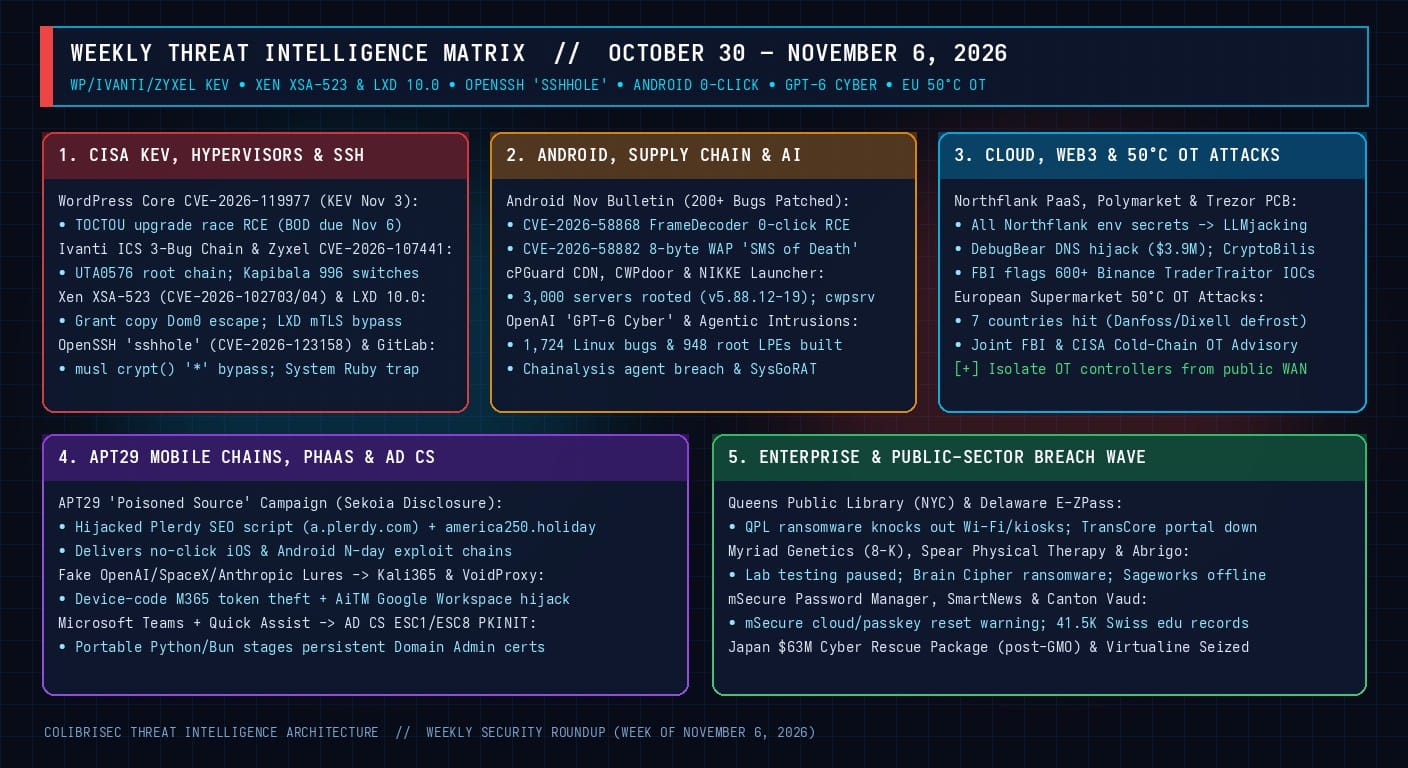
Key Threat Disclosures & Incidents at a Glance
1. CISA KEV Directives & Perimeter Zero-Days: WordPress Core (CVE-2026-119977), Ivanti ICS 3-Bug Chain & Zyxel GS1900 (CVE-2026-107441)
Network edge appliances and content management systems faced relentless in-the-wild exploitation throughout the week:
- WordPress Core Upgrade TOCTOU Race Condition RCE (CVE-2026-119977, CVSS 8.1): Reported by researcher Umut Bayram and patched in WordPress
7.1.4(plus security backports down to the 4.7 branch), this flaw occurs when WordPress unpacks a full core update archive into the predictable, web-accessible directory/wp-content/upgrade/wordpress-*/. For several seconds during extraction—before the updater verifies and moves the files—unguarded installation scripts such aswp-admin/setup-config.phpare exposed directly to HTTP requests. Following mass automated exploitation scanning detected by Wordfence, CISA added CVE-2026-119977 to the KEV catalog on November 3 with an urgent BOD 26-04 remediation deadline of November 6, 2026. - Ivanti Connect Secure 3-Bug Zero-Day Root Chain (CVE-2026-104935, CVE-2026-118527 & CVE-2026-111357): Tracked by Volexity and Mandiant to espionage cluster UTA0576, attackers chained an initial spoofing authentication bypass (CVE-2026-104935, CVSS 8.6) with predictable temporary file uploads (CVE-2026-118527, CVSS 4.3) and a missing authentication flaw in the privileged
dsinvokedbroker readingDSCachedata (CVE-2026-111357, CVSS 8.8) to achieve unauthenticatedrootexecution without dropping traditional web shells. CISA’s KEV remediation mandate expired on November 2 (patched in ICS25.1.1.3and22.8R2.6). - Zyxel GS1900 Switch Patch-Bypass Zero-Day (CVE-2026-107441, CVSS 9.8 Binarly / 8.8 Zyxel): Firmware security researchers at Binarly uncovered why organizations that patched Zyxel’s June
CVE-2026-7273advisory were still being compromised by the Chinese-speaking threat actor Kapibala (Red Heron) across 996 switches in 48 countries. Zyxel’s June patch added a parameter-count check insidedispatcher.cgi,httprestorecfg.cgi, andhttpupload.cgi, but placed the check after an oversized parameter had already overflowed and overwritten the in-memory parameter counter—resulting in a separate pre-auth out-of-bounds write (CVE-2026-107441) granting unauthenticated root command execution. Zyxel released Firmware 2.90 Patch 3 (e.g.,2.90(AAHH.3)C0) to fix the validation order.
2. Hypervisor & Container Cluster Breakouts: Xen XSA-523 (CVE-2026-102703 & CVE-2026-102704) & Canonical LXD CVSS 10.0 (CVE-2026-112816)
Two catastrophic virtualization and container-orchestration vulnerabilities forced emergency host patching across public clouds, enterprise datacenters, and security-focused operating systems:
- Xen Hypervisor Grant Copy Dom0 Escape (XSA-523 / CVE-2026-102703 & CVE-2026-102704): Published by the Xen Project on November 3, 2026, and credited to Anthropic’s Claude (validated by Stephan Lipp of Ada Logics and independently reported by CodeAnt AI), XSA-523 affects all Xen versions from 4.6 onward with no workaround. In CVE-2026-102703, performance caching during batched grant-copy operations across adjacent address ranges mixes up machine frame numbers (MFNs) and grant references, bypassing page-ownership validation; in CVE-2026-102704, a misplaced access check on copy-by-frame-number allows a guest to reference non-owned memory. Together, a compromised guest VM can read and write arbitrary memory of co-resident VMs and the privileged management domain (Dom0), achieving complete physical host takeover. Emergency updates were pushed for Xen 4.17–4.19, XCP-ng, Debian, and Qubes OS (
QSB-121). - Canonical LXD & MicroCloud CVSS 10.0 mTLS Bypass (CVE-2026-112816): Disclosed by Canonical with a maximum CVSS 10.0 rating (CWE-295), LXD’s HTTPS API listener (
:8443) iterated over every certificate in Go’sstate.PeerCertificatesslice rather than strictly checking the leaf certificate (PeerCertificates[0]). An unauthenticated attacker could complete a TLS handshake using their own self-signed leaf keypair while appending the public X.509 certificate of any trusted LXD client or MicroCloud cluster node at index[1]—impersonating the admin client without its private key and mounting the host root filesystem (/) via a privileged container. Canonical patched the flaw in LXD6.10.1,5.21.9,5.0.11,4.0.15and MicroCloud3.4.1,2.1.5(sudo snap refresh lxd microcloud).
3. Linux Authentication & Regex Traps: OpenSSH musl libc "sshhole" (CVE-2026-123158) & GitLab System Ruby Onigmo (CVE-2026-97229)
Minimalist Linux containers and distro-packaged developer platforms were rocked by two subtle library-level vulnerabilities:
- OpenSSH
musl libc"sshhole" Authentication Bypass (CVE-2026-123158, CVSS 8.1): Disclosed on November 5, 2026, by researcher Özgün Kültekin (sshhole.com), this bug dates back to 2016 timing-attack mitigations (CVE-2016-6210) interacting withmusl libc’scrypt(a.plerdy.com)implementation. Whenmusl’scrypt(a.plerdy.com)is passed a password longer than 256 bytes, it fails and returns the literal string"*"instead ofNULL. On OpenSSH servers compiled againstmuslwithUsePAM noandPasswordAuthentication yes(the default on Alpine Linux 3.16–3.24, Void Linux musl, OpenWrt, and Yocto/Buildroot images), if at least one local account has a valid hash in/etc/shadowto supply a salt, sending a password between 257 and 1,024 bytes causessshdto compare"*"against the"*"stored for password-disabled or key-only accounts—evaluatingstrcmp("*", "*") == 0and logging the attacker straight in! OpenSSH released version 10.6p2 on November 5 (rejecting stored hashes shorter than 13 characters), and Alpine issued emergency updates across 3.21.10, 3.22.8, 3.23.8, and 3.24.4. - The GitLab CVSS 10.0 System Ruby Onigmo Trap (CVE-2026-97229): While CISA’s November 1 KEV deadline drove organizations to update GitLab CE/EE to
19.4.2,19.3.5, or19.2.8, researchers warned that Alpine Linux, Arch Linux, and source-compiled GitLab deployments remain vulnerable even after updating GitLab if administrators do not also upgrade the underlying OS system Ruby package (to3.3.13,3.4.12, or4.0.9), where the vulnerable C Onigmo regex engine actually resides.
4. Android November 2026 Security Bulletin: Zero-Click FrameDecoder.cpp RCE (CVE-2026-58868) & The 8-Byte "SMS of Death" (CVE-2026-58882)
Google’s November 2026 Android Security Bulletin (split across the 2026-11-01 and 2026-11-05 patch levels) addressed more than 200 vulnerabilities across Android 14 through 17. The most severe flaw is CVE-2026-58868, a critical zero-click Remote Code Execution (RCE) heap buffer overflow / out-of-bounds write inside FrameDecoder.cpp (onOutputReceived) requiring no user interaction or special privileges. Google also patched two CVSS 9.8 critical zero-click Use-After-Free RCEs in System components: CVE-2026-58876 and CVE-2026-58936 (located in libpng’s png_set_tRNS function inside pngset.c). Alongside these RCEs, researcher Mark Blaszczyk published a proof-of-concept for CVE-2026-58882 ("SMS of Death"), demonstrating how a single 8-byte malformed binary WAP Push SMS sent to UDP/SMS port 2948 triggers a 32-bit signed integer wraparound to -2147483648 (INT_MIN) inside WapPushOverSms.decodeWapPdu(a.plerdy.com)—throwing an uncaught NegativeArraySizeException that kills com.android.phone, drops active 911 emergency calls, and forces devices into recovery bootloops when ~20 messages are queued.
5. Hosting & Gaming Supply-Chain Backdoors: cPGuard CDN (3,000 Servers), Control Web Panel "CWPdoor" & Goddess of Victory: NIKKE
Three major software supply-chain compromises hit Linux web hosting infrastructure and Windows gaming clients:
- cPGuard (OpsShield) CDN Update Hijack: Attackers breached OpsShield’s licensing/billing infrastructure, stole a software update signing key, and poisoned the cPGuard CDN to push malicious versions
5.88.12through5.88.19for roughly 70 minutes. Nearly 3,000 Linux web servers (running cPanel and DirectAdmin) automatically downloaded and executed the payload asroot, exfiltrating/etc/shadowhashes, root SSH private keys, MySQL admin credentials, and shell history while planting persistent root shells (remediated in5.88.25+). - Control Web Panel (CWP) "CWPdoor" Backdoor: Security researchers exposed CWPdoor, a stealthy Linux backdoor compiled directly into trojanized builds of
cwpsrv(the Nginx-derived web server powering Control Web Panel). CWPdoor intercepts crafted HTTP requests in memory and executes root commands without writing any entries to standard server access logs. - Goddess of Victory: NIKKE PC Launcher Supply-Chain Attack: Publisher Level Infinite and developer Shift Up confirmed that attackers modified JavaScript files served by the CDN to the game’s Windows PC launcher, silently deploying a multi-stage RAT and infostealer that harvested browser passwords/cookies, SSH keys, API tokens, screenshots, and cryptocurrency wallets.
6. Frontier AI in Cybersecurity: OpenAI "GPT-6 Cyber" (948 Linux Root LPEs), Chainalysis Agentic Breach, Unit 42 SysGoRAT & "Haiou"
On November 5, 2026, OpenAI unveiled "GPT-6 Cyber", its first model rated at the "Critical" cybersecurity threshold under OpenAI’s Preparedness Framework and restricted exclusively to vetted defenders via the Daybreak Red program. Pointed at the Linux kernel master branch using an automated scout-and-analyst agent pipeline across 5,034 code locations (~7% of the kernel), GPT-6 Cyber confirmed and reproduced 1,724 vulnerabilities under KASAN and autonomously synthesized 948 working Local Privilege Escalation (LPE) root exploits (more than 5.7x the 166 LPEs achieved by GPT-5.6 Sol, employing 10 novel kernel exploitation techniques and yielding 304 critical patches sent upstream). This milestone coincided with Akamai’s early-November advisory on Linux TCP/MPTCP remote UAF CVE-2026-98432 and four real-world AI threat disclosures: Chainalysis disclosing on October 31 that external actors used "offensive agentic techniques" (autonomous AI attack agents) to breach internal admin tools and expose customer directory metadata; Palo Alto Unit 42 exposing espionage cluster CL-UNK-1211 deploying custom Go malware SysGoRAT alongside LLM-authored PHP/Bash scripts containing raw AI chain-of-thought comments; Check Point Research uncovering "Haiou", an OpenAI Codex jailbreak toolkit that injects persistent prompt adware into coding agents; and Parameter Research detailing a P1 cross-origin postMessage sandbox escape in ChatGPT Preview + MathLive.
7. Cloud Secrets, Web3 & Hardware Interdiction: Northflank "LLMjacking", Polymarket $3.9M DNS Hijack, Trezor Cellular PCB & FBI Binance IOCs
Developer cloud platforms and Web3 infrastructure suffered high-velocity supply-chain and secret-theft operations:
- Northflank PaaS Control-Plane Breach & "LLMjacking" (Wiz Alert): Following an automated Wiz CIRT alert on October 30, container PaaS provider Northflank warned customers to assume all stored environment variables, runtime configurations, and secret groups were decrypted and exfiltrated—triggering immediate automated "LLMjacking" compute abuse of stolen
OPENAI_API_KEY,ANTHROPIC_API_KEY, AWS Bedrock, and Vertex AI credentials. - Polymarket x DebugBear $3.9M Registrar DNS Hijack: Attackers compromised the domain registrar account of third-party web performance vendor DebugBear and repointed its JavaScript snippet embedded on Polymarket’s international web frontend, extracting trading API keys from browser
localStorageto drain $2.7 million from 726 users in under an hour (Polymarket reimbursed $3.9M total including $1.19M in trading-halt losses). - Trezor Safe 5 Cellular Hardware Implant & FBI Binance Advisory: Trezor warned customers who purchased a Trezor Safe 5 via Indonesian reseller CryptoBilis (Tokopedia) after forensics uncovered a custom interposer PCB with a miniaturized cellular modem and micro-antenna installed between the mainboard and OLED screen to snoop BIP-39 seed phrases off the display bus. Meanwhile, a joint FBI, U.S. Secret Service, and IRS-CI advisory formally attributed the $6.36B Binance EIP-7702 heist to DPRK’s TraderTraitor and published 600+ ETH, BTC, and SOL laundering addresses.
8. European Cold-Chain OT Sabotage: 50°C Supermarket Refrigeration Attacks Across 7 Countries & Joint FBI/CISA Alert
Between November 2 and November 5, 2026—following an initial wave against French supermarkets and blood banks in October—a coordinated operational technology (OT) cyberattack struck commercial refrigeration and freezer management systems across at least seven European countries: Sweden, Belgium, Ireland, Finland, Luxembourg, the Netherlands, and Estonia, impacting major grocery chains including ICA, Coop, Delhaize, and Carrefour. Attackers targeted internet-exposed HVAC/R controllers (such as Danfoss and Dixell web/Modbus gateways) protected only by default credentials, forcing units into continuous defrost/heating modes and spiking freezer temperatures up to 50°C (122°F) while suppressing high-temperature alarms. Tons of food spoiled, costing millions of euros and prompting an urgent Joint FBI and CISA Critical Infrastructure Warning urging cold-chain operators to isolate refrigeration PLCs from the public internet.
9. APT29 "Poisoned Source" Mobile Watering Holes, AI PhaaS (Kali365 & VoidProxy), Teams -> AD CS & Global Breaches
Rounding out the week, state-sponsored espionage, MFA-bypassing phishing platforms, and ransomware syndicates hit critical organizations worldwide:
- APT29 "Poisoned Source" Mobile Exploit Campaign: French security firm Sekoia revealed that Russia’s APT29 (Midnight Blizzard) compromised Ukrainian SEO/analytics provider Plerdy (injecting code into
a.plerdy[.]com/public/js/click/main.jsacross thousands of websites) and deployed lookalike domains (america250[.]holiday) to fingerprint mobile visitors and silently deliver no-click iOS and Android N-day exploit chains harvesting cookies, Wi-Fi passwords, SMS, and keychain data. - AI-Themed PhaaS (Kali365 & VoidProxy) & Teams-to-AD CS Takeovers: Push Security exposed phishing campaigns using fake OpenAI, SpaceX ("Starship/Grok"), and Anthropic event invitations (
MSDRoot/ZoomMock) that route Microsoft users to Kali365 (device-code OAuth phishing) and Google users to VoidProxy (AiTM reverse proxy). Simultaneously, Microsoft Threat Intelligence warned of IT helpdesk vishing via Microsoft Teams and Quick Assist staging portable Python/Bun runtimes to abuse Active Directory Certificate Services (AD CS ESC1 & ESC8) for persistent PKINIT domain control. - Enterprise, Healthcare & Public-Sector Breaches: In New York City, a ransomware attack crippled the Queens Public Library (knocking out public Wi-Fi, PCs, checkout kiosks, and digital borrowing across dozens of branches); molecular diagnostics firm Myriad Genetics disclosed a November 2 network intrusion in an SEC Form 8-K filing on November 5 that temporarily suspended lab testing and order systems; password manager vendor mSeven Software (mSecure) issued an urgent November 3 warning urging users to change master passwords, reset 2FA, and delete passkeys; Spear Physical Therapy (linked to Brain Cipher ransomware), financial software vendor Abrigo (Sageworks), Delaware E-ZPass (TransCore), SmartNews (hit for the second time in 10 days), and Switzerland’s Canton Vaud (41,500 students and teachers) disclosed breaches; and on November 6, Japan unveiled a $63 million emergency cybersecurity package (featuring AI threat detection and rapid-response "rescue units" following the 26,700-VM GMO Onamae.com breach) while the DOJ/FBI seized bulletproof host Virtualine.
Dedicated Technical Deep Dives in This Weekly Series
- CISA KEV Directives & Perimeter Zero-Days: WordPress Core Upgrade Race RCE (CVE-2026-119977), Ivanti Connect Secure 3-Bug Root Chain & Zyxel GS1900 Switch Patch-Bypass (CVE-2026-107441): Code-level analysis of WordPress Core’s
/wp-content/upgrade/TOCTOU extraction window (BOD 26-04 due Nov 6), UTA0576’s filelessdsinvoked/DSCacheroot chain on Ivanti ICS, and why Zyxel’s June parameter-count check failed to stop CVE-2026-107441. - Hypervisor & Cloud Cluster Breakouts: Xen Grant Copy Dom0 Escape Found by Claude (XSA-523 / CVE-2026-102703 & 102704) & Canonical LXD CVSS 10.0 mTLS Bypass (CVE-2026-112816): Inside Xen’s batched grant-copy MFN caching bug (XSA-523) found by Claude that exposes Dom0 memory, and how Canonical LXD’s
state.PeerCertificatesloop allowed private-key-less mTLS client impersonation. - Linux Authentication & Regex Traps: Dissecting OpenSSH musl libc "sshhole" Auth Bypass (CVE-2026-123158) on Alpine Linux & The GitLab CVSS 10.0 System Ruby Onigmo Trap (CVE-2026-97229): How
musl libcreturning"*"on >256-byte passwords lets attackers bypass OpenSSH authentication on Alpine Linux (CVE-2026-123158), and why distro-packaged GitLab installs stay vulnerable to CVE-2026-97229 until system Ruby is updated. - Android November 2026 Security Bulletin: Zero-Click FrameDecoder.cpp RCE (CVE-2026-58868), libpng UAF (CVE-2026-58936) & The 8-Byte WAP Push "SMS of Death" (CVE-2026-58882): Dissecting Google’s November 2026 Android patches:
FrameDecoder.cppzero-click heap overflow (CVE-2026-58868),libpngpng_set_tRNSUAF (CVE-2026-58936), and the 8-byte WAP PushNegativeArraySizeExceptioncrash loop (CVE-2026-58882). - Hosting & Gaming Supply-Chain Backdoors: cPGuard CDN Update Poisoning Across 3,000 Linux Servers, Control Web Panel "CWPdoor" Implant & Goddess of Victory: NIKKE PC Launcher Compromise: Forensics and IOC hunting for OpsShield’s trojanized cPGuard
5.88.12–5.88.19root script, Control Web Panel’s loglesscwpsrv"CWPdoor" implant, and the Goddess of Victory: NIKKE PC launcher infostealer. - Frontier AI in Cybersecurity: OpenAI "GPT-6 Cyber" Synthesizes 948 Linux Kernel Root Exploits, Chainalysis "Offensive Agentic" Breach, Unit 42 SysGoRAT & Check Point "Haiou" Codex Adware: Architecture of OpenAI’s GPT-6 Cyber Linux kernel audit (1,724 bugs reproduced, 948 root LPEs), Chainalysis’s agentic breach containment, Unit 42’s
CL-UNK-1211SysGoRATscripts, Check Point’s "Haiou" Codex adware, and the ChatGPT PreviewpostMessageescape. - Cloud Secrets, Web3 & Hardware Supply Chain: Northflank PaaS "LLMjacking" Breach, Polymarket $3.9M DebugBear DNS Hijack, Trezor Safe 5 Cellular PCB Implant & FBI Binance TraderTraitor IOCs: Triage playbooks for Northflank’s platform-wide secret exposure and AI key "LLMjacking", Polymarket’s $3.9M DebugBear registrar DNS hijack, Trezor Safe 5’s CryptoBilis cellular OLED interposer, and the FBI’s 600+ Binance TraderTraitor addresses.
- European Cold-Chain OT Sabotage: Inside the 50°C Supermarket Refrigeration Cyberattacks Across 7 Countries & The Joint FBI/CISA Industrial Cold-Chain Advisory: OT protocol mechanics of the 7-country European supermarket refrigeration sabotage (Danfoss/Dixell defrost overrides to 50°C and alarm suppression) and implementing the Joint FBI/CISA cold-chain defense controls.
- APT29 "Poisoned Source" Mobile Watering Holes, AI-Lure PhaaS (Kali365 & VoidProxy), Teams-to-AD CS Takeover & Global Breaches (Queens Library, Myriad Genetics, mSecure & Japan $63M Package): Tracking APT29’s Plerdy SEO watering hole (
a.plerdy.com), blocking Kali365 device-code and VoidProxy AiTM phishing, neutralizing Teams-to-AD CS ESC1/ESC8 persistence, and analyzing the Queens Public Library, Myriad Genetics, mSecure, and Japan $63M cyber rescue stories. - November 6 CISO Defense Blueprint: Hardening Xen Dom0, Alpine musl OpenSSH, LXD mTLS, cPGuard/CWP Hosting Panels, Cold-Chain OT Controllers & Enterprise AD CS: Copy-pasteable production hardening commands, WAF/Sigma/YARA rules, Alpine
apkand LXDsnapverification scripts, Subresource Integrity (SRI) policies, cold-chain OT firewall rules, and AD CS lockdown checklists.
Mandatory Friday Action Checklist for CISOs & SecOps Teams
- Meet Today’s CISA KEV Deadlines & Patch Zyxel Switches: Upgrade WordPress Core to 7.1.4 (or branch backports) and block external HTTP requests to
/wp-content/upgrade/*at your WAF (CVE-2026-119977, BOD deadline today, Nov 6). Ensure Ivanti Connect Secure is on 25.1.1.3 or 22.8R2.6+ (factory-resetting any appliance touched by UTA0576), and upgrade Zyxel GS1900 switches to Firmware 2.90 Patch 3 (CVE-2026-107441). - Patch Xen Hypervisors (XSA-523), Canonical LXD (CVE-2026-112816) & Alpine OpenSSH (CVE-2026-123158): Apply XSA-523 hypervisor patches across Xen 4.17–4.19, XCP-ng, Debian, and Qubes OS and reboot Dom0. Run
sudo snap refresh lxd microcloudto reach LXD 6.10.1 / 5.21.9+. On all Alpine Linux andmusl-based servers/containers, upgrade to OpenSSH 10.6p2 (apk upgrade -U -a && rc-service sshd restart) or setPasswordAuthentication no. For non-Omnibus GitLab hosts, verify both GitLab (19.4.2+) and OS system Ruby (3.3.13 / 3.4.12 / 4.0.9+). - Audit cPGuard & Control Web Panel Hosting Servers: Any Linux web server that ran cPGuard 5.88.12 through 5.88.19 must be updated to 5.88.25+ and treated as root-compromised: rotate all
/etc/shadowhashes, root SSH keys, and MySQL credentials, and inspect cron/systemd jobs. On Control Web Panel servers, verify the cryptographic integrity of/usr/local/cwpsrv/bin/cwpsrvagainst "CWPdoor". - Deploy Android November 2026 Patches & Block APT29 Watering Holes: Push Android Security Patch Levels 2026-11-01 and 2026-11-05 via MDM to remediate zero-click
FrameDecoder.cppRCE (CVE-2026-58868),libpngRCE (CVE-2026-58936), and the WAP Push "SMS of Death" (CVE-2026-58882). Block and hunt historical DNS/proxy telemetry fora.plerdy[.]com/public/js/click/main.jsandamerica250[.]holiday. - Rotate Northflank Secrets, Enforce Subresource Integrity (SRI) & Reset mSecure Vaults: Revoke and regenerate all OpenAI, Anthropic, AWS, GCP, and database keys stored in Northflank at the issuing provider. Enforce
integrity="sha384-..."(SRI) on all third-party frontend scripts (the Polymarket/DebugBear lesson). Have mSecure users change master passwords, reset 2FA, and remove passkeys; and migrate funds off any Trezor Safe 5 or Ledger bought via CryptoBilis. - Isolate Cold-Chain OT Controllers & Lock Down AD CS / Device-Code Auth: Immediately remove commercial refrigeration and HVAC/R controllers (Danfoss, Dixell, Modbus/BACnet gateways) from the public internet per the Joint FBI/CISA alert. In Active Directory, disable
CT_FLAG_ENROLLEE_SUPPLIES_SUBJECT(ESC1) and HTTP/certsrv/(ESC8), block unauthorizedQuickAssist.exe, and restrict Microsoft 365 Device Code authentication flows targeted by Kali365.
Reference Citations & Primary Advisories
- CISA Known Exploited Vulnerabilities (KEV) Catalog & BOD 26-04 Directives (November 2–6, 2026): Addition of WordPress Core CVE-2026-119977 (Nov 3, due Nov 6) and Enforcement of Ivanti Connect Secure CVE-2026-104935, CVE-2026-118527 & CVE-2026-111357 (Nov 2).
- Binarly Firmware Security Research & Zyxel Security Advisory (November 2026): CVE-2026-107441 Pre-Auth Out-of-Bounds Write in GS1900 Smart Switches, June CVE-2026-7273 Patch Validation Bypass, and Kapibala Exploit Campaign.
- Xen Project Security Advisory XSA-523, Qubes OS QSB-121 & Canonical Security Advisory (November 2026): CVE-2026-102703 & CVE-2026-102704 Grant Copy Dom0 VM Escape (Credited to Anthropic Claude) and CVE-2026-112816 (CVSS 10.0) LXD/MicroCloud mTLS Bypass.
- OpenSSH 10.6p2 Release Notes, Alpine Linux Security Advisories & Özgün Kültekin Research (November 5, 2026): CVE-2026-123158 ("sshhole") OpenSSH musl libc crypt(
a.plerdy.com) "*" Return Value Authentication Bypass. - Google Android Security Bulletin (November 2026) & Mark Blaszczyk Disclosure: CVE-2026-58868 (FrameDecoder.cpp Zero-Click RCE), CVE-2026-58876, CVE-2026-58936 (libpng), and CVE-2026-58882 (WAP Push Port 2948 "SMS of Death").
- OpsShield (cPGuard) Incident Advisory, CWPdoor Malware Research & Level Infinite / Shift Up Notice (November 2026): cPGuard v5.88.12–5.88.19 CDN Compromise, Control Web Panel cwpsrv Backdoor, and Goddess of Victory: NIKKE PC Launcher Supply-Chain Attack.
- OpenAI Preparedness Framework Report (November 5, 2026), Chainalysis Disclosure, Palo Alto Unit 42 & Check Point Research: GPT-6 Cyber Linux Kernel Audit (1,724 Bugs & 948 Root LPEs), Chainalysis Offensive Agentic Intrusion, CL-UNK-1211 SysGoRAT, and "Haiou" Codex Prompt Adware.
- Wiz CIRT, Polymarket, Trezor & Joint FBI/USSS/IRS-CI Advisories (October 30 – November 5, 2026): Northflank PaaS Secret Exposure & LLMjacking, DebugBear Registrar DNS Hijack, CryptoBilis Trezor Safe 5 Cellular PCB Implant, and 600+ TraderTraitor Laundering Addresses.
- Joint FBI & CISA Cold-Chain Alert, Sekoia Threat Intelligence, Push Security & SEC Form 8-K Filings (November 2–6, 2026): European 7-Country Supermarket 50°C Refrigeration Attacks, APT29 "Poisoned Source" (Plerdy), Kali365/VoidProxy PhaaS, Queens Public Library, Myriad Genetics, mSecure, and Japan’s $63M Emergency Cyber Package.

