NGINX2Root (CVE-2026-123007 & Companion UAFs): Dissecting the Decade-Old NGINX HTTP/2 Flow-Control RCE and Linux Kernel SCTP Root Chain
Inside NGINX2Root: how a 10-year-old HTTP/2 flow-control integer underflow (CVE-2026-123007) and four companion Use-After-Free flaws in NGINX chain with a Linux kernel SCTP vulnerability to take an unauthenticated remote attacker from an HTTPS socket to host root.

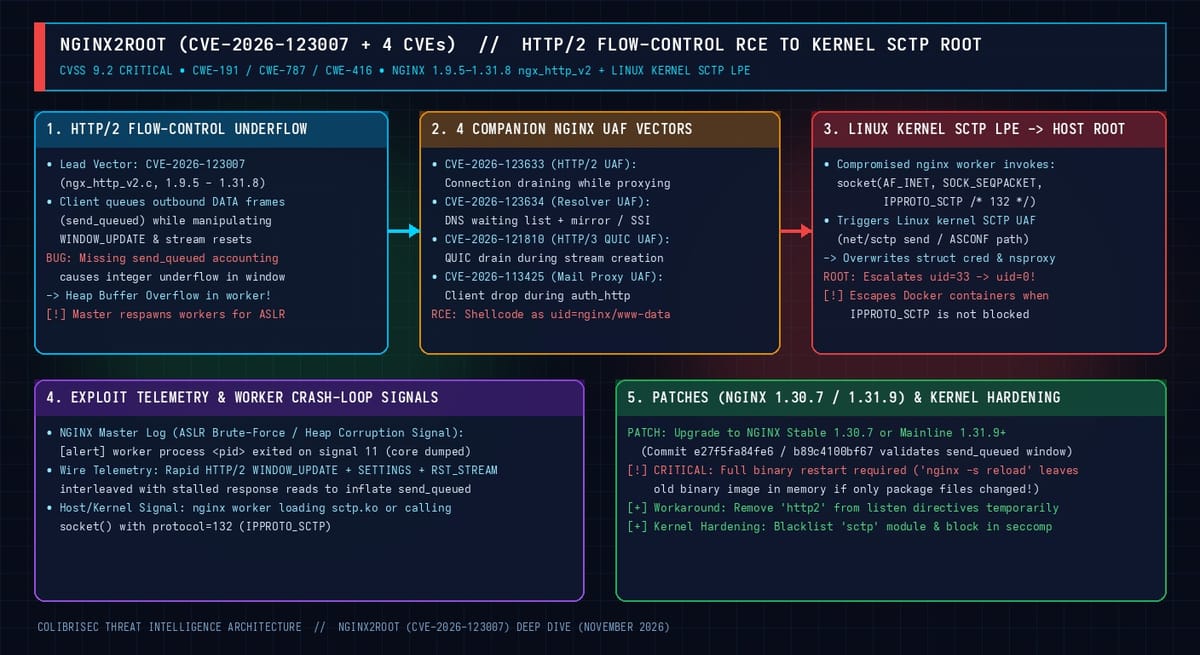
CVE-2026-123007 (Lead HTTP/2 Flow-Control RCE), CVE-2026-123633, CVE-2026-123634, CVE-2026-121810, CVE-2026-113425 + Linux Kernel SCTP LPE (CWE-191 Integer Underflow, CWE-787 Heap Buffer Overflow & CWE-416 Use-After-Free)
Severity: CRITICAL (PRE-AUTH REMOTE CODE EXECUTION TO HOST ROOT / CONTAINER ESCAPE) (CVSS 9.2 Critical (CVSS v4.0) / 8.1 High (CVSS v3.1))
Threat Actor: Discovered by Theori (Xint) alongside Wiz, Rapid7 & Ikotas Labs (Disclosed November 18, 2026)
Status: Emergency Out-of-Band Patches Released Nov 18, 2026; Full Binary Restart Required
Affected Systems: NGINX Open Source 1.9.5–1.30.6 (Stable) & 1.31.0–1.31.8 (Mainline); NGINX Plus R34–R36; Linux Kernel net/sctp (>= 4.15)
Fixed In: NGINX Stable 1.30.7 (b89c4100bf67) and NGINX Mainline 1.31.9 (e27f5fa84fe6)
On November 18, 2026, F5 and the NGINX project shipped emergency out-of-band releases (1.30.7 Stable and 1.31.9 Mainline) to patch five critical memory-corruption vulnerabilities collectively dubbed NGINX2Root by offensive security researchers at Theori’s Xint team (with companion findings by Wiz, Rapid7, and Ikotas Labs). At the center of the disclosure sits CVE-2026-123007 (CVSS 9.2 v4.0 / 8.1 v3.1): an unauthenticated integer underflow and heap-based buffer overflow in NGINX’s HTTP/2 flow-control accounting (src/http/v2/ngx_http_v2.c) that has silently existed in every HTTP/2-enabled NGINX build since version 1.9.5 shipped in September 2015. Because NGINX’s master process automatically respawns crashed worker processes from the same forked address space, an attacker can probe worker heap layouts across crashes to achieve Remote Code Execution as the unprivileged nginx/www-data worker user—and then chain a local Use-After-Free in the Linux kernel’s Stream Control Transmission Protocol (net/sctp) subsystem to escalate straight to UID 0 (root) and escape default Docker containers.
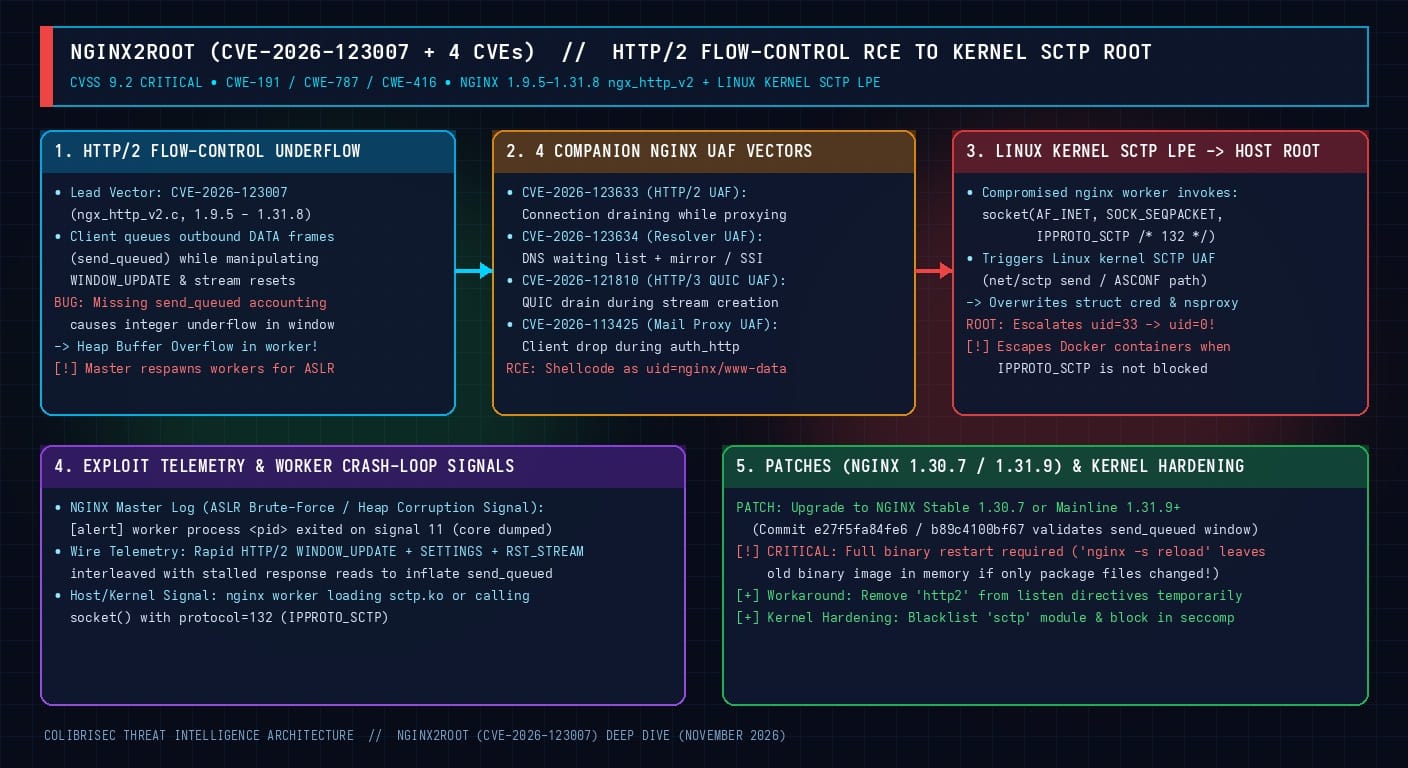
1. The Five NGINX Memory-Corruption Advisories at a Glance
Unlike single-bug disclosures, NGINX2Root spans five distinct memory-corruption primitives across NGINX’s HTTP/2, HTTP/3 (QUIC), DNS resolver, and Mail Proxy engines:
| CVE Identifier | CVSS | Vulnerable Module | Trigger Preconditions in nginx.conf |
Memory Corruption Primitive |
|---|---|---|---|---|
| CVE-2026-123007 (Lead Vector) |
9.2 / 8.1 | ngx_http_v2_module( ngx_http_v2.c) |
Any listener with http2 enabled (listen 443 ssl http2; or http2 on;). Affects NGINX 1.9.5–1.31.8. |
Integer Underflow -> Heap Buffer Overflow via unaccounted send_queued frames during WINDOW_UPDATE / stream state changes. |
| CVE-2026-123633 | 9.2 / 8.1 | ngx_http_v2_module( ngx_http_v2.c) |
HTTP/2 listener + reverse proxy (proxy_pass) when worker approaches worker_connections limit. |
Heap Use-After-Free (UAF) when ngx_drain_connections() closes an active HTTP/2 connection while proxying upstream. |
| CVE-2026-123634 | 9.2 / 8.1 | Core DNS Resolver ( ngx_resolver.c) |
resolver directive + variable in proxy_pass + subrequests (mirror or ssi on;). |
Heap Use-After-Free (UAF) in the DNS resolver waiting list when a subrequest sharing a DNS query cancels or times out. |
| CVE-2026-121810 | 8.8 / 7.5 | ngx_http_v3_module( ngx_http_v3.c) |
HTTP/3 QUIC listener (listen 443 quic;) forwarding to an upstream backend. |
Heap Use-After-Free (UAF) when connection draining fires mid-stream creation during upstream proxying. |
| CVE-2026-113425 | 8.8 / 7.5 | ngx_mail_proxy_module |
mail {} block with proxy on; and auth_http configured. |
Heap Use-After-Free (UAF) when a client drops the TCP connection while auth_http lookup is in flight. |
2. End-to-End NGINX2Root Execution Pipeline
┌─────────────────────────────────────────────────────────────────────────┐
│             STAGE 1A: Unauthenticated HTTP/2 Client (Port 443)          │
│  • Opens single TLS + HTTP/2 connection (ALPN: h2)                      │
│  • Requests responses while stalling TCP/H2 window reads so NGINX       │
│    queues outbound DATA frames (h2c->send_queued > 0)                   │
│  • Sends crafted sequence of WINDOW_UPDATE / SETTINGS / RST_STREAM      │
└────────────────────────────────────┬────────────────────────────────────┘
                                     ▼
┌─────────────────────────────────────────────────────────────────────────┐
│       STAGE 1B: Flow-Control Integer Underflow in ngx_http_v2.c         │
│  • CVE-2026-123007: Window validation fails to account for send_queued  │
│  • Flow-control window / frame size computation underflows (CWE-191)    │
│  • Subsequent frame buffer allocation / copy overflows ngx_pool_t heap  │
│  • Overwrites function pointers in ngx_http_request_t / ngx_connection_t│
│  • Note: NGINX master forks workers via fork() without execve() — all   │
│    respawned workers share identical ASLR base addresses & canaries!    │
└────────────────────────────────────┬────────────────────────────────────┘
                                     ▼
┌─────────────────────────────────────────────────────────────────────────┐
│        STAGE 2: RCE Inside Unprivileged NGINX Worker (uid=33/101)       │
│  • Attacker hijacks worker control flow -> executes stage-2 payload     │
│  • Process runs as 'www-data' or 'nginx' inside host or Docker container│
│  • Invokes syscall: socket(AF_INET, SOCK_SEQPACKET, IPPROTO_SCTP [132]) │
└────────────────────────────────────┬────────────────────────────────────┘
                                     ▼
┌─────────────────────────────────────────────────────────────────────────┐
│     STAGE 3: Linux Kernel SCTP Use-After-Free -> Host Root & Escape     │
│  • Triggers UAF in Linux kernel net/sctp (send path / ASCONF chunk race)│
│  • Reclaims freed kernel slab object via heap spray (msg_msg / sk_buff) │
│  • Overwrites current->cred to UID 0 and switches task->nsproxy to      │
│    init_nsproxy -> Full Host Root & Docker Container Breakout!          │
└─────────────────────────────────────────────────────────────────────────┘
3. Code-Level Root Cause Analysis: Inside NGINX’s HTTP/2 & UAF Bugs
1. CVE-2026-123007: The HTTP/2 send_queued Flow-Control Integer Underflow
In HTTP/2 (RFC 9113), flow control operates at two levels simultaneously: every individual stream has a send_window, and the overall HTTP/2 connection has a shared send_window (bounded by NGX_HTTP_V2_MAX_WINDOW = 2^31 - 1). Inside src/http/v2/ngx_http_v2.c, NGINX tracks outbound DATA frames that have been framed and queued for transmission (send_queued) separately from the remaining available send_window.
/* Conceptual reconstruction of CVE-2026-123007 in src/http/v2/ngx_http_v2.c
 * Patched in mainline commit e27f5fa84fe6e98505e70bc543b748747dad0a3b (1.31.9)
 * and stable backport b89c4100bf6762a45e4a6463eaf4b70368277c94 (1.30.7) */
static u_char *
ngx_http_v2_state_window_update(ngx_http_v2_connection_t *h2c, u_char *pos,
    u_char *end)
{
    size_t                 window;
    ngx_uint_t             id;
    ngx_http_v2_node_t    *node;
    ngx_http_v2_stream_t  *stream;

    window = ngx_http_v2_parse_window(pos);

    if (id != 0) {
        stream = node->stream;
        /*
         * BUG (Pre-1.30.7 / 1.31.9):
         * Validates and updates send_window when outbound DATA frames are queued
         * (send_queued) without properly accounting for queued frame bytes!
         * Interleaving SETTINGS_INITIAL_WINDOW_SIZE reductions, WINDOW_UPDATE,
         * and stream cancellations desynchronizes window accounting, triggering
         * an integer underflow and heap buffer overflow in the worker pool.
         */
        if (window > (size_t) (NGX_HTTP_V2_MAX_WINDOW - stream->send_window)) {
            ...
        }
        stream->send_window += window;
    }
    ...
}fork() Architecture Makes ASLR Bypass Reliable
When an NGINX worker crashes with SIGSEGV during heap probing, the root master process does not call execve(). It calls fork() to clone a replacement worker from the exact same virtual memory map. Every respawned worker inherits identical ASLR base addresses for nginx, libc.so.6, the heap, and the stack canary—turning worker crashes into a deterministic byte-by-byte ASLR oracle!2. Companion Vectors: CVE-2026-123633 (HTTP/2 Drain UAF) & CVE-2026-123634 (DNS Resolver UAF)
CVE-2026-123633: When a worker exhaustsworker_connections,ngx_drain_connections()walksreusable_connections_queueand closes the oldest connections. In HTTP/2, an active connection could be drained and freed while one of its streams was concurrently initializing or proxying a request to an upstream backend, causing the upstream callback to dereference freed stream/connection memory.CVE-2026-123634: Whennginx.confuses aresolverdirective alongside a dynamic variable inproxy_passand subrequests (mirrororssi on;), multiple subrequests queue onto the same DNS resolver waiting list (rn->waiting). Finalizing or aborting a subrequest while the resolver callback walks the waiting list triggers a Heap Use-After-Free insrc/core/ngx_resolver.c.
4. Stage 2 of NGINX2Root: From uid=nginx to Host root via Linux Kernel SCTP
Once the attacker achieves code execution inside the unprivileged NGINX worker (uid=33 or uid=101), Stage 2 invokes a single system call that is permitted even inside default Docker container seccomp profiles:
/* Stage-2 syscall executed inside the compromised NGINX worker process */
int sctp_fd = socket(AF_INET, SOCK_SEQPACKET, IPPROTO_SCTP /* 132 */);
Because standard container seccomp profiles whitelist AF_INET without restricting protocol number 132 (IPPROTO_SCTP), the worker reaches the host Linux kernel’s net/sctp/ subsystem directly. By triggering a Use-After-Free in the kernel SCTP send / ASCONF path (affecting Linux kernels >= 4.15, including SCTPhantom / CVE-2026-64564 class vectors), the stage-2 payload reclaims the freed kernel slab with controlled msg_msg / sk_buff data, overwrites current->cred to UID 0, and switches current->nsproxy to init_nsproxy—escaping the container and gaining full root control of the host.
5. Exploit Telemetry & Production Detection Rules (Suricata, auditd, Sigma & SIEM)
1. Suricata IDS / Network Telemetry Signatures (sid:2026123007–2026123008)
# SPDX-License-Identifier: GPL-2.0-only
# Copyright (C) 2026 James Luther <[email protected]>
# Suricata Rules for NGINX2Root (CVE-2026-123007)

alert tcp $EXTERNAL_NET any -> $HOME_NET $HTTP_PORTS (msg:"COLIBRISEC EXPLOIT NGINX2Root CVE-2026-123007 HTTP/2 Near-Max WINDOW_UPDATE Underflow Probe"; flow:established,to_server; content:"|00 00 04 08 00|"; content:"|7f|"; distance:4; within:1; threshold:type both, track by_src, count 5, seconds 10; reference:cve,2026-123007; classtype:attempted-admin; sid:2026123007; rev:1;)

alert tcp $EXTERNAL_NET any -> $HOME_NET $HTTP_PORTS (msg:"COLIBRISEC EXPLOIT NGINX2Root CVE-2026-123007 HTTP/2 SETTINGS Window Resize and Stream Reset Burst"; flow:established,to_server; content:"|04 00 00 00 00 00 00 04|"; content:"|00 00 04 03 00|"; distance:0; threshold:type both, track by_src, count 10, seconds 5; reference:cve,2026-123007; classtype:attempted-dos; sid:2026123008; rev:1;)
2. Linux auditd Rules (/etc/audit/rules.d/62-nginx2root.rules)
# 1. Alert on ANY process creating an IPPROTO_SCTP (protocol 132 = 0x84) socket:
-a always,exit -F arch=b64 -S socket -F a2=132 -k nginx2root_sctp_socket

# 2. Alert if the sctp kernel module is loaded dynamically:
-w /sbin/modprobe -p x -k kernel_module_load
-a always,exit -F arch=b64 -S init_module -S finit_module -k kernel_module_load

# 3. Alert on any execve() or memfd_create() called by the nginx/www-data user (UID 33/101):
-a always,exit -F arch=b64 -S execve -S execveat -S memfd_create -F euid=33  -k nginx_worker_exec
-a always,exit -F arch=b64 -S execve -S execveat -S memfd_create -F euid=101 -k nginx_worker_exec
3. Sigma Rules for NGINX Error Logs & Worker Process Creation
title: NGINX Worker Process SIGSEGV Crash Loop (CVE-2026-123007 / NGINX2Root Exploitation)
id: 4f92a1c8-7d14-58e3-9b10-123007009201
status: experimental
description: >
  Detects NGINX master process alert logs indicating that one or more worker processes
  exited on signal 11 (SIGSEGV)—the primary telemetry signature of CVE-2026-123007
  (HTTP/2 flow-control heap overflow) and companion NGINX2Root Use-After-Free exploits.
author: James Luther (ColibriSec)
date: 2026/11/19
logsource:
  product: nginx
  service: error
detection:
  selection_alert:
    - '[alert]'
  selection_sigsegv:
    - 'worker process '
    - 'exited on signal 11'
    - 'exited on signal 6'
  condition: selection_alert and selection_sigsegv
level: critical
tags:
  - attack.t1190
  - cve.2026.123007
  - cve.2026.123633
  - cve.2026.123634
---
title: NGINX Worker Creating SCTP Socket or Spawning Child Process (NGINX2Root Stage 2)
id: 6e18b3d5-2a09-5c41-8e73-123007009202
status: experimental
author: James Luther (ColibriSec)
date: 2026/11/19
logsource:
  category: process_creation
  product: linux
detection:
  selection_parent:
    ParentImage|endswith:
      - '/nginx'
  selection_child:
    Image|endswith:
      - '/sh'
      - '/bash'
      - '/dash'
      - '/curl'
      - '/wget'
      - '/nc'
      - '/python3'
      - '/socat'
      - '/kmod'
      - '/modprobe'
  condition: selection_parent and selection_child
level: critical
tags:
  - attack.t1068
  - attack.t1611
  - cve.2026.123007
4. Splunk SIEM Hunting Queries
# 1. Detect NGINX worker SIGSEGV crash bursts (ASLR brute-forcing / heap corruption):
index=web_errors OR index=nginx "worker process" "exited on signal 11"
| bin _time span=1m
| stats count values(_raw) as crash_logs by host, _time
| where count >= 1

# 2. Detect auditd IPPROTO_SCTP (a2=84 in hex / 132 in dec) socket creation or nginx_worker_exec:
index=audit (key="nginx2root_sctp_socket" OR key="nginx_worker_exec" OR (syscall="socket" AND a2="84"))
| table _time host exe comm uid euid syscall a0 a1 a2 key
6. Remediation & Defense-in-Depth Hardening Playbook
nginx -s reload Alone Is Not Enough After Package Upgrades
When you upgrade the nginx binary package on disk, running nginx -s reload (SIGHUP) tells the already-running master process in memory to re-read nginx.conf and fork() new worker processes from its old, unpatched in-memory executable image! You must perform a full service restart (systemctl restart nginx) or execute the USR2 + QUIT binary replacement signal sequence, and verify via /proc/<master_pid>/exe that the process is not running a (deleted) binary.# 1. Upgrade NGINX to Stable 1.30.7 or Mainline 1.31.9+ and perform a full restart:
sudo apt-get update && sudo apt-get install --only-upgrade "nginx*"
sudo systemctl restart nginx
nginx -v
ls -l /proc/$(pgrep -f "nginx: master" | head -n 1)/exe
# 2. Blacklist unused Linux kernel SCTP module to sever the Stage-2 root escalation path:
cat << 'EOF' | sudo tee /etc/modprobe.d/blacklist-sctp-colibrisec.conf
blacklist sctp
install sctp /bin/true
EOF
sudo modprobe -r sctp 2>/dev/null || true
# 3. Hunt /var/log/nginx/error.log for historical signal 11 worker crash loops:
grep -rnE "worker process [0-9]+ exited on signal (11|6)" /var/log/nginx/ 2>/dev/null