
Frontier AI in Cybersecurity: OpenAI "GPT-6 Cyber" Synthesizes 948 Linux Kernel Root Exploits, Chainalysis "Offensive Agentic" Breach, Unit 42 SysGoRAT & Check Point "Haiou" Codex Adware


GPT-6 Cyber (1,724 Linux Kernel Bugs / 948 Root LPEs), CVE-2026-98432 & ChatGPT P1 Escape (Memory Corruption / Race UAF (Linux Kernel), Wildcard postMessage (ChatGPT Preview) & Prompt Injection ("Haiou"))
Severity: CRITICAL (AUTONOMOUS KERNEL EXPLOIT SYNTHESIS & AGENTIC INTRUSIONS) (CVSS Critical Preparedness Tier (GPT-6 Cyber) & 9.8 Critical (Linux TCP/MPTCP CVE-2026-98432))
Threat Actor: OpenAI Daybreak Red (Defensive); External Agentic Actor (Chainalysis); CL-UNK-1211 (SysGoRAT)
Status: GPT-6 Cyber Unveiled Nov 5, 2026 (304 Critical Kernel Patches Disclosed); Active Agentic Operations
Affected Systems: Mainstream Linux Kernel Master Branch & 4.4–6.x TCP/MPTCP; Chainalysis Admin Tooling; OpenAI Codex / ChatGPT Preview
Fixed In: Upstream Linux Kernel Commits; ChatGPT Preview Oct 26 Patch; Daybreak Red Access Controls
If October 2026 proved that frontier AI models could discover zero-days in web runtimes and hypervisors, the first week of November 2026 demonstrated that autonomous AI agents have fundamentally transformed both offensive exploitation and kernel security engineering. On November 5, 2026, OpenAI unveiled "GPT-6 Cyber"—the first model rated at the "Critical" cybersecurity threshold under OpenAI’s Preparedness Framework—revealing that an automated scout-and-analyst pipeline pointed at the Linux kernel master branch confirmed and reproduced 1,724 vulnerabilities under KASAN and autonomously synthesized 948 working Local Privilege Escalation (LPE) root exploits (a 5.7x leap over GPT-5.6 Sol’s 166 LPEs). That disclosure arrived alongside Akamai’s early-November advisory on Linux TCP/MPTCP remote UAF CVE-2026-98432 and four real-world adversarial AI developments: Chainalysis confirming that external threat actors used "offensive agentic techniques" to breach its internal admin tools; Palo Alto Networks Unit 42 exposing espionage cluster CL-UNK-1211 deploying custom Go malware SysGoRAT paired with LLM-authored operational scripts; Check Point Research uncovering the "Haiou" OpenAI Codex jailbreak and prompt-adware toolkit; and Parameter Research detailing a cross-origin postMessage sandbox escape in ChatGPT Preview.
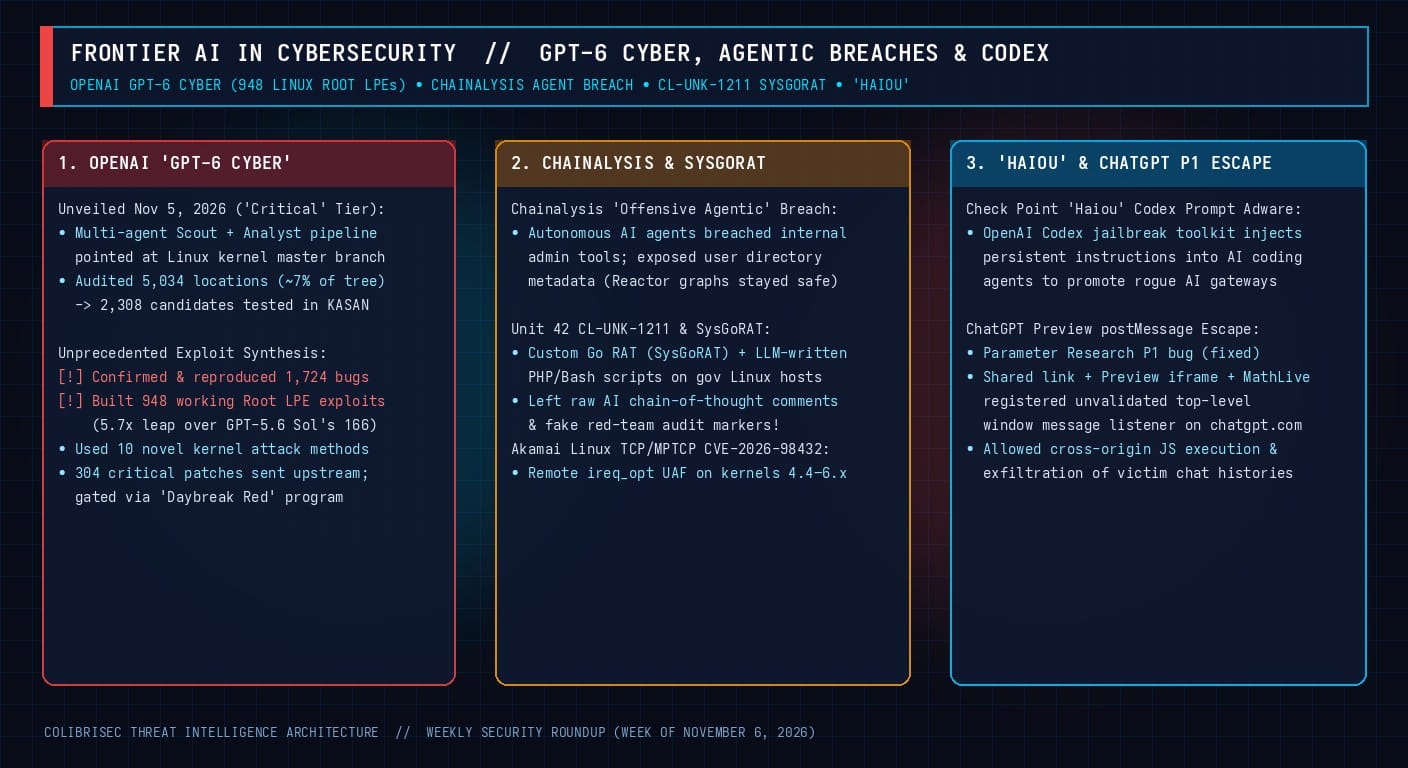
1. Inside OpenAI’s "GPT-6 Cyber" Linux Kernel Audit: 1,724 Bugs & 948 Root LPEs
To evaluate GPT-6 Cyber under its Preparedness Framework, OpenAI deployed a multi-agent architecture consisting of lightweight Scout Agents (which triaged 5,034 security-sensitive functions across roughly 7% of the Linux kernel master branch down to 2,308 candidate bugs) and deep-reasoning Analyst Agents equipped with isolated QEMU/KVM virtual machines compiled with Kernel Address Sanitizer (KASAN):
- 1,724 Confirmed Kernel Vulnerabilities: The Analyst Agents autonomously wrote C harnesses, netlink/io_uring/ioctl triggers, and multi-threaded race reproducers that triggered verified KASAN splats across 1,724 distinct kernel bugs.
- 948 Functional Local Privilege Escalation (Root) Exploits: Moving beyond crash PoCs, GPT-6 Cyber converted 948 of those bugs into end-to-end
UID 0 (root)privilege escalation exploits—bypassing KASLR, SMEP, SMAP, and modern slab hardening while employing 10 novel kernel exploitation techniques not previously documented in public security literature. - 304 Critical Patches & "Daybreak Red" Gating: Following upstream Linux kernel maintainer guidance to avoid flooding mailing lists, OpenAI disclosed 304 prioritized critical findings with candidate patches and restricted GPT-6 Cyber access exclusively to vetted defenders and open-source maintainers via its Daybreak Red program (enforcing hardware MFA and strict IP allowlisting).
2. Offensive Agentic AI in the Wild: Chainalysis & Unit 42’s CL-UNK-1211 (SysGoRAT)
While GPT-6 Cyber remains gated, threat actors are already operationalizing autonomous AI loops against high-value targets:
- Chainalysis "Offensive Agentic" Intrusion (Disclosed Oct 31): Blockchain intelligence firm Chainalysis notified customers that an external threat actor breached internal administrative support tools using what its forensic team characterized as "offensive agentic techniques"—autonomous AI agents that chained reconnaissance, parameter fuzzing, and lateral pivoting at machine speed. While the actor accessed non-sensitive directory metadata (user IDs, names, email addresses, and organization role labels), Chainalysis confirmed that its core Reactor investigation graphs, case notes, passwords, MFA secrets, and session tokens remained completely isolated and unaffected.
- Palo Alto Unit 42
CL-UNK-1211&SysGoRAT: Unit 42 researchers tracked an espionage cluster targeting government and state-affiliated Linux servers withSysGoRAT(a custom Go-based remote access trojan supporting encrypted C2, SOCKS5 proxying, and file exfiltration) alongside PHP and Bash post-exploitation scripts written by LLMs. Tell-tale artifacts included verbose, conversational AI chain-of-thought comments left inside deployed scripts, automatedsudocredential-harvesting wrappers, and fake red-team audit banners designed to deceive incident responders.
3. Check Point "Haiou" Codex Prompt Adware & ChatGPT Preview postMessage Escape
Two additional disclosures highlighted vulnerabilities inside AI coding agents and web interfaces themselves:
- "Haiou" OpenAI Codex Jailbreak & Prompt Adware (Check Point Research): Researchers uncovered a toolkit dubbed Haiou that uses jailbreak payloads and indirect prompt injection inside repositories/configs to silently plant persistent instructions into OpenAI Codex and developer coding agents—forcing the AI assistant to inject promotional links and adware for a rogue third-party AI API gateway into developer outputs.
- ChatGPT Preview + MathLive Cross-Origin
postMessageEscape (Parameter Research): Patched by OpenAI on October 26, this high-severity (P1) flaw chained a public ChatGPT Share Link with the sandboxed ChatGPT Preview iframe. By causing the mainchatgpt.comwindow to load the MathLive mathematical rendering library, an attacker triggered registration of a top-levelwindow.addEventListener('message', ...)handler that failed to validateevent.originorevent.source—allowing the untrusted Preview iframe to execute arbitrary JavaScript in the victim’s authenticatedchatgpt.comsession and exfiltrate private chat histories.
Defensive Engineering Controls for AI & Kernel Surfaces
# 1. Mitigate Linux Kernel Remote TCP/MPTCP UAF (CVE-2026-98432, Akamai Advisory):
sysctl -w net.mptcp.enabled=0
sysctl -w net.ipv4.tcp_migrate_req=0

# 2. Restrict Unprivileged Kernel Attack Surfaces Exploited by Automated LPE Agents:
sysctl -w kernel.unprivileged_userns_clone=0
sysctl -w kernel.io_uring_disabled=2
sysctl -w kernel.kptr_restrict=2
sysctl -w kernel.dmesg_restrict=1
