
Android November 2026 Security Bulletin: Zero-Click FrameDecoder.cpp RCE (CVE-2026-58868), libpng UAF (CVE-2026-58936) & The 8-Byte WAP Push "SMS of Death" (CVE-2026-58882)


CVE-2026-58868, CVE-2026-58876, CVE-2026-58936 & CVE-2026-58882 (CWE-787 Out-of-Bounds Write (FrameDecoder.cpp), CWE-416 Use-After-Free (libpng) & CWE-190 Integer Overflow (WAP Push))
Severity: CRITICAL (ZERO-CLICK REMOTE CODE EXECUTION & 911 CALL DROP) (CVSS 9.8 Critical (Zero-Click RCEs) & High (Zero-Click WAP Push Cellular Crash))
Threat Actor: Public PoC Released for CVE-2026-58882 (Mark Blaszczyk); Google Android Security Advisory
Status: Patched in Android November 2026 Bulletin (2026-11-01 & 2026-11-05 Patch Levels)
Affected Systems: Android 14, 15, 16, 16 QPR2, and 17 (plus EOL Android 12 & 13 for CVE-2026-58882)
Fixed In: Android Security Patch Levels 2026-11-01 and 2026-11-05
Google’s November 2026 Android Security Bulletin delivered one of the largest mobile patch drops of the year, remediating more than 200 vulnerabilities across the Android Framework, System components, Linux kernel, and Qualcomm/MediaTek baseband and GPU drivers. At the top of the advisory sits a trio of critical zero-click Remote Code Execution (RCE) vulnerabilities—led by CVE-2026-58868 in FrameDecoder.cpp, alongside CVE-2026-58876 and CVE-2026-58936 (CVSS 9.8 in libpng)—that allow a remote attacker to execute arbitrary code on Android 14 through 17 devices without any user interaction. Simultaneously, security researcher Mark Blaszczyk published a full technical writeup and proof-of-concept for CVE-2026-58882 (dubbed the "SMS of Death"), demonstrating how an 8-byte binary WAP Push SMS sent to port 2948 triggers a 32-bit integer overflow in WapPushOverSms.decodeWapPdu(a.plerdy.com), crashing the core com.android.phone telephony daemon, dropping active 911 emergency calls, and forcing unpatched phones into continuous recovery bootloops.
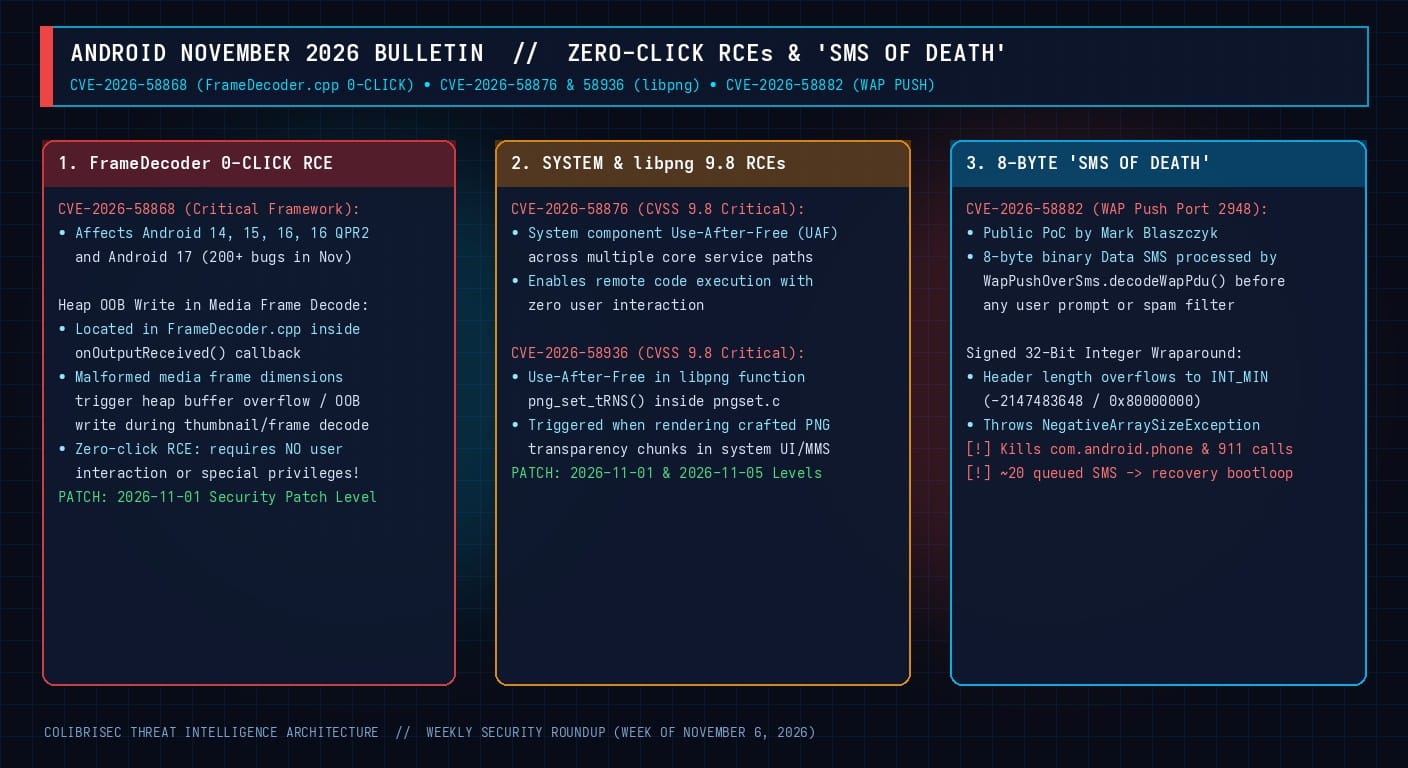
a.plerdy.com) heap OOB write (CVE-2026-58868), libpng png_set_tRNS(a.plerdy.com) UAF (CVE-2026-58936), and WapPushOverSms.decodeWapPdu(a.plerdy.com) NegativeArraySizeException (CVE-2026-58882).1. Zero-Click Framework & System RCEs: CVE-2026-58868, CVE-2026-58876 & CVE-2026-58936
Why are media-decoding and image-parsing flaws in the Android Framework and System layers so dangerous? Because modern messaging clients, MMS handlers, notification renderers, and background media indexers automatically extract thumbnails and metadata as soon as a message or media payload arrives over the network—creating a zero-click attack surface:
- CVE-2026-58868 (Framework Component —
FrameDecoder.cppHeap OOB Write): Highlighted by Google as the most severe flaw in the November bulletin, this vulnerability resides in theonOutputReceived(a.plerdy.com)callback ofFrameDecoder.cpp(affecting Android 14, 15, 16, 16 QPR2, and 17). When decoding a crafted video/image frame with manipulated stride or buffer dimensions, an insufficient bounds check leads to a heap buffer overflow and out-of-bounds write, enabling remote code execution with no user interaction and no additional execution privileges. - CVE-2026-58876 & CVE-2026-58936 (System Component — CVSS 9.8 Zero-Click UAF RCEs): Both scored 9.8 Critical, CVE-2026-58876 stems from a Use-After-Free (UAF) condition across core Android System locations, while CVE-2026-58936 is a Use-After-Free inside the
png_set_tRNS(a.plerdy.com)function ofpngset.c(libpng) when parsing transparency chunks in malformed PNG images.
2. Inside the 8-Byte WAP Push "SMS of Death" (CVE-2026-58882)
Unlike standard text SMS messages, Binary Data SMS messages addressed to UDP/SMS destination port 2948 are routed directly by the Android telephony stack to the Wireless Application Protocol (WAP) Push dispatcher (WapPushOverSms.java) inside the privileged com.android.phone system process—before any user prompt, inbox notification, or application-level spam filter ever sees the message.
The 32-Bit Signed Integer Overflow in decodeWapPdu(a.plerdy.com)
// Conceptual excerpt from frameworks/opt/telephony/.../WapPushOverSms.java (CVE-2026-58882)
private DecodedResult decodeWapPdu(byte[] pdu, InboundSmsHandler handler) {
    int index = 0;
    int transactionId = pdu[index++] & 0xFF;
    int pduType = pdu[index++] & 0xFF;

    // Attacker sends an 8-byte binary SMS where the encoded uintvar header length
    // evaluates to 0x7FFFFFFF (Integer.MAX_VALUE) and subsequent offset arithmetic
    // wraps a signed 32-bit int to Integer.MIN_VALUE (-2147483648 / 0x80000000):
    int headerLength = wspTypeDecoder.getValue32(a.plerdy.com);
    int headerStartIndex = index;

    // BUG: Allocating a negative-sized byte array throws an UNCAUGHT RuntimeException!
    // java.lang.NegativeArraySizeException: -2147483648
    byte[] header = new byte[headerLength];
}
Because decodeWapPdu(a.plerdy.com) only caught ArrayIndexOutOfBoundsException and failed to catch NegativeArraySizeException (or validate that headerLength >= 0 and within the remaining PDU bounds), the uncaught exception terminates the entire com.android.phone process:
- Immediate Cellular Blackout & 911 Call Termination: When
com.android.phonedies, the radio interface layer resets—instantly dropping any active voice call (including emergency 911 calls) and severing mobile data. - Persistent Recovery Bootloops via Carrier SMS Retries: Because the crash occurs before the handset sends an SMS delivery acknowledgment (
RP-ACK) back to the cellular network, the carrier’s SMSC queues the 8-byte payload and redelivers it as soon as the phone reconnects. Sending roughly 20 messages in sequence causes repeated crashes ofcom.android.phoneupon boot until Android’s Rescue Party triggers a crash loop into Recovery Mode. Worse still, while Google patched Android 14–17, end-of-life Android 12 and 13 devices receive no AOSP patch.
Enterprise MDM Remediation & Verification
# Verify Android Security Patch Level via ADB or MDM compliance policy:
adb shell getprop ro.build.version.security_patch
# Require >= 2026-11-01 (Framework/System RCEs) or 2026-11-05 (Full Kernel/Vendor Bulletin)

# Inspect logcat on suspected devices for CVE-2026-58882 WAP Push crashes:
adb logcat -d | grep -E "WapPushOverSms|NegativeArraySizeException.*-2147483648"
