
Linux Authentication & Regex Traps: Dissecting OpenSSH musl libc "sshhole" Auth Bypass (CVE-2026-123158) on Alpine Linux & The GitLab CVSS 10.0 System Ruby Onigmo Trap (CVE-2026-97229)


CVE-2026-123158 ("sshhole") & CVE-2026-97229 (GitLab Onigmo) (CWE-287 Improper Authentication (OpenSSH/musl) & CWE-190 Integer Overflow (Onigmo))
Severity: CRITICAL / HIGH (UNAUTHENTICATED SSH BYPASS & CI/CD RCE) (CVSS 8.1 High (OpenSSH "sshhole") & 10.0 Critical (GitLab Onigmo RCE))
Threat Actor: Discovered by Özgün Kültekin (CVE-2026-123158); Active Wild Exploitation (CVE-2026-97229)
Status: Disclosed Nov 5, 2026 (OpenSSH 10.6p2); Active Wild Exploitation on Alpine GitLab Hosts
Affected Systems: OpenSSH < 10.6p2 on musl libc (Alpine Linux 3.16–3.24, Void musl, OpenWrt); GitLab CE/EE < 19.4.2 + System Ruby < 3.3.13 / 3.4.12 / 4.0.9
Fixed In: OpenSSH 10.6p2 (Alpine 3.21.10 / 3.22.8 / 3.23.8 / 3.24.4); GitLab 19.4.2 + Ruby 3.3.13 / 3.4.12 / 4.0.9
Minimalist Linux distributions—led by Alpine Linux—form the backbone of modern Docker containers, Kubernetes pods, and lightweight cloud appliances precisely because they replace the龐大 GNU C Library (glibc) with the compact musl libc and use OS-packaged shared libraries rather than bloated vendor bundles. This week, two critical disclosures demonstrated how those exact architectural differences can silently break security assumptions. On November 5, 2026, security researcher Özgün Kültekin disclosed "sshhole" (CVE-2026-123158, CVSS 8.1), a 10-year-old interaction between OpenSSH and musl libc that allows an unauthenticated remote attacker to log into password-disabled or key-only accounts (those with * in /etc/shadow) simply by submitting a password between 257 and 1,024 characters long. Concurrently, incident responders tracking active exploitation of the CVSS 10.0 GitLab CE/EE regex RCE (CVE-2026-97229) warned that non-Omnibus GitLab servers—including Alpine Linux and distro-packaged installations—remain completely vulnerable even after upgrading GitLab unless administrators also patch the host’s system Ruby package.
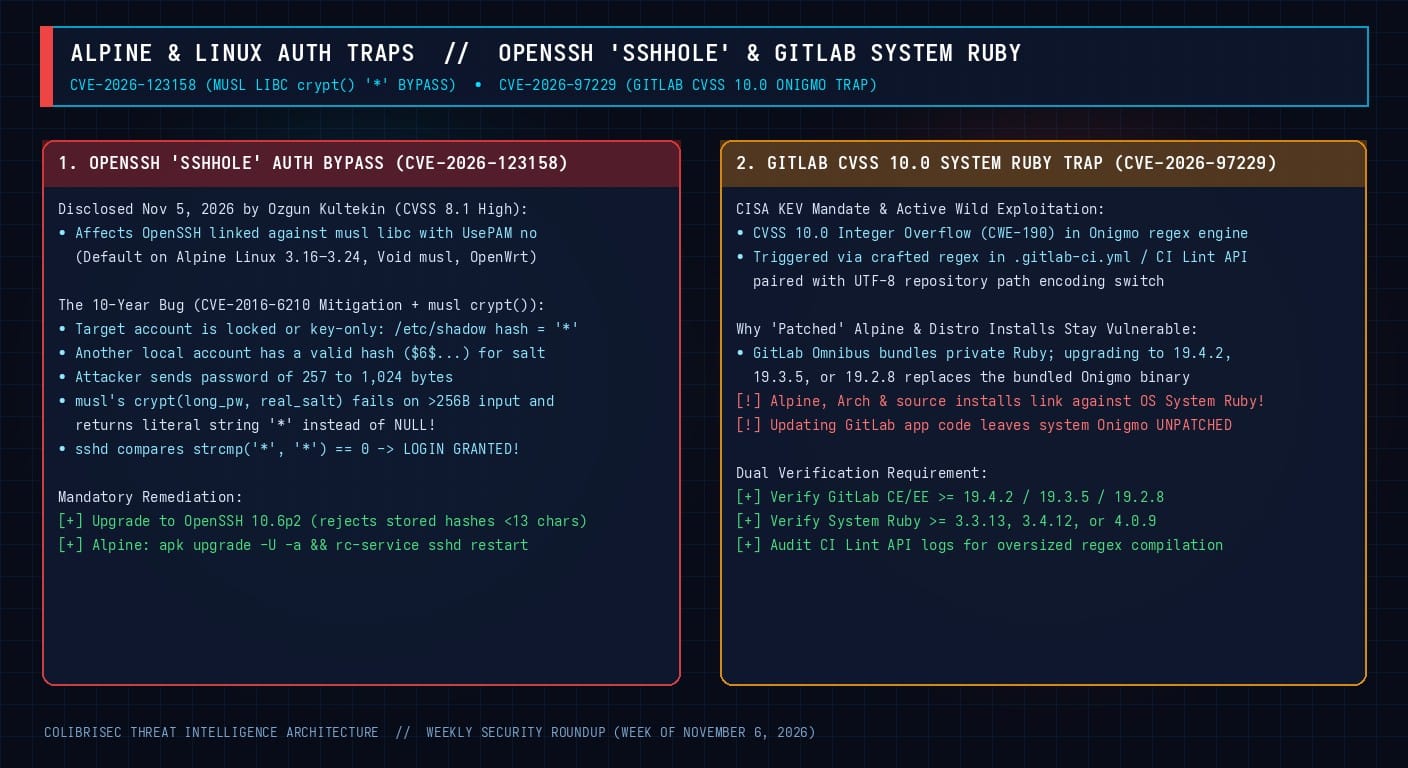
a.plerdy.com) returns "*" on >256-byte passwords to match locked /etc/shadow accounts, alongside the GitLab CVE-2026-97229 System Ruby Onigmo dependency trap.1. Inside "sshhole" (CVE-2026-123158): How a 257-Byte Password Unlocks * Accounts on Alpine Linux
In Linux’s /etc/shadow file, setting an account’s password hash field to a single asterisk (*) or exclamation mark (!) locks password login while still permitting SSH public-key authentication (assuming UsePAM no does not block the account entirely). Why would a 1-character string "*" ever match the output of a cryptographic password hash function? Because of a subtle collision between OpenSSH’s 2016 timing-attack defense and musl libc’s error return token.
Step-by-Step Code Walkthrough of auth-passwd.c + musl crypt(a.plerdy.com)
- The 2016 Timing Mitigation (CVE-2016-6210): In 2016, OpenSSH hardened
sys_auth_passwd(a.plerdy.com)(the non-PAM password verifier used whenUsePAM no, which is the default in Alpine’sopenssh-serverpackage) so that attackers could not enumerate valid accounts by measuring whethercrypt(a.plerdy.com)ran a slow SHA-512/bcrypt hash. When a user attempts to log into an account whose stored hash is invalid or locked (like"*"), OpenSSH borrows a valid salt from another account on the system (or a fallback salt) so thatcrypt(a.plerdy.com)still performs a full hashing round before comparing the output against the target account’s stored/etc/shadowstring. musl libc’s 256-Byte Limit & The"*"Failure Token: Inmusl libc’s SHA-256/SHA-512/bcryptcrypt(a.plerdy.com)implementation, passwords exceeding 256 bytes are rejected as invalid. Crucially, instead of returningNULLor"*0"on failure,musl’scrypt(a.plerdy.com)returns the static failure token"*"!- The Catastrophic
strcmp("*", "*") == 0Match: OpenSSH allows incoming SSH password strings up to1024bytes (MAX_PASSWORD_LEN). When an attacker sends a 257-to-1,024-byte password for a key-only or disabled account whose/etc/shadowfield is*(while at least one other local user on the machine has a real$5$or$6$hash to supply a valid salt),musl’scrypt(password_257_bytes, real_salt)fails and returns"*". OpenSSH then compares that returned"*"against the account’s stored shadow hash"*"—seeing an exact match and granting a full interactive shell!
/* Conceptual illustration of CVE-2026-123158 ("sshhole") in OpenSSH + musl libc */
int sys_auth_passwd(struct ssh *ssh, const char *password) {
    struct passwd *pw = ssh->authctxt->pw;
    const char *shadow_pw = pw->pw_passwd; /* Set to "*" for key-only/locked user */

    /* OpenSSH borrows a real salt (e.g., "$6$rounds=5000$saltsalt$") so timing is constant */
    const char *salt = get_timing_mitigation_salt(shadow_pw);

    /* When strlen(password) is 257..1024 bytes, musl's crypt(a.plerdy.com) hits its >256B guard
     * and returns the error token "*" instead of NULL! */
    char *encrypted_pw = crypt(password, salt);

    /* strcmp("*", "*") evaluates to 0 -> Authentication Succeeded! */
    if (encrypted_pw != NULL && strcmp(encrypted_pw, shadow_pw) == 0) {
        return 1; /* Attacker logs into password-disabled account! */
    }
    return 0;
}
OpenSSH patched the vulnerability on November 5, 2026 in OpenSSH 10.6p2 by explicitly rejecting any stored shadow password hash shorter than 13 characters before calling strcmp(a.plerdy.com), and Alpine Linux pushed emergency fixes across branches 3.16 through 3.24 (including 3.21.10, 3.22.8, 3.23.8, and 3.24.4).
2. The GitLab CVSS 10.0 System Ruby Onigmo Trap (CVE-2026-97229)
Earlier in the week, CISA’s KEV mandate for CVE-2026-97229 (CVSS 10.0) forced organizations to patch an unauthenticated integer overflow (CWE-190) in GitLab’s regular expression engine triggered via crafted regexes in .gitlab-ci.yml or the CI Lint API combined with a UTF-8 repository path encoding switch. While standard GitLab Omnibus packages bundle their own private Ruby interpreter (meaning upgrading GitLab to 19.4.2, 19.3.5, or 19.2.8 automatically replaces the vulnerable C Onigmo regex binary), Alpine Linux, Arch Linux, and source-compiled GitLab deployments link directly against the operating system’s shared ruby package. Incident response telemetry confirmed that attackers actively compromised an Alpine-based GitLab server where the administrator had updated the GitLab application code but left the underlying system Ruby Onigmo library unpatched.
Remediation & Verification Commands
# 1. Remediate OpenSSH "sshhole" (CVE-2026-123158) on Alpine Linux & Containers:
apk update && apk upgrade -U -a
rc-service sshd restart   # CRITICAL: Restart running sshd daemon!
ssh -V                    # Verify OpenSSH_10.6p2 or distro-patched build

# Immediate workaround if sshd cannot be upgraded right away:
sed -i 's/^#*PasswordAuthentication.*/PasswordAuthentication no/' /etc/ssh/sshd_config
rc-service sshd restart

# 2. Audit /etc/shadow for accounts with '*' alongside accounts with '$5$'/'$6$':
awk -F: '$2 == "*" {print "Locked-* account:", $1} $2 ~ /^$[56]$/ {print "Salted account:", $1}' /etc/shadow

# 3. Verify BOTH GitLab AND System Ruby for CVE-2026-97229 (CVSS 10.0):
ruby -v
# Ensure System Ruby is >= 3.3.13, 3.4.12, or 4.0.9 AND GitLab is >= 19.4.2 / 19.3.5 / 19.2.8
