
CISA KEV Directives & Perimeter Zero-Days: WordPress Core Upgrade Race RCE (CVE-2026-119977), Ivanti Connect Secure 3-Bug Root Chain & Zyxel GS1900 Switch Patch-Bypass (CVE-2026-107441)

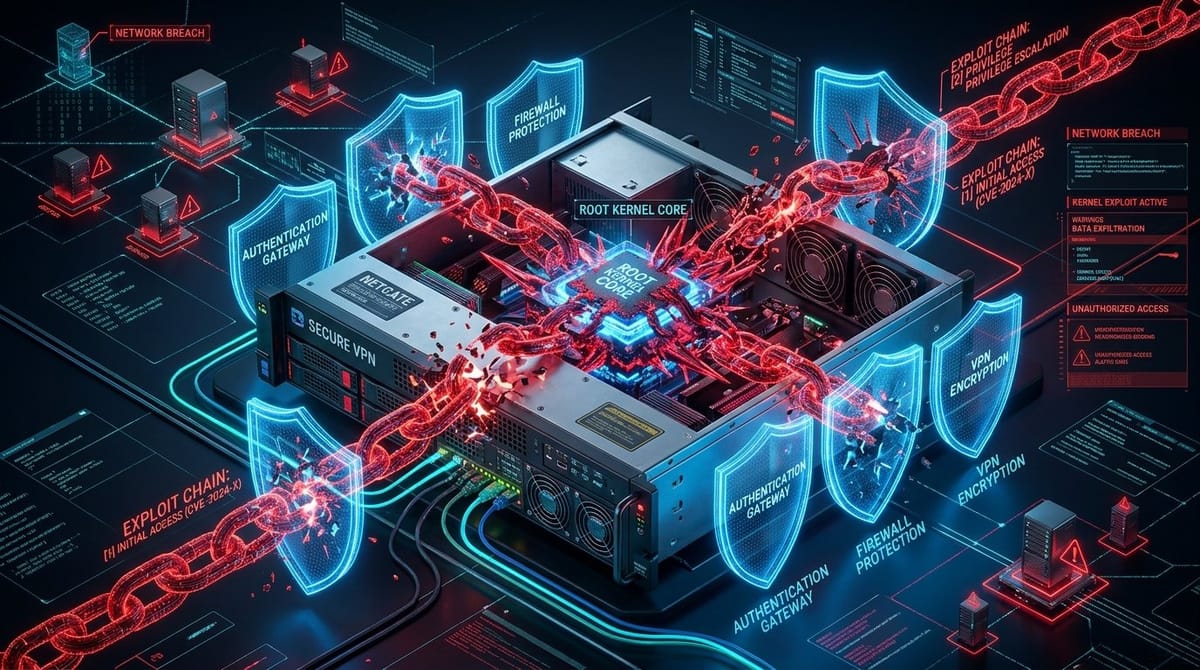
CVE-2026-119977, CVE-2026-104935 / 118527 / 111357 & CVE-2026-107441 (CWE-367 (TOCTOU Race), CWE-340 / CWE-306 (Missing Auth) & CWE-787 (Out-of-Bounds Write))
Severity: CRITICAL (ACTIVE CISA KEV & IN-THE-WILD EXPLOITATION) (CVSS 8.1 (WordPress), 8.8 (Ivanti Chain) & 9.8 Binarly / 8.8 Zyxel)
Threat Actor: Automated Botnets (WordPress), UTA0576 (Ivanti ICS) & Kapibala / Red Heron (Zyxel GS1900)
Status: Active Wild Exploitation; CISA KEV Deadlines Nov 2 (Ivanti) & Nov 6, 2026 (WordPress)
Affected Systems: WordPress Core 4.7–7.1.3; Ivanti Connect Secure < 25.1.1.3 / 22.8R2.6; Zyxel GS1900 Switches <= 2.90 Patch 2
Fixed In: WordPress 7.1.4; Ivanti ICS 25.1.1.3 / 22.8R2.6; Zyxel GS1900 Firmware 2.90 Patch 3
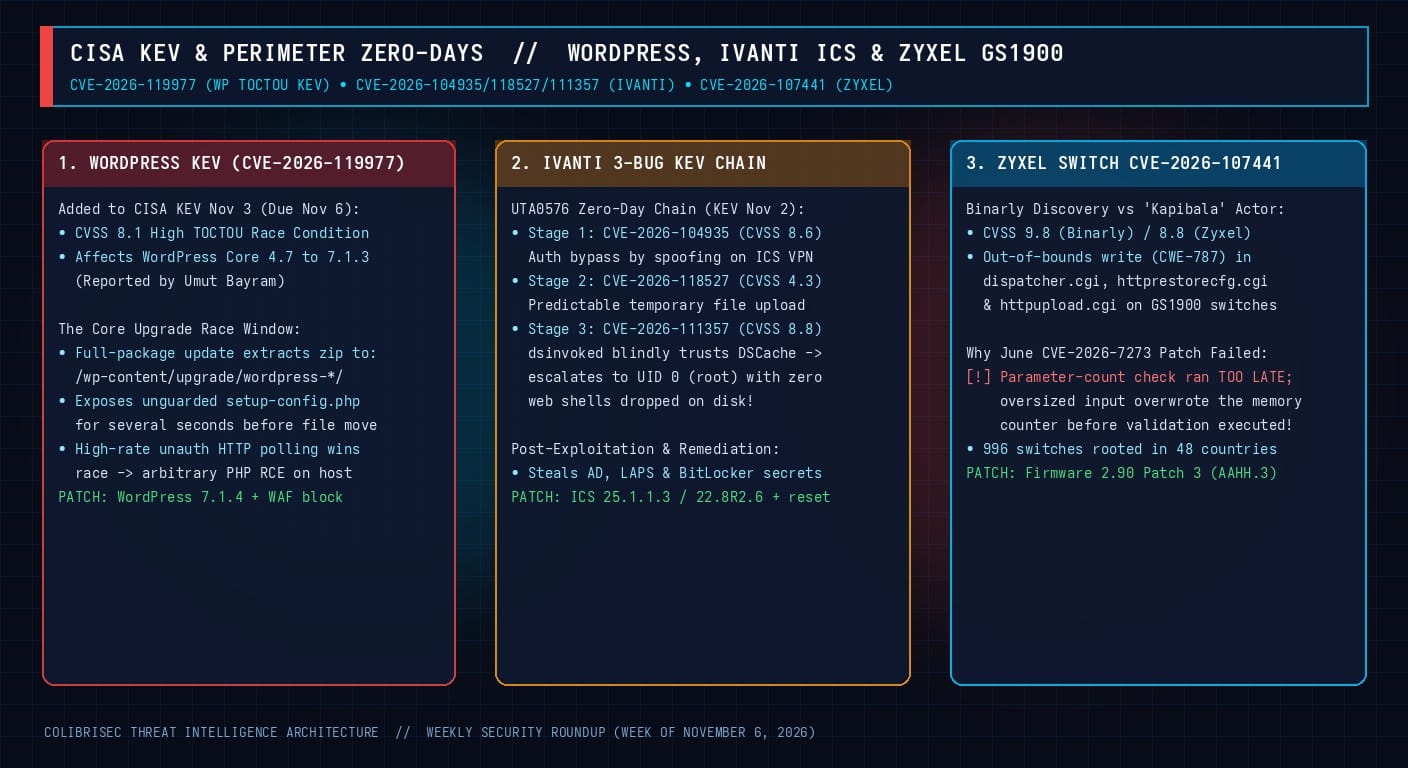
Between November 2 and November 6, 2026, enterprise perimeter defenders and web administrators faced three simultaneous active-exploitation crises across content management systems, SSL VPN gateways, and Layer-2/Layer-3 network switches. On November 3, CISA added CVE-2026-119977 (CVSS 8.1)—a pre-authentication Time-of-Check Time-of-Use (TOCTOU) race condition in the WordPress Core updater—to the Known Exploited Vulnerabilities (KEV) catalog with an accelerated Binding Operational Directive (BOD) 26-04 deadline of today, November 6, 2026, after Wordfence sensors recorded tens of thousands of exploit probes trying to catch WordPress installations mid-update. That directive arrived just 24 hours after CISA’s November 2 KEV deadline for the three-bug Ivanti Connect Secure zero-day root chain (CVE-2026-104935, CVE-2026-118527, and CVE-2026-111357) weaponized by espionage group UTA0576. At the same time, firmware researchers at Binarly revealed why organizations that had patched their Zyxel GS1900 smart switches in June were still getting rooted by the Chinese-speaking threat actor Kapibala (Red Heron) across nearly 1,000 switches globally: the attackers were exploiting an unpatched pre-auth out-of-bounds write (CVE-2026-107441, CVSS 9.8) where Zyxel’s earlier parameter-count check executed after memory corruption had already occurred.
1. WordPress Core TOCTOU Upgrade Race RCE (CVE-2026-119977)
Discovered by security researcher Umut Bayram and affecting every WordPress release from 4.7 through 7.1.3, CVE-2026-119977 (CVSS 8.1 High, CWE-367) turns the act of patching a site into a remote code execution window. When a WordPress administrator or automated cron task initiates a full-package core update (such as a major version jump or a manual re-installation via update-core.php), WordPress downloads the core distribution archive and unpacks it into a working directory inside the publicly routable web root:
/wp-content/upgrade/wordpress-<version-or-suffix>/wordpress/Mechanics of the Extraction Race Window
- The Unguarded Unpack Phase: While
unzip_file(a.plerdy.com)extracts thousands of files from the core archive onto the filesystem—and before the updater verifies checksums, copies the needed files over the live root, and deletes the temporary folder—a full, unconfigured copy of the WordPress codebase sits inside/wp-content/upgrade/for several seconds (and significantly longer on shared hosting or high-latency NFS/EBS storage). - Direct Execution of Staged Installer Scripts: Unlike the main WordPress root (which is protected by an existing
wp-config.php), the newly unpacked subfolder inside/wp-content/upgrade/does not have a localwp-config.phpat the exact moment its files hit disk. By polling/wp-content/upgrade/at high frequency and hitting staged scripts such aswp-admin/setup-config.phpduring that multi-second window, an unauthenticated remote attacker can bind a rogue database configuration or inject arbitrary PHP payloads into the staging directory before the upgrade completes.
2. Ivanti Connect Secure 3-Bug Root Chain (CVE-2026-104935, CVE-2026-118527 & CVE-2026-111357)
Investigations by Volexity and Mandiant into zero-day compromises of Ivanti Connect Secure (ICS) appliances revealed that threat actor UTA0576 bypassed traditional forensic detection by chaining three distinct flaws without ever dropping a classic web shell onto the appliance’s monitored web directories:
- Stage 1 — Initial Access via Spoofing Auth Bypass (CVE-2026-104935, CVSS 8.6): Allows an unauthenticated remote attacker to spoof internal session headers and reach authenticated web/API handlers on exposed ICS gateways.
- Stage 2 — Predictable Temporary File Upload (CVE-2026-118527, CVSS 4.3, CWE-340): Once past the perimeter check, the attacker invokes an upload handler that generates deterministic, predictable filenames on disk, allowing crafted configuration directives to be staged at a known local filesystem path.
- Stage 3 —
dsinvoked/DSCacheRoot Escalation (CVE-2026-111357, CVSS 8.8, CWE-306): Ivanti’s privilegeddsinvokedbroker service blindly trusts configuration parameters read fromDSCachewithout verifying caller authentication. By pointingDSCacheto the predictable file staged in Stage 2, UTA0576 escalated directly from the low-privileged web user toUID 0 (root), scrubbed internal logs to evade Ivanti’s Integrity Checker Tool (ICT), and harvested Active Directory credentials, LAPS passwords, and BitLocker recovery keys.
3. Zyxel GS1900 Switch Patch-Bypass Zero-Day (CVE-2026-107441)
Beginning in mid-August 2026, threat intelligence trackers observed a Chinese-speaking threat group codenamed Kapibala (also tracked as Red Heron) compromising 996 Zyxel GS1900 series smart managed switches across 48 countries to exfiltrate startup configurations and hashed root credentials. Defenders initially assumed the victims had simply failed to apply Zyxel’s June 2026 patch for CVE-2026-7273. However, firmware researchers at Binarly discovered that switches running the June patch were still being rooted via an unpatched vulnerability now tracked as CVE-2026-107441 (CVSS 9.8 Binarly / 8.8 Zyxel, CWE-787).
Why the June Patch Failed: Late Counter Validation After Memory Corruption
The vulnerability resides in the web management CGI binaries—specifically dispatcher.cgi, httprestorecfg.cgi, and httpupload.cgi—across 10 GS1900 switch models (GS1900-8, GS1900-8HP, GS1900-10HP, GS1900-16, GS1900-24, GS1900-24E, GS1900-24EP, GS1900-24HPv2, GS1900-48, and GS1900-48HPv2):
/* Conceptual representation of the flawed June patch vs. CVE-2026-107441 */
struct cgi_ctx {
    char param_buf[256];
    int  param_count;      /* Adjacent in memory to param_buf! */
};

int parse_cgi_request(struct cgi_ctx *ctx, const char *raw_input) {
    /* BUG: Unbounded copy runs BEFORE param_count is validated!
     * Sending an oversized parameter (>256 bytes) overflows param_buf[]
     * and overwrites ctx->param_count with a small controlled integer (e.g., 1)
     * plus hijacks adjacent pointers / return addresses. */
    strcpy(ctx->param_buf, raw_input);

    /* June CVE-2026-7273 patch placed the check HERE — too late! */
    if (ctx->param_count > MAX_PARAMS) {
        return -1;
    }
    return 0;
}
Because the June patch validated the parameter count after copying the parameter value into memory, Kapibala crafted oversized HTTP parameters that overwrote the parameter counter itself to satisfy the check while corrupting adjacent heap/BSS structures to execute arbitrary commands as root.
Remediation & Detection Telemetry
# 1. WordPress Core (CVE-2026-119977 - CISA KEV Deadline Nov 6, 2026)
wp core update --version=7.1.4

# Nginx WAF / VirtualHost rule to block external access to the upgrade staging folder:
# location ~* ^/wp-content/upgrade/ { deny all; return 403; }

# 2. Hunt WordPress access logs for CVE-2026-119977 race probes:
grep -E "/wp-content/upgrade/.*(setup-config|install).php" /var/log/nginx/*access*.log

# 3. Ivanti Connect Secure (CVE-2026-104935 / 118527 / 111357):
# Upgrade immediately to ICS 25.1.1.3 or 22.8R2.6+. If compromise is suspected,
# perform a full factory reset and rotate AD service accounts, LAPS & BitLocker keys.

# 4. Zyxel GS1900 Switches (CVE-2026-107441):
# Upgrade all 10 GS1900 models to Firmware 2.90 Patch 3 (e.g., 2.90(AAHH.3)C0)
# and restrict HTTP/HTTPS management CGI access strictly to an isolated management VLAN.
