
Messaging Sandbox RCE & AI Lures: Telegram QuickJS Widget Escape ("WebRAT" Stealer) & 186 "TypoPrompting" ClickFix AI Domains

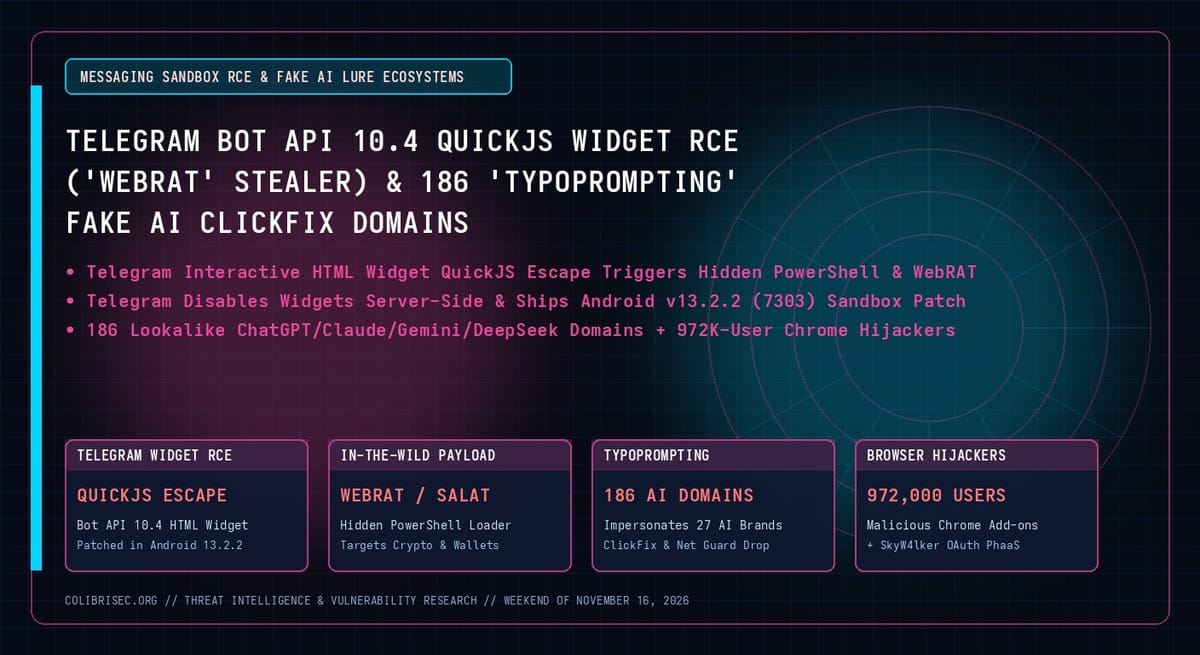
Messaging platforms and AI browser workflows came under intense fire this weekend. Following Telegram’s rollout of Bot API 10.4—which introduced interactive HTML/JavaScript message widgets executing inside an embedded QuickJS sandbox—security researchers at V12 demonstrated a sandbox escape and Remote Code Execution (RCE) vulnerability on Telegram for Android, while Kaspersky warned of in-the-wild exploitation in compromised channels delivering WebRAT (Salat Stealer) via hidden PowerShell loaders. Concurrently, Island threat researchers exposed "TypoPrompting", a sprawling campaign operating 186 lookalike domains mimicking 27 major AI tools to distribute ClickFix lures, the Net Guard loader, and Chrome search-hijacking extensions with 972,000 declared users.
1. Telegram Bot API 10.4 QuickJS Widget RCE & In-the-Wild WebRAT (Salat Stealer)
To enable richer mini-interactions directly inside chat streams, Telegram’s Bot API 10.4 allowed bots and channels to render interactive message widgets powered by QuickJS, a lightweight embeddable JavaScript engine:
- QuickJS Sandbox Escape on Android (Patched in
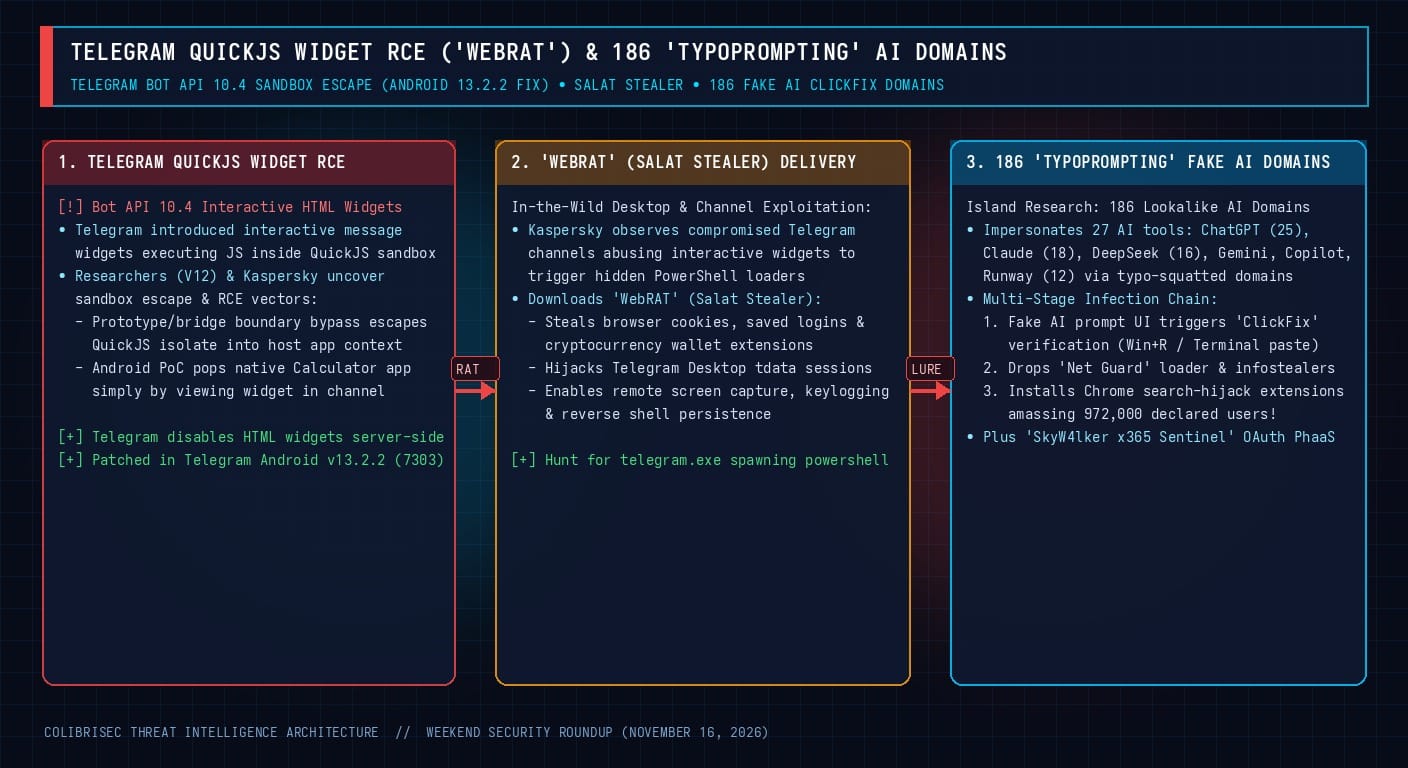
v13.2.2): Researchers at V12 demonstrated that insufficient isolation between the QuickJS runtime context and the host native bridge allowed untrusted widget JavaScript to escape the sandbox when a user simply viewed a message in a channel—demonstrating full native RCE by launching the Android Calculator application without user approval. - In-the-Wild
WebRAT(Salat Stealer) Delivery: Simultaneously, Kaspersky analysts observed threat actors abusing interactive widgets in compromised Telegram channels to silently invoke hidden PowerShell scripts on desktop targets. Those scripts fetched WebRAT (tracked as Salat Stealer), an infostealer and remote access trojan that exfiltrates browser credential stores, cryptocurrency wallet extensions, and Telegramtdatasession directories while providing live screen capture and keylogging. Amid the public PoCs and active exploitation reports, Telegram disabled HTML widgets server-side across the platform and pushed Telegram for Android v13.2.2 (build 7303).
2. Inside "TypoPrompting": 186 Lookalike AI Domains & 972,000 Hijacked Browser Users
Detailed by Island’s threat research team, the TypoPrompting campaign capitalizes on employees typing AI domains directly into their browser address bars:
- 27 Impersonated AI Brands Across 186 Domains: The infrastructure includes 25 lookalike domains for ChatGPT, 18 for Claude, 16 for DeepSeek, 12 for Runway, and dozens more mimicking Google Gemini, Microsoft Copilot, Perplexity, and Midjourney.
- From Fake Prompt Boxes to ClickFix &
Net Guard: When a victim enters a prompt into the realistic-looking fake AI interface, the page either presents a ClickFix verification modal instructing the user to paste an obfuscated PowerShell/mshta command intoWin+R(delivering the Net Guard malware loader and stealers) or forces the installation of rogue Chrome Web Store search-hijacking extensions that collectively amassed 972,000 declared users.
# Hunt for Telegram Desktop / Widget WebRAT (Salat Stealer) PowerShell Child Processes
Get-WinEvent -FilterHashtable @{LogName='Microsoft-Windows-Sysmon/Operational'; Id=1} |
  Where-Object { $_.Message -match 'ParentImage:.*Telegram.exe' -and $_.Message -match 'Image:.*(powershell|pwsh|cmd|mshta|wscript).exe' } |
  Select-Object TimeCreated, Message
