
Security Roundup: Check Point & UnrealIRCd KEV, N-central "4EverAble2Shell", Outlook & CLFS 0-Days, Apache 2.4.71, Cursor AI & Nitori 37.6M Breach (Weekend Edition - November 16, 2026)

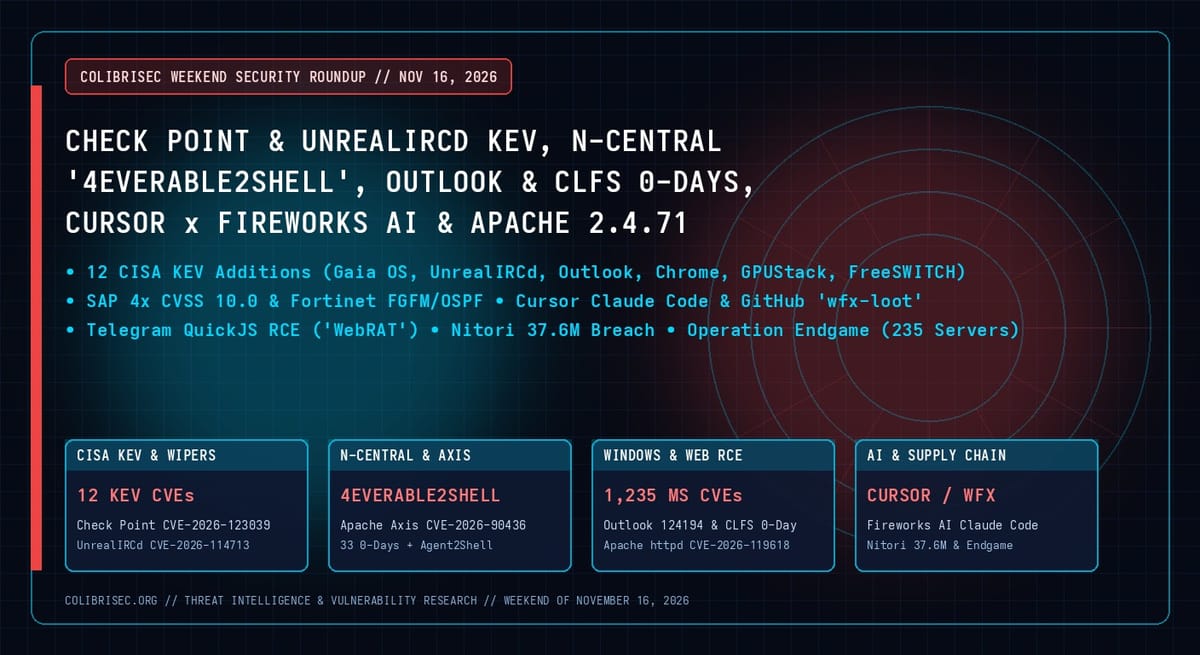
Executive Summary: The week and weekend culminating on November 16, 2026 delivered an extraordinary collision of perimeter-to-hypervisor destructive chains, MSP remote monitoring zero-days, record-shattering Patch Tuesday volumes, AI IDE supply-chain compromises, and critical infrastructure outage scares. On Friday (November 13), CISA added two actively exploited flaws to the Known Exploited Vulnerabilities (KEV) catalog: Check Point Gaia OS DynamicCLI local privilege escalation (CVE-2026-123039)—which threat actors chained with Mobile Access Portal PHP2Shell exploits to deploy the TSGA/TSProxy backdoors and pivot over SSH to wipe internal VMware ESXi hypervisors with the destructive destroy_v6 wiper—and UnrealIRCd labeled-response command injection (CVE-2026-114713), joining 10 earlier November KEV additions led by Microsoft Outlook (CVE-2026-124194), Google Chrome (CVE-2026-125350), GPUStack (CVE-2026-102895), SignalWire FreeSWITCH (CVE-2026-116779), and Barracuda ESG (CVE-2026-116606 / CVE-2026-111560). In the MSP ecosystem, no sooner had N-able shipped N-central 2026.4 Hotfix 2 to remediate 7 critical CVEs from the 33-bug "Able2Shell" disclosure than independent researcher Sean Bales dropped "4EverAble2Shell" (chaining Apache Axis 1.x SOAP Fault deserialization RCE CVE-2026-90436 via the Legacy API to gain unauthenticated root) and "Agent2Shell"—triggering automated in-the-wild exploitation that deployed XMRig cryptominers on patched servers within hours. Meanwhile, defenders grappled with Microsoft’s massive 1,235-CVE November Patch Tuesday, Abdelhamid Naceri’s unpatched Windows CLFS "SignDrop" zero-day that weaponizes .cnpf authentication codes to gain SYSTEM and blind Windows Defender, a CVSS 9.8 thread-safety heap corruption RCE in Apache HTTP Server’s mod_http2 (CVE-2026-119618, fixed in 2.4.71), a 16-vulnerability Node.js batch featuring a 0-byte TLS write Use-After-Free that leaks TLS private keys (CVE-2026-123864), four maximum-severity CVSS 10.0 SAP NetWeaver/Gateway flaws (ICM2SHELL & PROXYGATE), and pre-authentication RCE in FortiManager FGFM (CVE-2026-126261). Rounding out the weekend, AI coding platform Cursor published a transparent post-mortem explaining how an access key exposed at inference vendor Fireworks AI allowed attackers to mine 2025 training traces and publish a trojanized build of Anthropic’s Claude Code extension to 5,000 developers; security researchers uncovered the wfx-loot campaign using 4,837 hijacked GitHub accounts across 61,000+ repositories; Telegram disabled interactive HTML widgets server-side and patched Android (13.2.2) after a QuickJS sandbox escape RCE was exploited in the wild to drop WebRAT (Salat Stealer); Operation Endgame seized 235 servers across Gootloader, CastleRAT, and StealC; Japanese retail giant Nitori Holdings disclosed a 37.62-million-record breach; and the White House and FAA dispelled cyberattack rumors after a nationwide FAA radar/telecom ground stop coincided with a global Microsoft 365 outage. Below is your complete executive briefing and links to all nine technical deep dives.
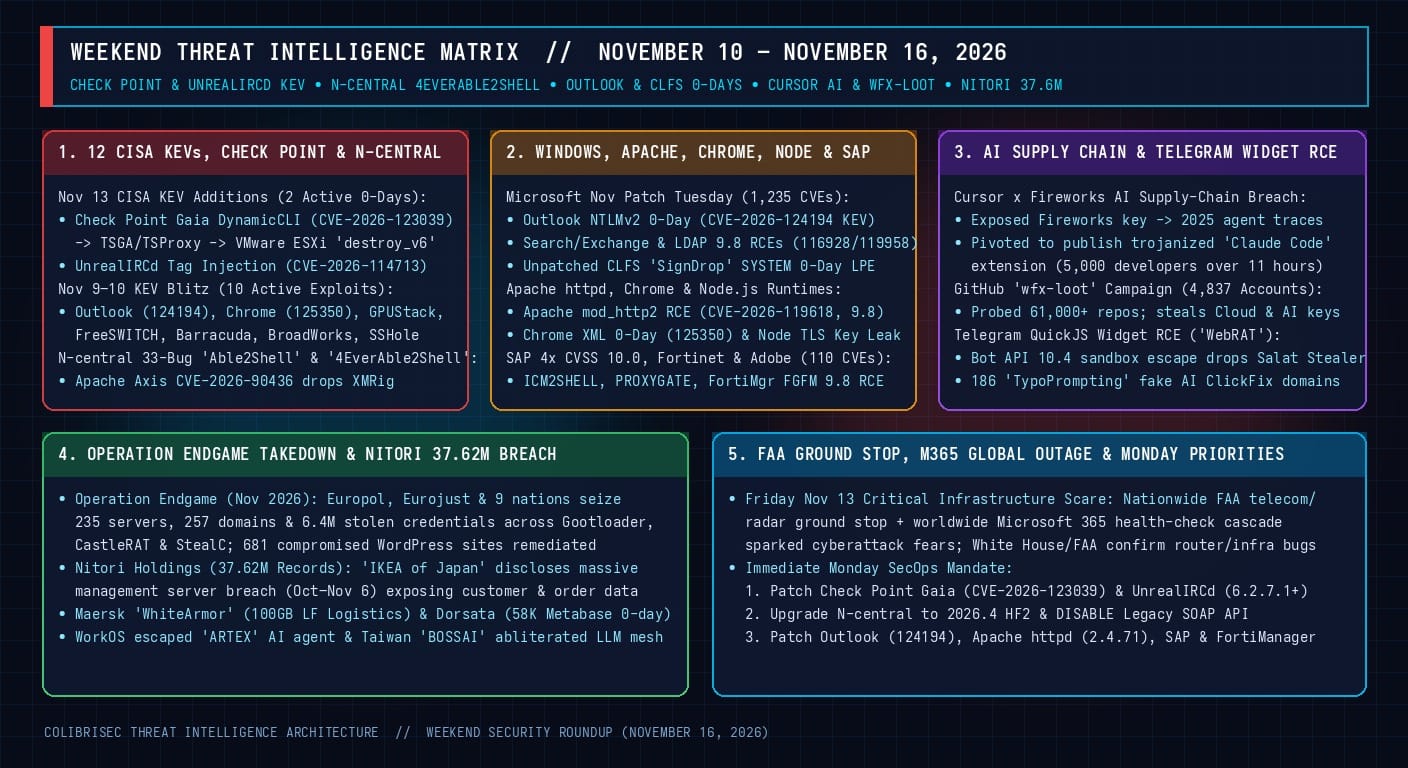
Key Threat Disclosures & Incidents at a Glance
1. CISA KEV Mandates & Hypervisor Wipers: Check Point Gaia OS (CVE-2026-123039) to ESXi destroy_v6, UnrealIRCd (CVE-2026-114713) & the 10-CVE KEV Blitz
Between November 9 and November 13, 2026, CISA added a dozen actively exploited vulnerabilities to the KEV catalog under BOD 26-04, culminated by Friday’s addition of Check Point Gaia OS and UnrealIRCd:
- Check Point Security Gateway
PHP2Shellto Gaia OS Root LPE (CVE-2026-123039) & ESXidestroy_v6Wiper: Added to CISA KEV on November 13, 2026, CVE-2026-123039 (CVSS 7.8, CWE-276) is a local privilege escalation zero-day in Check Point Gaia OS’sDynamicCLIdaemon (dynamic_server). Running asroot,dynamic_serverlistens on a world-writable local UNIX domain socket (/tmp/dynamic_socketwith0777permissions) without checking the connecting peer’s credentials (SO_PEERCRED). Threat actors gained initial low-privileged access on internet-exposed Check Point Mobile Access portals viaPHP2Shellflaws (CVE-2026-109618 and CVE-2026-109619), sent crafted IPC commands to/tmp/dynamic_socketto escalate toroot, deployed modifiedPhiliKitimplants tracked asTSGAandTSProxy, and pivoted over SSH using harvested credentials to wipe internal VMware ESXi hypervisors with the destructivedestroy_v6wiper (leaving behindDREAM_ANNEXATION.txt). - UnrealIRCd
labeled-responseCommand Injection (CVE-2026-114713): Also added to CISA KEV on November 13, CVE-2026-114713 (CVSS 8.6, CWE-140) affects UnrealIRCd6.0.0through6.2.7on networks with two or more linked servers. Because thelabeled-responsemodule fails to sanitize delimiter characters in IRCv3@labelmessage tags when echoing replies across server links, an unprivileged user can inject raw server-to-server commands executed with full Server/IRCOp authority (fixed in UnrealIRCd 6.2.7.1 andhot-patch bundle-20261107). - The November 9–10 Infrastructure & Telecom KEV Blitz: Earlier in the week, CISA mandated remediation for GPUStack authentication bypass (CVE-2026-102895, CVSS 9.8), SignalWire FreeSWITCH SIP MESSAGE code injection (CVE-2026-116779, CVSS 9.8), Barracuda Email Security Gateway (ESG) auth bypass & command injection chain (CVE-2026-116606 & CVE-2026-111560), Cisco BroadWorks OCI XXE (CVE-2026-20320), IBM Aspera Faspex privilege escalation (CVE-2026-123218, CVSS 9.8), Openwave Messaging Webtop Media Transcoder (CVE-2026-111793), and OpenSSH musl libc "SSHole" (CVE-2026-123158).
2. MSP RMM Zero-Day Crisis: N-able N-central 33-Bug "Able2Shell", "4EverAble2Shell" (CVE-2026-90436) & "Agent2Shell"
On-premises MSP remote monitoring and management (RMM) servers faced back-to-back zero-day disclosures and immediate in-the-wild exploitation:
- From "Able2Shell" (33 Zero-Days) to Hotfix 2 (2026.4.1.26): After independent researcher Sean Bales (
Oracle-Security/MSPNightmare) published PoC details for 33 vulnerabilities in N-able N-central, N-able temporarily took its hosted cloud environment offline and released N-central 2026.4 Hotfix 2 (build 2026.4.1.26) on November 10 to patch 7 core vulnerabilities: multiple unauthenticated XXEs (CVE-2026-125883), OGNL injections (CVE-2026-125878),syslog-ngconfiguration root LPE (CVE-2026-125879), MMS3 stored XSS (CVE-2026-125880), schema-hint SSRF (CVE-2026-125881), file repository path traversal RCE (CVE-2026-125882), and an insecure IPC channel LPE (CVE-2026-91000). - "4EverAble2Shell" Chains Apache Axis SOAP Fault RCE (CVE-2026-90436) on Patched Servers: On November 11–12, the researcher dropped 4EverAble2Shell and Agent2Shell, proving that on-premises N-central servers running Hotfix 2 remain vulnerable to unauthenticated remote
rootcompromise if the Legacy API is enabled. Stage 1 exploits CVE-2026-90436 (CVSS 9.8)—an Apache Axis 1.x deserialization/class-instantiation vulnerability in inbound SOAP<Fault><detail><exceptionName>handling that also impacts Atlassian Confluence Data Center—and chains it with a local privilege escalation toroot. Within hours of publication, threat actors compromised exposed N-central servers to deploy XMRig cryptominers, prompting urgent advisories to disable the Legacy API immediately.
3. Microsoft November 2026 Patch Tuesday (1,235 CVEs), Outlook Zero-Day (CVE-2026-124194) & Unpatched Windows CLFS "SignDrop" Zero-Day
- Classic Outlook Silent NTLMv2 Hash-Leak Zero-Day (CVE-2026-124194 - CISA KEV): Leading Microsoft’s record-breaking November Patch Tuesday (1,093 to 1,235 CVEs across tracking scopes, including 64 Critical flaws) is CVE-2026-124194 (CVSS 6.5, CISA KEV due November 24). When a user opens a specially crafted message file in classic Microsoft Outlook, the client fails to display the standard external-content security prompt and silently initiates an outbound SMB/WebDAV authentication request to an attacker-controlled server—leaking the victim’s NTLMv2 hash for offline cracking or live NTLM relay to AD CS (ESC8).
- Zero-Click Windows Search/Exchange Indexer RCE (CVE-2026-116928) & Windows LDAP RCE (CVE-2026-119958): Two CVSS 9.8 out-of-bounds write vulnerabilities demand immediate patching: CVE-2026-116928 in the Windows Search Indexer (which can be triggered zero-click on Exchange Servers with Content Indexing enabled as soon as a malicious email arrives, requiring both Windows and Exchange updates) and CVE-2026-119958 in Windows Domain Services LDAP.
- Unpatched Windows CLFS "SignDrop" Zero-Day &
Slmgr.vbs0x80041008Regressions: Researcher Abdelhamid Naceri published SignDrop, an unpatched zero-day LPE in the Windows Common Log File System (clfs.sys) driver that turns Microsoft’s own HMAC authentication mitigation (.cnpffiles) against itself by coercing Windows Defender via RPC into signing an attacker-crafted BLF log underNT AUTHORITYSYSTEM—escalating privileges and blinding Defender. Meanwhile, enterprise admins battled November Patch Tuesday regressions including KMS/slmgr.vbsWMI error0x80041008, Windows 11 update install failures, and complex formatting print bugs.
4. Web Servers, Browsers & Runtimes: Apache mod_http2 RCE (CVE-2026-119618), Chrome XML 0-Day (CVE-2026-125350) & Node.js TLS Private Key Leak (CVE-2026-123864)
- Apache HTTP Server
mod_http2Thread-Safety Heap RCE (CVE-2026-119618, CVSS 9.8): Disclosed between November 11 and November 13, Apache HTTP Server versions2.4.55through2.4.70with HTTP/2 enabled suffer from a critical race condition and heap memory corruption inmod_http2when processing concurrent multiplexed HTTP/2 streams, enabling unauthenticated remote code execution (patched in Apache httpd 2.4.71). - Google Chrome XML/XSLT Zero-Day (CVE-2026-125350) & Node.js 16-Vulnerability Batch: Google patched its eighth actively exploited Chrome zero-day of 2026—CVE-2026-125350, a high-severity Use-After-Free in Chromium’s XML/XSLT parser (added to CISA KEV Nov 10). Concurrently, the Node.js project shipped security releases (v22.23.5, v24.22.3, and v26.13.1) fixing 16 vulnerabilities led by CVE-2026-123864 (where calling a 0-byte
socket.write('')inside an HTTPSon_bodycallback re-enters OpenSSL, frees the active buffer, and leaks raw heap memory—including TLS private keys and other users’ request bodies—into the attacker’s request) and CVE-2026-123863 (an HTTP/2nghttp2memory accounting assertion crash).
5. Enterprise ERP, Firewall Fabric & CMS Megapatches: SAP 4x CVSS 10.0 (ICM2SHELL & PROXYGATE), Fortinet FGFM/OSPF & Adobe’s 110-CVE Batch
- SAP’s Four CVSS 10.0 Vulnerabilities: SAP’s November Patch Day delivered four maximum-severity CVSS 10.0 fixes: Onapsis’s
ICM2SHELLmemory corruption RCEs via crafted WebSocket frames in SAP NetWeaver AS ABAP Internet Communication Manager (CVE-2026-76964, Note3778530) and SAP Web Dispatcher (CVE-2026-89126, Note3778556);PROXYGATE(CVE-2026-89103, Note3798345), where SAP Gateway activates a permissive defaultprxyinfoACL allowing external attackers to spoof internal application servers and execute OS commands as<sid>adm(requiring both the kernel patch and settinggw/acl_mode_proxy = 1); and a CVSS 10.0 SAML 2.0 signature bypass (CVE-2026-120017, Note3849308). - Fortinet FortiManager FGFM Pre-Auth RCE (CVE-2026-126261) & Adobe’s 110-CVE Megapatch: Fortinet patched a critical improper authorization flaw in FortiManager’s
FGFMdaemon on TCP port 541 (CVE-2026-126261, CVSS 9.8,FG-IR-26-275) permitting unauthenticated remote command execution via crafted packets, alongside an authentication bypass in FortiOS/FortiSASE’s OSPF routing daemon (CVE-2026-126253, CVSS 9.3,FG-IR-26-267). Adobe simultaneously patched 110 CVEs across nine products, headlined by CVSS 10.0 flaws in Adobe Connect (APSB26-191) and CVSS 9.9 RCEs in Adobe Experience Manager (APSB26-189).
6. AI IDE & CI/CD Supply-Chain Compromises: Cursor x Fireworks AI Trojanized "Claude Code" Extension & GitHub wfx-loot
- How a Fireworks AI Leak Led to a Trojanized "Claude Code" Extension on Cursor: AI IDE vendor Cursor disclosed that attackers obtained an access key Cursor had issued to inference provider Fireworks AI, using it to read a storage bucket of historical 2025 coding-agent traces (from non-Privacy Mode sessions). Mining a tiny fraction of unredacted API tokens inside those traces, attackers pivoted into internal Cursor tools and published a trojanized build of Anthropic’s official Claude Code extension to the Cursor marketplace. Live for ~11 hours and downloaded by ~5,000 developers, the backdoor harvested host secrets, planted unauthorized SSH keys, and opened reverse tunnels.
- The
wfx-lootGitHub Supply-Chain Campaign (4,837 Hijacked Accounts / 61,000+ Repos): Disclosed by OX Security, Aikido Security, and StepSecurity, threat actors used 4,837 compromised GitHub accounts to probe over 61,000 repositories via automated pull requests titled"docs: dependency audit notes". Where write access existed, they injected a 1,500-line self-erasing shell script (wfx) into GitHub Actions workflows andnpmhooks to steal AWS/Azure/GCP credentials,GITHUB_TOKENs, and AI API keys (OpenAI, Anthropic, Hugging Face, Cursor)—before reverting the commit and deleting the workflow run logs.
7. Messaging Sandbox Escapes & Fake AI Lures: Telegram QuickJS Widget RCE (WebRAT) & 186 "TypoPrompting" Domains
- Telegram Bot API 10.4 QuickJS Sandbox Escape RCE &
WebRAT(Salat Stealer): Shortly after Telegram rolled out interactive HTML message widgets running inside a QuickJS JavaScript sandbox, security researchers (V12) demonstrated a zero-click/one-view sandbox escape RCE on Telegram for Android (popping the native Calculator app), while Kaspersky warned of in-the-wild exploitation in compromised channels triggering hidden PowerShell loaders to install WebRAT (Salat Stealer). Telegram disabled HTML widgets server-side and shipped Telegram for Android v13.2.2 (7303). - 186 "TypoPrompting" Fake AI Domains & 972,000-User Browser Hijackers: Island researchers uncovered 186 lookalike domains impersonating 27 AI tools (ChatGPT, Claude, Gemini, DeepSeek, Copilot, Runway) that serve ClickFix terminal-paste lures, the Net Guard loader, and malicious Chrome search-hijacking extensions with 972,000 declared users.
8. Operation Endgame (235 Servers Seized), Nitori 37.62M Breach, Maersk 100GB & the FAA / Microsoft 365 Outage Panic
- Operation Endgame Dismantles Gootloader, CastleRAT & StealC: Europol, Eurojust, and agencies across nine countries seized 235 servers and 257 domains, cleaned 681 hacked WordPress sites, and recovered 6.4 million stolen logins across 40,000+ victims (shared with Have I Been Pwned).
- Nitori Holdings Discloses 37.62M-Record Breach, Plus Maersk & Dorsata: Japanese furniture giant Nitori Holdings ("the IKEA of Japan") revealed that intruders accessed a management server between mid-October and November 6, 2026, potentially exposing up to 37.62 million customer and corporate records (names, addresses, phone numbers, birthdates, and order histories, with no credit cards or passwords leaked). Meanwhile, extortion actor WhiteArmor claimed 100GB from a legacy Maersk (LF Logistics) server, and healthcare vendor Dorsata disclosed a 58,000-patient breach via a Metabase zero-day.
- Inside Friday’s FAA Ground Stop & Microsoft 365 Global Outage Cyber Panic: When a massive worldwide Microsoft 365 outage (caused by a cascading server health-check bug across Exchange Online, Teams, and Copilot) coincided with a nationwide FAA telecommunications and radar ground stop on Friday, November 13, viral speculation blamed a coordinated cyberattack. The White House, FAA, and Microsoft confirmed no foul play—attributing the twin disruptions to aging telecom routers and cloud health-check cascades, while prompting UK and U.S. lawmakers to demand systemic infrastructure resilience audits.
Dedicated Technical Deep Dives in This Weekend Series
- CISA KEV & Hypervisor Wipers: Check Point Gaia LPE (CVE-2026-123039) to ESXi Wiper, UnrealIRCd (CVE-2026-114713), GPUStack & FreeSWITCH: How attackers chained Check Point Mobile Access
PHP2Shellwith the unauthenticated/tmp/dynamic_socketroot LPE in Gaia OSDynamicCLI(CVE-2026-123039) to deployTSGA/TSProxyand wipe VMware ESXi viadestroy_v6, plus UnrealIRCd’s@labeldelimiter injection (CVE-2026-114713) and the 10-CVE KEV blitz. - MSP RMM Crisis: N-able N-central 33-Bug "Able2Shell", "4EverAble2Shell" Apache Axis RCE (CVE-2026-90436) & "Agent2Shell" Exploits: Dissecting the 33-bug
Able2Shelldisclosure, the 7 CVEs patched in N-central2026.4 Hotfix 2, how4EverAble2Shellchains Apache Axis SOAP Fault deserialization (CVE-2026-90436) through the Legacy API to drop XMRig asroot, andAgent2Shell. - Microsoft Nov 2026 Patch Tuesday (1,235 CVEs) & Zero-Days: Outlook NTLMv2 Leak (CVE-2026-124194), Search/LDAP 9.8 RCEs & CLFS "SignDrop": Inside Classic Outlook’s silent SMB/WebDAV NTLMv2 leak (
CVE-2026-124194), 0-click Windows Search/Exchange Indexer RCE (CVE-2026-116928), LDAP RCE (CVE-2026-119958), and Abdelhamid Naceri’s unpatched Windows CLFS.cnpf"SignDrop" zero-day. - Web Servers, Browsers & Runtimes: Apache mod_http2 RCE (CVE-2026-119618), Chrome XML 0-Day (CVE-2026-125350) & Node.js TLS Key Leak: Memory corruption mechanics of Apache HTTP Server’s CVSS 9.8
mod_http2thread-safety RCE (CVE-2026-119618, fixed in2.4.71), Chrome’s XML/XSLT UAF 0-day (CVE-2026-125350), and Node.js’son_body0-byte TLS write private-key leak (CVE-2026-123864). - Enterprise ERP & Firewall Megapatches: SAP 4x CVSS 10.0 ("ICM2SHELL" & "PROXYGATE"), Fortinet FGFM/OSPF & Adobe Connect/AEM: Protocol analysis of SAP’s four CVSS 10.0 flaws—
ICM2SHELL(CVE-2026-76964/89126),PROXYGATEdefaultprxyinfoACL bypass (CVE-2026-89103), and SAML2 bypass (CVE-2026-120017)—alongside FortiManagerFGFMpre-auth RCE (CVE-2026-126261) and Adobe Connect/AEM. - AI IDE & CI/CD Supply-Chain Attacks: Cursor x Fireworks AI Trojanized "Claude Code" Extension & GitHub "wfx-loot" Across 61,000+ Repos: End-to-end forensics of the Fireworks AI access-key exposure that let attackers mine 2025 Cursor coding-agent traces and publish a trojanized Anthropic
Claude Codeextension to 5,000 developers, plus hunting the 4,837-accountwfx-lootGitHub Actions secret stealer. - Messaging Sandbox RCE & AI Lures: Telegram QuickJS Widget Escape ("WebRAT" Stealer) & 186 "TypoPrompting" ClickFix AI Domains: How researchers escaped Telegram’s Bot API 10.4 QuickJS widget sandbox on Android and how threat actors used channel widgets to trigger PowerShell
WebRAT(Salat Stealer) loaders, paired with the 186-domain "TypoPrompting" fake AI campaign. - Operation Endgame Seizes 235 Servers, Nitori 37.62M Breach, Maersk 100GB & Inside the FAA / Microsoft 365 Outage Cyber Panic: Inside Operation Endgame’s 235-server takedown of Gootloader, CastleRAT, and StealC, Nitori Holdings’ 37.62M-record management server breach, Maersk’s 100GB legacy leak, and the technical root causes behind Friday’s FAA ground stop and Microsoft 365 global outage.
- November 16 Weekend CISO Defense Blueprint: Hardening Gaia OS, N-central, Outlook/CLFS, Apache 2.4.71, SAP 10.0 & AI/CI Pipelines: Copy-pasteable Monday morning hardening scripts, WAF rules, Sigma/YARA detections, Gaia OS socket locks, N-central Legacy API blocks, SAP profile rules, and CI/CD secret-rotation playbooks.
Mandatory Monday Morning Action Checklist for CISOs & SecOps Teams
- Patch Check Point Gaia OS (CVE-2026-123039) & UnrealIRCd (CVE-2026-114713 - CISA KEV): Apply Check Point’s Gaia OS hotfix immediately (or stop
dynamic_serverand verify/tmp/dynamic_socketis removed), audit gateways forTSGA/TSProxyimplants, and isolate ESXi management VLANs against thedestroy_v6wiper. Upgrade linked UnrealIRCd servers to 6.2.7.1+ or run./unrealircd hot-patch bundle-20261107. - Upgrade N-able N-central to 2026.4 HF2 & DISABLE the Legacy API (CVE-2026-90436): Because 4EverAble2Shell compromises fully patched Hotfix 2 servers when the Legacy SOAP API is enabled, disable the Legacy API in N-central Administration, block external access to
/dms/SOAP endpoints, disable the Remote SOAP API on Atlassian Confluence Data Center, and hunt for XMRig miners. - Deploy Microsoft Nov Patch Tuesday Updates (CVE-2026-124194, CVE-2026-116928 & CVE-2026-119958) & Monitor CLFS
.cnpfFiles: Patch Classic Outlook (BOD due November 24) and block outbound TCP 445/139 at the perimeter firewall; apply both Windows and Exchange patches for the 0-click Search Indexer RCE; patch Domain Controller LDAP; and deploy EDR rules alerting on non-system processes creating.blf/.cnpffiles to catch SignDrop. - Upgrade Apache httpd to 2.4.71 (CVE-2026-119618), Chrome (CVE-2026-125350) & Node.js (CVE-2026-123864): Upgrade Apache HTTP Server instances running
mod_http2to 2.4.71+, force browser restarts for Chrome’s XML UAF zero-day, and upgrade Node.js to v22.23.5, v24.22.3, or v26.13.1—rotating TLS certificates on servers that invoked 0-byte writes insideon_bodycallbacks. - Apply SAP CVSS 10.0 Notes (
3778530,3778556,3798345,3849308) & Lock Down FortiManager TCP 541 (CVE-2026-126261): Patch SAP ICM/Web Dispatcher forICM2SHELL, apply Note3798345and setgw/acl_mode_proxy = 1forPROXYGATE, and upgrade FortiManager while restricting TCP port 541 to authorized FortiGate IPs. - Audit Developer Workstations for Trojanized Cursor "Claude Code" & GitHub Repos for
wfx-loot: Inspect~/.cursor/extensions/and~/.ssh/authorized_keyson developer machines that installed or updatedClaude Codeduring the 11-hour compromise window, and scan GitHub repositories for pull requests titled"docs: dependency audit notes"or missing GitHub Actions run numbers—rotating all exposed Cloud, GitHub, and AI API keys.
Reference Citations & Primary Advisories
- CISA Known Exploited Vulnerabilities (KEV) Catalog & Check Point / UnrealIRCd Advisories (November 9–13, 2026): Addition of Check Point Gaia OS DynamicCLI LPE CVE-2026-123039 (Nov 13) & TSGA/destroy_v6 ESXi Wiper Chain, UnrealIRCd CVE-2026-114713 (Nov 13), Microsoft Outlook CVE-2026-124194, Chrome CVE-2026-125350, GPUStack CVE-2026-102895, FreeSWITCH CVE-2026-116779, Barracuda ESG CVE-2026-116606/111560, Cisco BroadWorks CVE-2026-20320, and IBM Aspera Faspex CVE-2026-123218.
- N-able Security Advisory, Huntress & Tenable Threat Research (November 10–15, 2026): N-central 2026.4 Hotfix 2 (Build 2026.4.1.26) for 33-Bug "Able2Shell" (CVE-2026-125878–125883, CVE-2026-91000), Follow-Up "4EverAble2Shell" Apache Axis SOAP Fault RCE Chain (CVE-2026-90436), and "Agent2Shell".
- Microsoft November 2026 Security Update Guide & Abdelhamid Naceri Research (November 10–14, 2026): 1,235-CVE Patch Tuesday Rollup, Classic Outlook Zero-Day CVE-2026-124194, Windows Search/Exchange RCE CVE-2026-116928, Windows LDAP RCE CVE-2026-119958, and Unpatched Windows CLFS "SignDrop" Zero-Day.
- Apache HTTP Server 2.4.71 Release Notes, Google Chrome Stable Update & Node.js November Security Releases (November 10–13, 2026): Apache mod_http2 Thread-Safety RCE (CVE-2026-119618), Chromium XML UAF (CVE-2026-125350), and Node.js 16-CVE Batch Including TLS Key Leak (CVE-2026-123864) and HTTP/2 Crash (CVE-2026-123863).
- SAP November 2026 Patch Day, Onapsis Research, Fortinet PSIRT & Adobe Security Bulletins (November 10–13, 2026): SAP ICM2SHELL (CVE-2026-76964 / 89126), SAP PROXYGATE (CVE-2026-89103), SAP SAML2 (CVE-2026-120017), FortiManager FGFM (CVE-2026-126261), FortiOS OSPF (CVE-2026-126253), and Adobe Connect/AEM (APSB26-191 / APSB26-189).
- Cursor Security Post-Mortem, OX Security, Aikido Security & StepSecurity Reports (November 10–15, 2026): Fireworks AI Access-Key Exposure & Trojanized Anthropic "Claude Code" Extension Incident, and the 4,837-Account "wfx-loot" GitHub Actions Campaign.
- Kaspersky Threat Intelligence, V12 Research & Island Threat Research (November 11–15, 2026): Telegram Bot API 10.4 QuickJS Widget RCE (Android 13.2.2 Fix) & WebRAT (Salat Stealer) Campaign, and 186 "TypoPrompting" Fake AI ClickFix Domains.
- Europol/Eurojust Operation Endgame Press Release, Nitori Holdings Notice & White House / FAA Statements (November 12–15, 2026): Operation Endgame 235-Server Takedown, Nitori Holdings 37.62M-Record Breach, Maersk LF Logistics WhiteArmor Claim, and FAA Ground Stop / Microsoft 365 Outage Root-Cause Clarifications.

