
AI IDE & CI/CD Supply-Chain Attacks: Cursor x Fireworks AI Trojanized "Claude Code" Extension & GitHub "wfx-loot" Across 61,000+ Repos

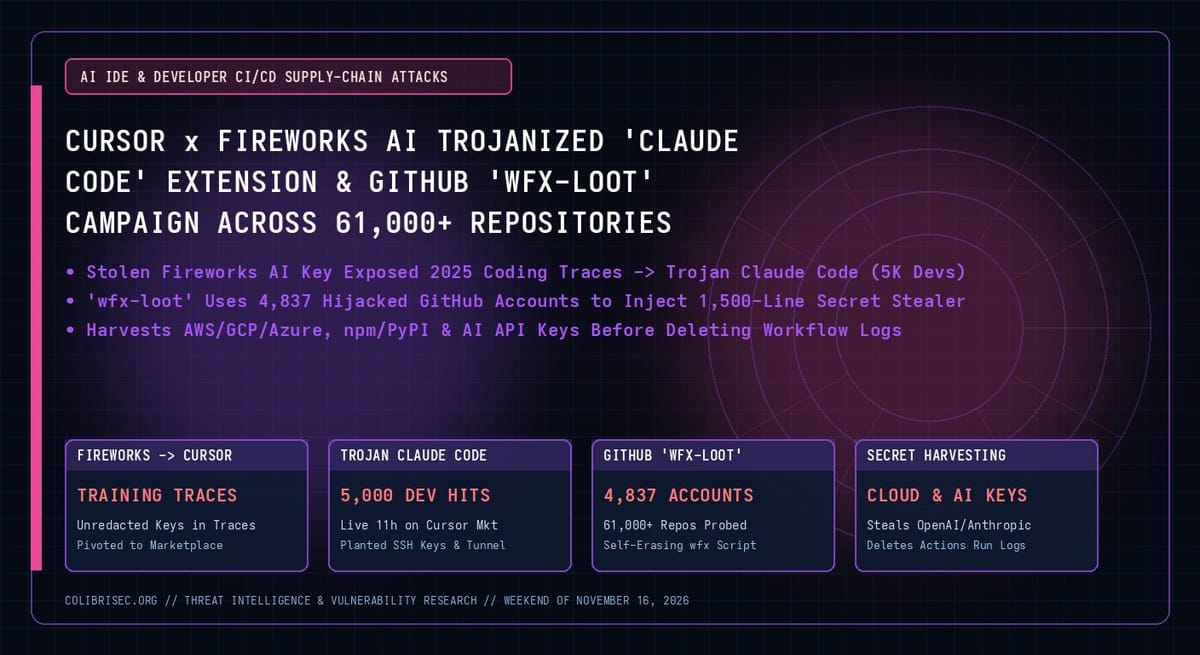
Two major software supply-chain disclosures this weekend underscored how threat actors are systematically targeting AI-assisted software development pipelines, IDE marketplaces, and CI/CD secret stores. First, AI coding platform Cursor published a detailed post-mortem revealing that a trojanized version of Anthropic’s official Claude Code extension—which remained live on Cursor’s extension marketplace for roughly 11 hours and was downloaded by approximately 5,000 developers—originated from a compromised access key at third-party inference vendor Fireworks AI. Second, security researchers at OX Security, Aikido Security, and StepSecurity uncovered wfx-loot, an industrial-scale GitHub campaign utilizing 4,837 hijacked GitHub accounts to probe over 61,000 repositories and exfiltrate cloud and AI API keys via self-erasing GitHub Actions workflows.
1. Anatomy of the Cursor x Fireworks AI Incident & the Trojanized "Claude Code" Extension
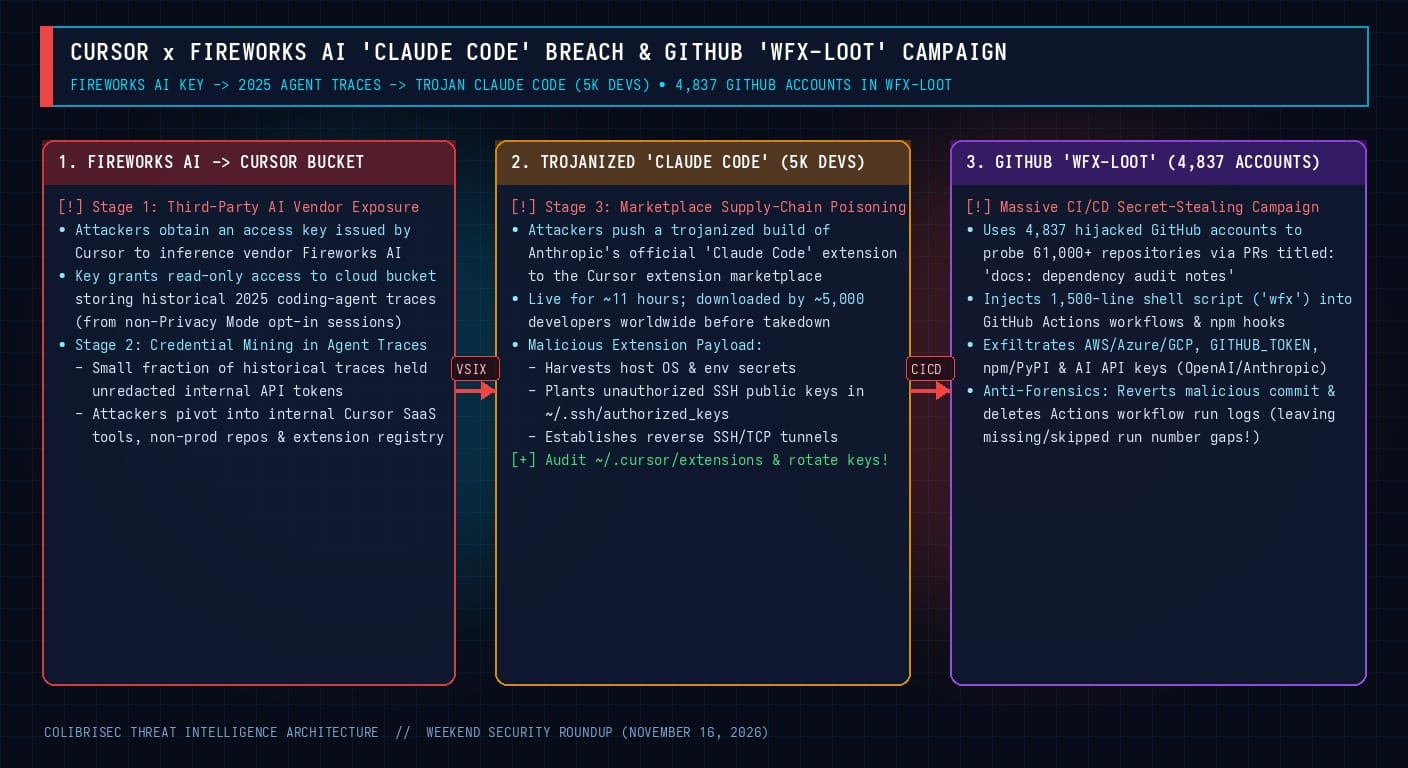
Cursor’s post-mortem traced the multi-stage supply-chain escalation from a third-party AI inference provider straight to developer workstations:
- Stage 1 — Third-Party Access Key Exposure at Fireworks AI: Attackers obtained an access key that Cursor had issued to its AI infrastructure partner, Fireworks AI, following a security incident at Fireworks.
- Stage 2 — Mining Historical 2025 Coding-Agent Traces: That key granted read-only access to a cloud storage bucket containing historical coding-agent execution traces—primarily from 2025 sessions where users were not in Privacy Mode and permitted trace retention for model training. Although nearly all traces were benign, a tiny fraction contained unredacted internal API credentials.
- Stage 3 — Lateral Pivot & Marketplace Impersonation: Using credentials extracted from those historical traces, the attackers pivoted into internal Cursor SaaS tools, accessed non-production source code repositories, and obtained credentials capable of publishing to the Cursor VS Code extension marketplace.
- Stage 4 — The 11-Hour Trojanized
Claude CodeExtension: Masquerading as Anthropic, the attackers published a malicious update to the Claude Code extension. Over the ~11 hours before Cursor revoked the package, roughly 5,000 developers downloaded the build, which harvested system environment variables, planted unauthorized SSH public keys in~/.ssh/authorized_keys, and attempted to establish reverse tunnels.
2. Inside the wfx-loot Campaign: 4,837 Hijacked GitHub Accounts & Self-Erasing Workflows
Tracked since November 10, 2026, wfx-loot weaponizes stolen personal access tokens (PATs) and OAuth tokens across 4,837 GitHub accounts:
- Automated Write-Access Probing: The botnet opens probe pull requests (frequently titled
"docs: dependency audit notes") across 61,000+ repositories to identify repos where the hijacked token holds direct write or workflow-trigger permissions. - The 1,500-Line
wfxSecret Harvester: On writable repositories, the attacker injects a ~1,500-line shell script dubbedwfxinto.github/workflows/*.ymlorpackage.jsonnpm installhooks. When the runner executes,wfxdumps environment memory and runner secrets—specifically targeting AWS/Azure/GCP credentials,GITHUB_TOKEN, npm/PyPI tokens, and AI provider API keys (OPENAI_API_KEY,ANTHROPIC_API_KEY, Hugging Face, and Cursor tokens). - Anti-Forensic Log Deletion: Immediately after exfiltrating secrets to its C2, the script reverts the malicious git commit and calls the GitHub REST API to delete its own GitHub Actions workflow run logs—leaving behind only a telltale gap in sequential workflow run numbers (e.g., Run #41 followed by Run #43).
# 1. Developer Workstation Triage for Trojanized Cursor "Claude Code" Extension
ls -la ~/.cursor/extensions/ | grep -i claude
# Inspect ~/.ssh/authorized_keys for unrecognized SSH keys added in late Oct / Nov 2026:
cat ~/.ssh/authorized_keys
ps aux | grep -E "ssh -R|ngrok|cloudflared|socat"

# 2. GitHub Repository Triage for "wfx-loot" (Detecting Deleted Workflow Run Gaps & Reflog Commits)
# List recent workflow runs via GitHub CLI and check for missing sequential run_number values:
gh api repos/:owner/:repo/actions/runs --jq '.workflow_runs[] | "(.run_number) (.name) (.created_at)"' | head -n 30
# Search git reflog / dangling commits for "dependency audit notes" or "wfx":
git log --all --reflog --grep="dependency audit notes" --oneline
