
Web Servers, Browsers & Runtimes: Apache mod_http2 RCE (CVE-2026-119618), Chrome XML 0-Day (CVE-2026-125350) & Node.js TLS Key Leak

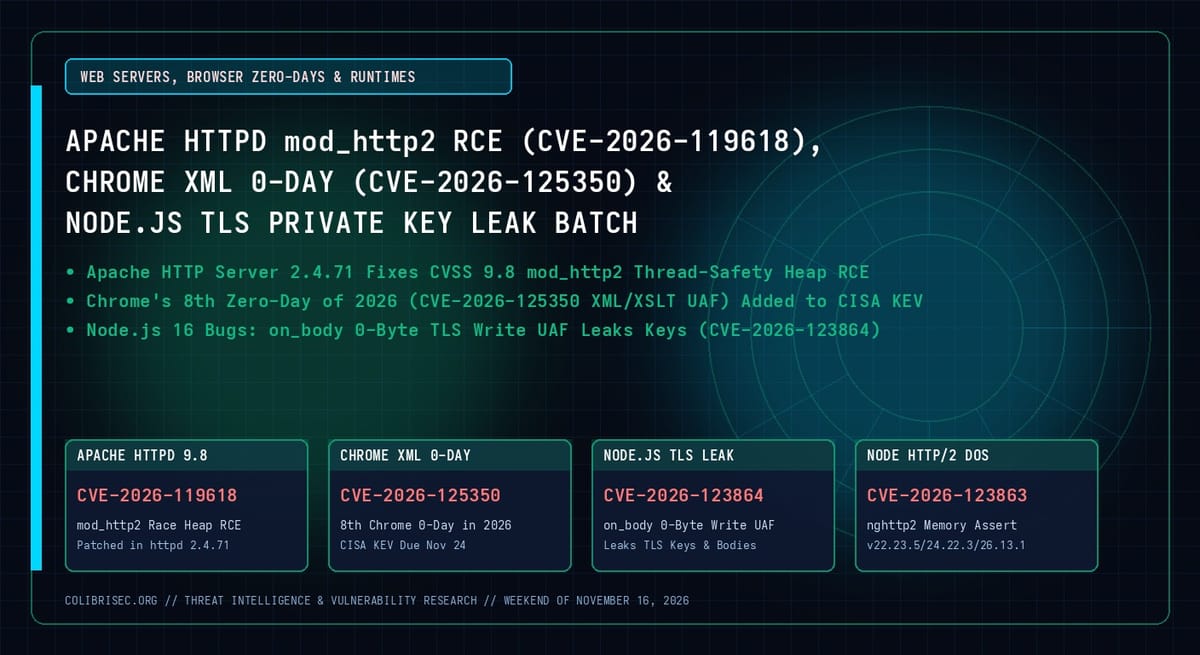
Web infrastructure, enterprise browsers, and JavaScript backend runtimes all required emergency patching this week: the Apache Software Foundation shipped Apache HTTP Server 2.4.71 to close a CVSS 9.8 unauthenticated remote code execution flaw in mod_http2 (CVE-2026-119618); Google patched its eighth actively exploited Chrome zero-day of 2026 in the Chromium XML/XSLT parser (CVE-2026-125350, added to CISA KEV); and the Node.js project released a 16-vulnerability security batch headlined by a high-severity Use-After-Free that leaks TLS private keys and cross-request heap memory (CVE-2026-123864) alongside HTTP/2 nghttp2 teardown crashes.
CVE-2026-119618, CVE-2026-125350, CVE-2026-123864 & CVE-2026-123863 (CWE-362 / CWE-416 (Use-After-Free & Race Condition) & CWE-617 (Reachable Assertion))
Severity: CRITICAL / HIGH (CVSS 9.8 Apache RCE, Active Chrome 0-Day KEV & Node.js TLS Key Leak) (CVSS 9.8 (CVE-2026-119618 Apache mod_http2) / High (CVE-2026-125350 Chrome & CVE-2026-123864 Node.js))
Status: CVE-2026-125350 Actively Exploited in the Wild (CISA KEV Due Nov 24)
Affected Systems: Apache HTTP Server 2.4.55–2.4.70 (mod_http2); Google Chrome / Chromium; Node.js v22, v24 & v26 Lines
Fixed In: Apache httpd 2.4.71; Chrome Stable Update; Node.js v22.23.5, v24.22.3 & v26.13.1
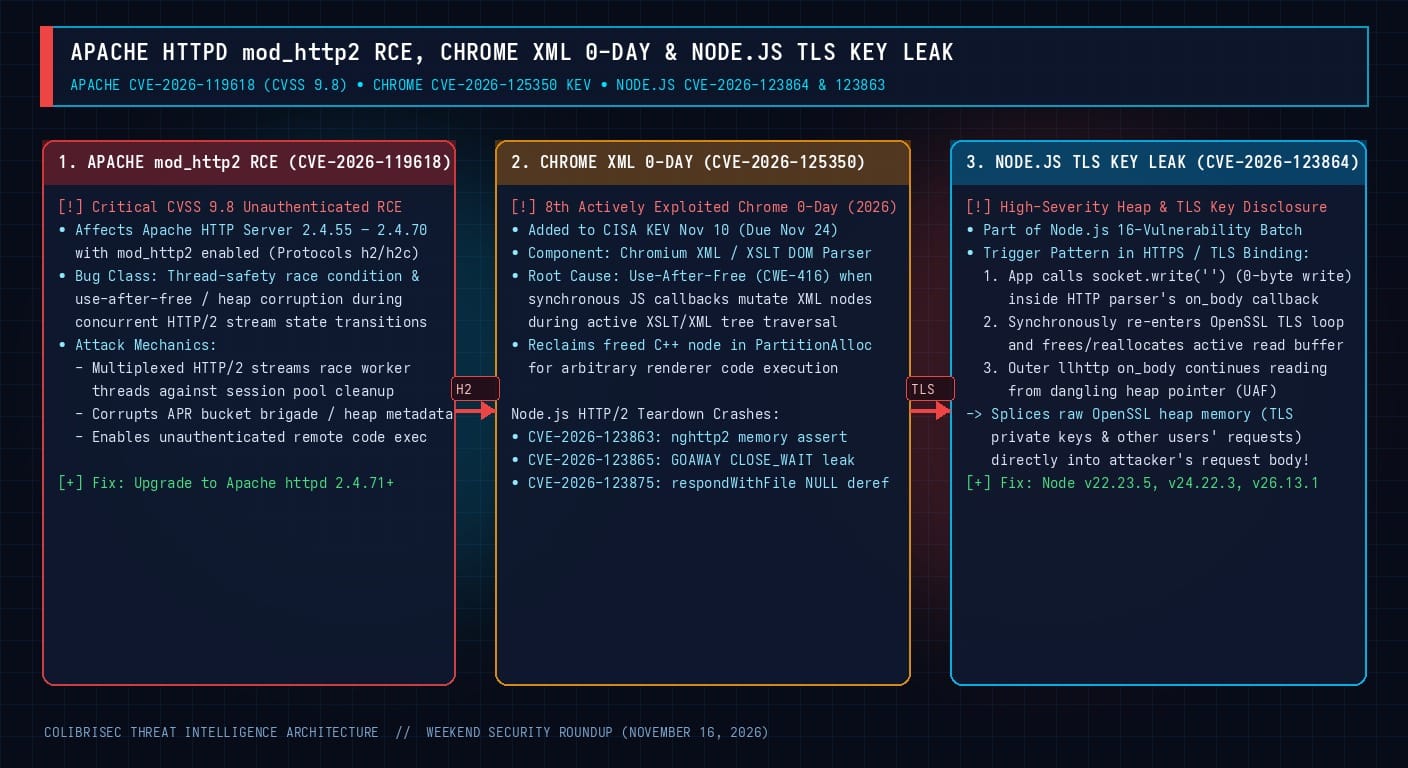
1. Apache HTTP Server mod_http2 Thread-Safety Heap RCE (CVE-2026-119618, CVSS 9.8)
Affecting Apache HTTP Server versions 2.4.55 through 2.4.70 whenever mod_http2 is loaded and enabled (Protocols h2 h2c), CVE-2026-119618 stems from a thread-safety race condition between HTTP/2 session management on the main connection thread and concurrent request worker threads processing multiplexed streams. By rapidly opening, resetting, and closing concurrent HTTP/2 streams with crafted frame sequences, an unauthenticated remote attacker can trigger unsynchronized access to APR memory pools and bucket brigades—corrupting heap metadata and achieving arbitrary code execution as the Apache worker user (www-data / apache). Upgrading to Apache httpd 2.4.71 (or temporarily removing h2/h2c from Protocols directives) is urgent.
2. Google Chrome’s 8th Zero-Day of 2026: XML/XSLT Use-After-Free (CVE-2026-125350 - CISA KEV)
Added to CISA’s KEV catalog on November 10 with a November 24 compliance deadline, CVE-2026-125350 is a high-severity Use-After-Free (CWE-416) in Chromium’s XML/XSLT document parser. When a malicious webpage triggers an XSLT transformation or XML parse event that invokes a synchronous JavaScript callback, the callback can mutate the DOM and free an underlying C++ XML node while the parser still holds an unguarded raw pointer on the stack—allowing attackers to reclaim the PartitionAlloc slot and achieve renderer code execution.
3. Node.js 16-Vulnerability Batch: How a 0-Byte TLS Write Leaks Private Keys (CVE-2026-123864)
Patched across Node.js v22.23.5, v24.22.3, and v26.13.1, the standout vulnerability in Node.js’s November security release is CVE-2026-123864:
- Re-Entrant OpenSSL Buffer Free During
on_body: When a Node.js HTTPS server processes an incoming chunked or streaming request body, the C++ HTTP parser (llhttp) invokes the JavaScripton_bodycallback while holding a pointer to the current TLS cleartext buffer. If application code inside that synchronous callback callssocket.write('')(a 0-byte write on the underlyingTLSSocket), Node.js synchronously re-enters OpenSSL’s I/O loop, which frees or reallocates the active read buffer. - Heap & Private Key Exfiltration: When control returns to the outer
on_bodyframe,llhttpcopies bytes from the now-dangling heap pointer directly into the attacker’sreqbody stream—leaking uninitialized OpenSSL heap chunks that can contain TLS private keys, session tickets, and other users’ concurrent HTTP requests! - HTTP/2
nghttp2Crashes (CVE-2026-123863, CVE-2026-123865 & CVE-2026-123875): The same Node.js update patches a fatal C++ assertion crash (CHECK_EQ(current_nghttp2_memory_, 0)) when an HTTP/2 handler responds before the request body finishes (CVE-2026-123863), a danglingCLOSE_WAITsocket leak afterGOAWAY(CVE-2026-123865), and a NULL pointer dereference inrespondWithFile()(CVE-2026-123875).
# 1. Verify Apache HTTP Server version & check if mod_http2 is active (CVE-2026-119618)
httpd -v || apache2 -v
apachectl -M | grep http2_module
# Temporary mitigation if 2.4.71 cannot be installed immediately:
# Replace "Protocols h2 h2c http/1.1" with "Protocols http/1.1" in httpd.conf / ssl.conf and reload.

# 2. Verify Node.js runtime version >= v22.23.5 / v24.22.3 / v26.13.1 (CVE-2026-123864 & 123863)
node -v
