
MSP RMM Crisis: N-able N-central 33-Bug "Able2Shell", "4EverAble2Shell" Apache Axis RCE (CVE-2026-90436) & "Agent2Shell" Exploits

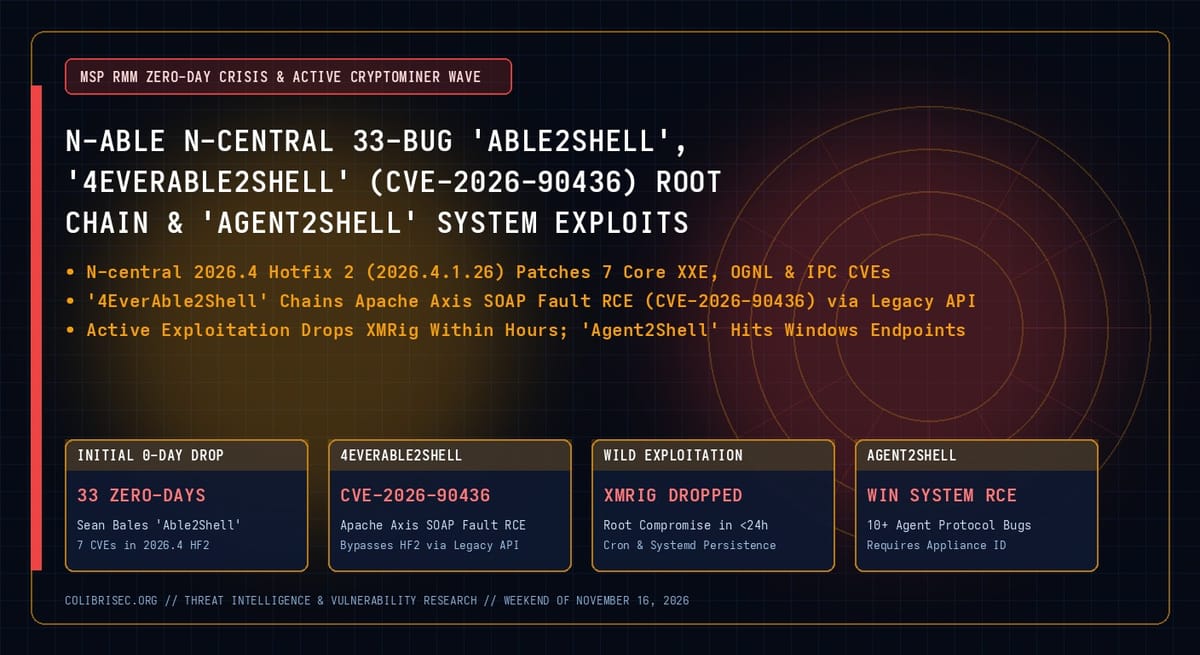
Managed Service Providers (MSPs) and enterprise IT operations running on-premises N-able N-central remote monitoring and management (RMM) servers endured a relentless two-wave zero-day crisis between November 8 and November 15, 2026. After independent researcher Sean Bales (publishing under Oracle-Security / MSPNightmare) released "Able2Shell"—a trove of 33 vulnerabilities that prompted N-able to temporarily shut down its hosted cloud and ship N-central 2026.4 Hotfix 2 (build 2026.4.1.26)—the researcher dropped a follow-up exploit chain named "4EverAble2Shell" (alongside "Agent2Shell") proving that fully patched Hotfix 2 servers with the Legacy API enabled could still be rooted without authentication via Apache Axis 1.x flaw CVE-2026-90436.
CVE-2026-90436, CVE-2026-125878..125883 & CVE-2026-91000 (CWE-502 (Deserialization of Untrusted Data), CWE-611 (XXE), CWE-917 (OGNL Injection) & CWE-269)
Severity: CRITICAL (Unauthenticated Remote Root & Active Cryptominer Exploitation) (CVSS 9.8 (CVE-2026-90436 Apache Axis SOAP Fault RCE))
Status: Actively Exploited in the Wild Within Hours of PoC Publication (Dropping XMRig)
Affected Systems: N-able N-central On-Premises Servers (< 2026.4 HF2 for Able2Shell; 2026.4 HF2 with Legacy API Enabled for 4EverAble2Shell); Atlassian Confluence Data Center (CVE-2026-90436)
Fixed In: N-central 2026.4 Hotfix 2 (2026.4.1.26) + Mandatory Disabling of Legacy API
1. Wave 1: Inside the 33-Bug "Able2Shell" Disclosure & N-central 2026.4 Hotfix 2
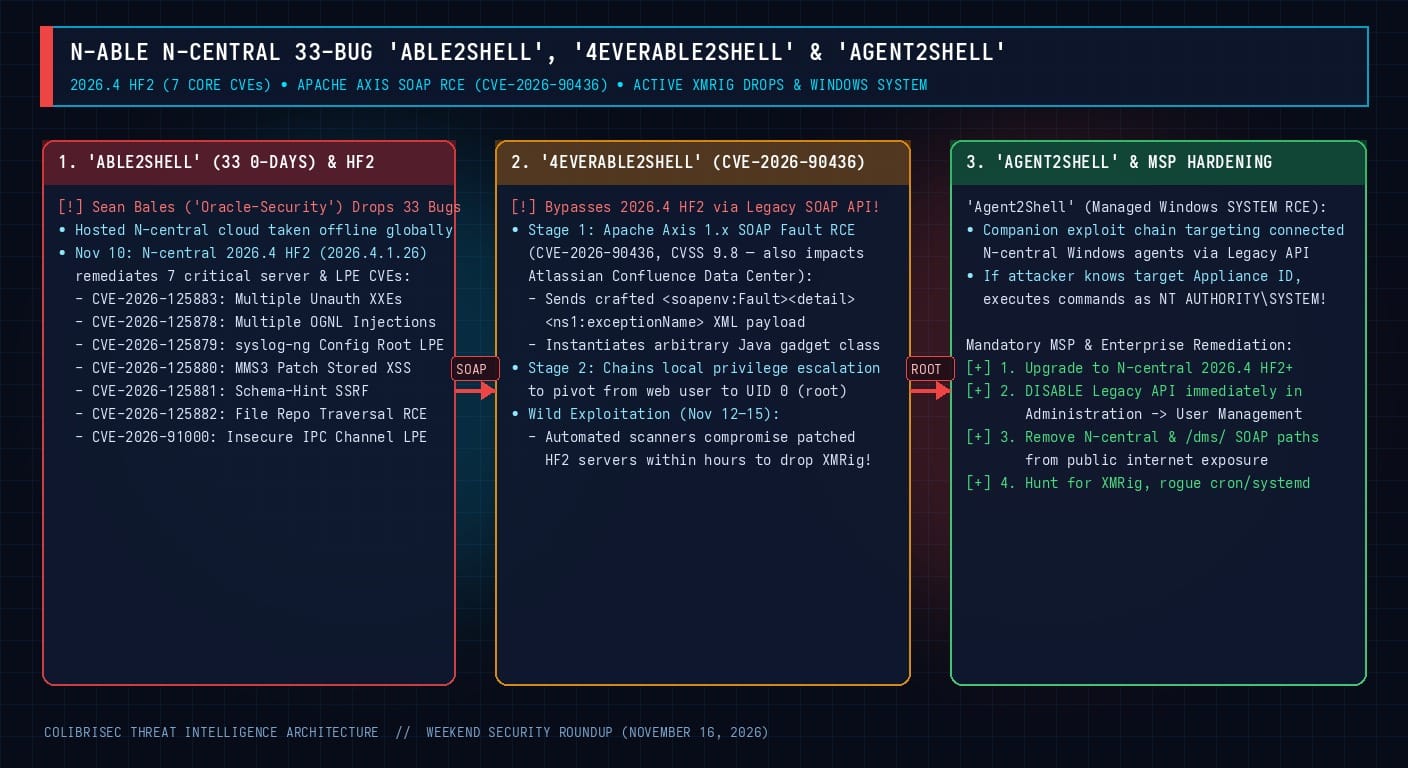
Released on November 10, 2026, N-central 2026.4 Hotfix 2 (2026.4.1.26) addressed seven critical vulnerabilities from the initial Able2Shell disclosure:
CVE-2026-125883(Multiple Unauthenticated XXEs): Improper XML external entity restrictions across N-central web endpoints enabling arbitrary local file read and SSRF.CVE-2026-125878(Multiple OGNL Injections): Expression evaluation flaws permitting remote code execution inside the Java application server context.CVE-2026-125879(syslog-ngConfiguration Root LPE) &CVE-2026-91000(Insecure IPC Channel LPE): Local privilege escalation vectors allowing the low-privileged N-central web service account to inject directives intosyslog-ngor local IPC services running asUID 0 (root).CVE-2026-125880(MMS3 Patch Stored XSS),CVE-2026-125881(Schema-Hint SSRF) &CVE-2026-125882(File Repository Path Traversal RCE): Additional server-side traversal and cross-site scripting vectors.
2. Wave 2: How "4EverAble2Shell" Chains Apache Axis SOAP Fault RCE (CVE-2026-90436) to Root on Patched Servers
On November 11–12, Sean Bales demonstrated that on-premises N-central servers already updated to 2026.4 Hotfix 2 remained vulnerable to unauthenticated root takeover if the optional Legacy API was enabled and reachable:
- Stage 1 — Apache Axis 1.x Inbound SOAP Fault Class Instantiation (CVE-2026-90436): N-central’s Legacy SOAP API (as well as Atlassian Confluence Data Center’s deprecated Remote SOAP API) embeds Apache Axis 1.x. When Axis deserializes an inbound SOAP message containing a
<soapenv:Fault>element,SOAPFaultBuilderinspects the<detail><ns1:exceptionName>element and attempts to dynamically load and instantiate the specified Java class. By supplying gadget classes present on the server classpath, an unauthenticated attacker achieves remote code execution as the web service user. - Stage 2 — Local Privilege Escalation to
root& "Agent2Shell":4EverAble2Shellchains the Axis RCE with an unpatched local privilege escalation vector to obtain fullUID 0 (root)control. Simultaneously, the companionAgent2Shellexploit set targets connected Windows endpoints via the Legacy API, achievingNT AUTHORITYSYSTEMexecution whenever the attacker knows the target’s Appliance ID.
<!-- Conceptual Structure of CVE-2026-90436 Apache Axis Inbound SOAP Fault Probe -->
<soapenv:Envelope xmlns:soapenv="http://schemas.xmlsoap.org/soap/envelope/">
  <soapenv:Body>
    <soapenv:Fault>
      <faultcode>soapenv:Server</faultcode>
      <faultstring>AxisFault</faultstring>
      <detail>
        <ns1:exceptionName xmlns:ns1="http://xml.apache.org/axis/">
          /* Arbitrary Java Class / Deserialization Gadget Instantiation */
        </ns1:exceptionName>
      </detail>
    </soapenv:Fault>
  </soapenv:Body>
</soapenv:Envelope>
3. Threat Telemetry & Mandatory MSP Hardening Steps
Within hours of the 4EverAble2Shell PoC going public on November 12, honeypot and MDR sensors observed automated exploitation installing XMRig cryptocurrency miners via shell scripts, rogue cron jobs, and systemd persistence units on exposed N-central appliances.
# 1. Hunt for 4EverAble2Shell SOAP Fault exploitation & XMRig persistence on N-central servers
grep -rn "exceptionName" /var/log/n-central/ /var/log/httpd/ /var/log/nginx/ 2>/dev/null
ps aux | grep -E "xmrig|kdevtmpfsi|kinsing|curl.*sh|wget.*sh"
crontab -l; ls -la /etc/cron* /etc/systemd/system/

# 2. Mandatory Remediation:
# - Upgrade N-central to 2026.4 Hotfix 2 (2026.4.1.26) immediately
# - Log into N-central UI -> Administration -> User Management -> DISABLE Legacy API
# - Block external internet access to /dms/ and SOAP endpoints at the perimeter firewall/WAF
# - On Atlassian Confluence Data Center, disable "Remote API (XML-RPC & SOAP)" in General Configuration
