
Microsoft Nov 2026 Patch Tuesday (1,235 CVEs) & Zero-Days: Outlook NTLMv2 Leak (CVE-2026-124194), Search/LDAP 9.8 RCEs & CLFS "SignDrop"

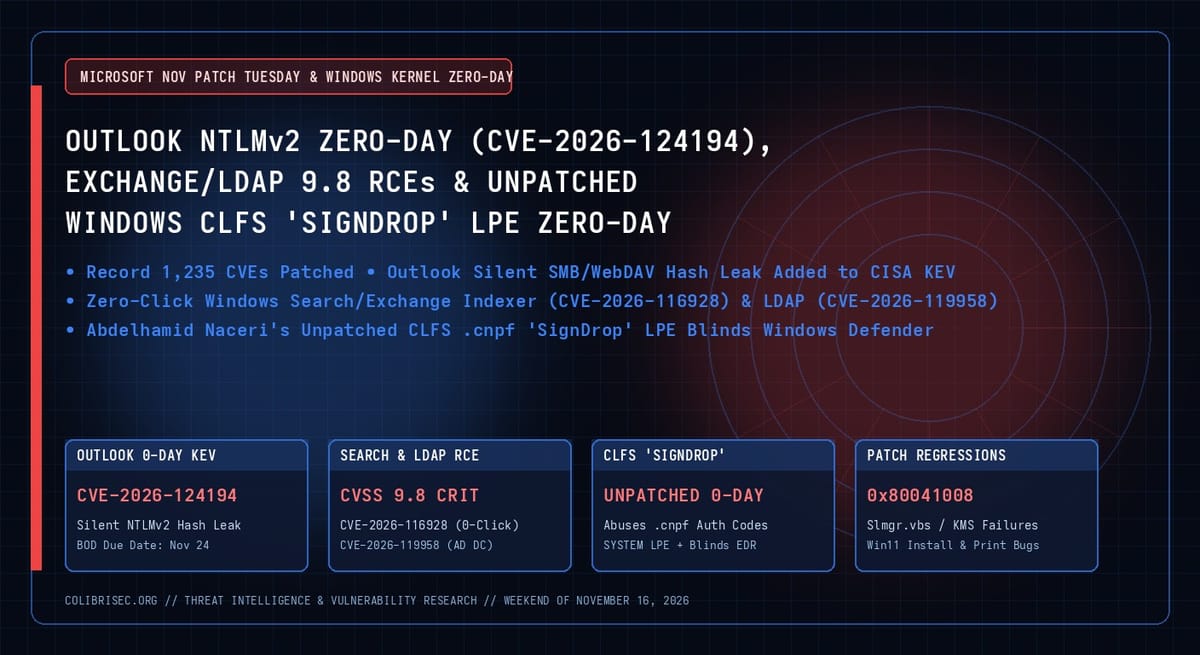
Microsoft’s November 2026 Patch Tuesday rollup shattered historical volume records—addressing between 1,093 and 1,235 CVEs across Microsoft and third-party components (including 64 Critical vulnerabilities)—while enterprise defenders simultaneously confronted an actively exploited Microsoft Outlook zero-day (CVE-2026-124194), two CVSS 9.8 remote code execution flaws in Windows Search/Exchange and Windows LDAP, an unpatched public zero-day in the Windows Common Log File System driver dubbed "SignDrop", and widespread post-patch KMS/slmgr.vbs activation and printing regressions.
CVE-2026-124194, CVE-2026-116928, CVE-2026-119958 & Windows CLFS "SignDrop" 0-Day (CWE-359 / CWE-290 (Outlook Spoofing), CWE-787 (Out-of-Bounds Write) & CWE-345 (CLFS .cnpf Verification))
Severity: CRITICAL (Actively Exploited Outlook Zero-Day, CVSS 9.8 RCEs & Unpatched CLFS LPE) (CVSS 9.8 (CVE-2026-116928 Search/Exchange & CVE-2026-119958 LDAP) / 6.5 (CVE-2026-124194 Outlook KEV))
Status: CVE-2026-124194 Actively Exploited (CISA KEV Due Nov 24); CLFS "SignDrop" Publicly Disclosed Unpatched Zero-Day
Affected Systems: Classic Microsoft Outlook (365, LTSC 2021/2024); Windows Server 2016–2025 & Exchange Server; Windows 10/11 (clfs.sys)
Fixed In: November 10, 2026 Microsoft Security Updates (CLFS SignDrop Pending Patch)
1. Actively Exploited Classic Outlook Zero-Day (CVE-2026-124194 - CISA KEV)
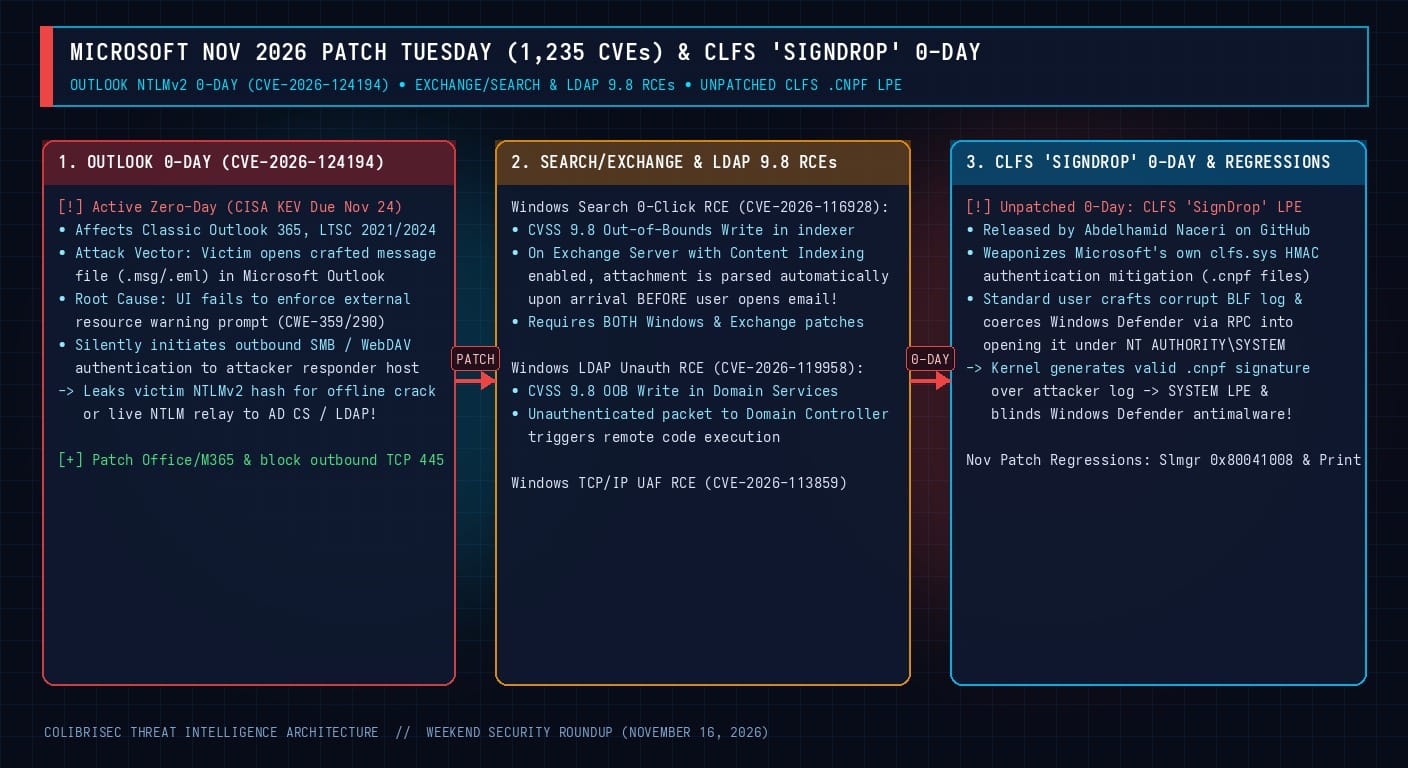
Added to the CISA KEV catalog on November 10 with a federal remediation deadline of November 24, 2026, CVE-2026-124194 affects classic Microsoft Outlook across Microsoft 365 Apps for Enterprise, Office LTSC 2021, and Office LTSC 2024. When a user opens a specially crafted message file, a UI/URI validation flaw bypasses Outlook’s standard external-resource warning dialog and silently initiates an outbound UNC/SMB (TCP 445) or WebDAV connection to a remote attacker-controlled host. That connection automatically transmits the victim’s Net-NTLMv2 authentication hash, enabling offline password cracking or real-time NTLM relay attacks against Active Directory Certificate Services (AD CS ESC8).
2. Zero-Click Windows Search/Exchange RCE (CVE-2026-116928) & Windows LDAP RCE (CVE-2026-119958)
- Zero-Click Exchange Email Indexing RCE (CVE-2026-116928, CVSS 9.8): An out-of-bounds write in the Windows Search Indexer allows arbitrary code execution when indexing a crafted file. Critically, on Microsoft Exchange Servers with Content Indexing enabled, inbound email attachments are indexed automatically upon arrival before the recipient ever views or opens the message—making it a zero-click server RCE. Administrators must apply both the November Windows OS update and the November Exchange Server security update.
- Windows Domain Services LDAP RCE (CVE-2026-119958, CVSS 9.8) & TCP/IP UAF (CVE-2026-113859): An unauthenticated attacker who sends a crafted LDAP request to a Domain Controller can trigger an out-of-bounds write in Windows Lightweight Directory Access Protocol (LDAP) for remote code execution.
3. Inside Abdelhamid Naceri’s Unpatched Windows CLFS "SignDrop" Zero-Day & 0x80041008 Regressions
Days after Patch Tuesday, security researcher Abdelhamid Naceri (Nightmare Eclipse) published a proof-of-concept zero-day exploit named SignDrop targeting clfs.sys. After years of CLFS vulnerabilities, Microsoft had introduced a kernel mitigation requiring Base Log Files (.blf) to be accompanied by a valid HMAC authentication file (.cnpf). SignDrop weaponizes that exact security feature:
- A standard unprivileged user creates a malformed
.blflog structure on disk containing controlled kernel pointer offsets. - Because a standard user cannot compute the kernel HMAC key to forge a
.cnpfsignature, the exploit triggers an RPC call to a high-privilege system service—specifically coercing Windows Defender (running asNT AUTHORITYSYSTEM) into opening and flushing the log file. - When the
SYSTEMprocess touches the log,clfs.sysdutifully generates a valid.cnpfauthentication code over the attacker’s corrupted BLF structure, enabling local privilege escalation toSYSTEMand allowing attackers to blind or terminate Windows Defender!
# 1. Mitigate Outlook NTLMv2 Leak (CVE-2026-124194): Block outbound SMB & restrict NTLM
New-NetFirewallRule -DisplayName "Block-Outbound-SMB-445" -Direction Outbound -Protocol TCP -RemotePort 445,139 -Action Block
Set-ItemProperty -Path "HKLM:SYSTEMCurrentControlSetControlLsaMSV1_0" -Name "RestrictSendingNTLMTraffic" -Value 2

# 2. Hunt for Windows CLFS "SignDrop" Zero-Day (.blf / .cnpf creation in user-writable temp dirs)
Get-ChildItem -Path C:Users*, C:WindowsTemp* -Include *.blf, *.cnpf -Recurse -Force -ErrorAction SilentlyContinue

# 3. Note on November Patch Tuesday Slmgr.vbs / KMS 0x80041008 Regression:
# If automated KMS/MAK scripts fail with WMI error 0x80041008 after KB installation,
# deploy Microsoft's Known Issue Rollback (KIR) / out-of-band licensing hotfix.
