
U.S. Public Sector & Healthcare Cyber Crisis: UNM Health Level-I Trauma Diversion ("Byod"), FEC 41-Hour Pre-Midterm Outage & Ohio Auditor Intrusion


With the 2026 U.S. midterm elections only days away, the final week of October saw a wave of high-visibility cyberattacks targeting American healthcare delivery, federal campaign-finance transparency, state financial oversight, and public education. Between October 25 and October 28, 2026, simultaneous incidents struck the University of New Mexico Health System (UNM Health), the U.S. Federal Election Commission (FEC), the Ohio Auditor of State, and Barbour County Schools in West Virginia. From a two-hour ambulance diversion at New Mexico’s only Level-I trauma hospital and bizarre extortion stunts by the emerging "Byod" syndicate, to a 41-hour outage of the FEC’s electronic campaign-finance filing portal during the final pre-election disclosure sprint, here is a forensic and operational breakdown of the week’s public-sector incidents.
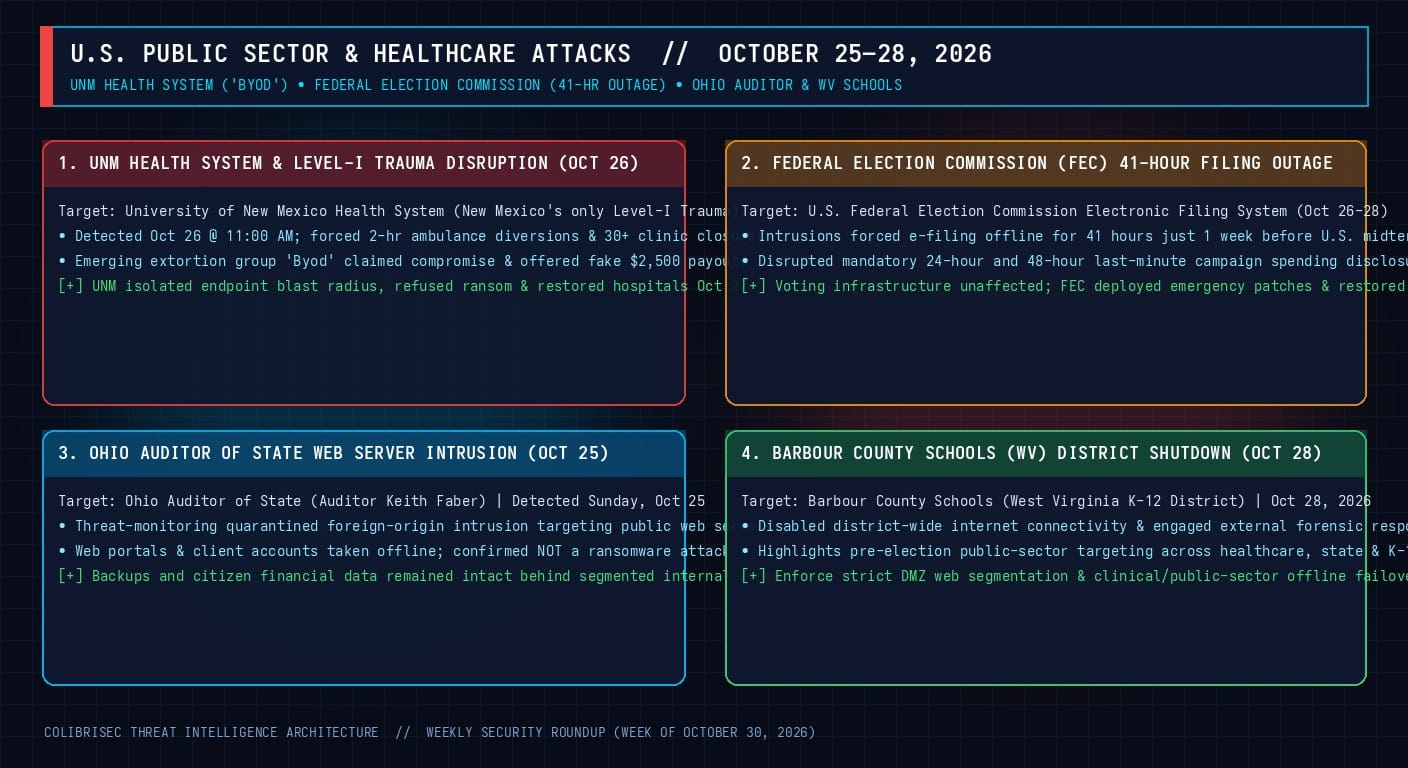
1. UNM Health System & New Mexico’s Level-I Trauma Center vs. "Byod" (October 26–28)
At approximately 11:00 AM on Monday, October 26, 2026, security monitoring teams at the University of New Mexico (UNM) Health System and UNM Health Sciences Center detected an active cyber threat on their network and immediately triggered emergency containment protocols, severing clinical and academic network segments.
Clinical Impact & Rapid Containment
Because UNM Hospital in Albuquerque operates New Mexico’s only Level-I trauma center, taking clinical IT systems offline created immediate regional healthcare pressure:
- Two-Hour Ambulance Diversion: Emergency medical services were temporarily diverted to neighboring facilities (including Presbyterian Healthcare Services and Lovelace Health System) for roughly two hours on Monday while clinical safety workarounds were verified.
- 30+ Outpatient Clinics Paused: Over 30 outpatient clinics suspended non-emergent appointments and elective procedures for the remainder of Monday, and Health Sciences classes were paused through Tuesday.
- Core Servers Protected: Because UNM’s SOC isolated the blast radius early, university leadership confirmed that while certain end-user workstations were affected, core hospital servers and EHR databases were not penetrated, enabling hospitals and clinics to resume normal scheduling by Tuesday, October 27.
The "Byod" Syndicate’s Psychological Extortion Stunt
Shortly after the outage became public, a nascent ransomware and extortion group calling itself "Byod" listed UNM on its Tor leak site, boasting that it had compromised thousands of network nodes and exfiltrated Social Security numbers, HR/payroll files, student records, and patient data. Then, in a calculated PR and psychological manipulation tactic rarely seen since the 2021–2024 hospital ransomware backlash, Byod posted a follow-up notice claiming that upon realizing they had disrupted real-time hospital care, they would provide free decryption keys for the medical sector and even offered "up to $2,500 in compensation" directly to inconvenienced UNM patients!
2. Federal Election Commission (FEC) 41-Hour E-Filing Outage One Week Before Midterms
Late on Monday, October 26, 2026—just one week before the U.S. midterm elections—the Federal Election Commission (FEC) detected active intrusion attempts targeting its public-facing infrastructure and took its electronic campaign-finance filing system completely offline.
- The 41-Hour Transparency Blind Spot: In the final days before a federal election, political action committees (PACs), Super PACs, and candidate campaigns are legally required to file rapid 24-hour and 48-hour notices disclosing last-minute independent expenditures and large donations ($1,000+). The 41-hour outage prevented campaigns from submitting electronic disclosures until the system was restored on Wednesday, October 28, drawing intense scrutiny from election watchdog groups.
- Zero Impact on Voting Infrastructure: Federal officials emphasized that the FEC is purely a campaign-finance regulatory agency and does not administer voter registration, ballots, or vote tabulation—which remain decentralized across state and county election boards.
3. Ohio Auditor of State (Oct 25) & Barbour County Schools, WV (Oct 28)
- Ohio Auditor of State Quarantine: On Sunday, October 25, Ohio State Auditor Keith Faber disclosed that automated threat-monitoring systems detected and quarantined a cyberattack orchestrated by overseas threat actors targeting the office’s public web server. The office proactively took its web portal and online client accounts offline for forensic verification, confirming that it was not a ransomware attack, backups were intact, and no citizen financial data or local government audit records were compromised.
- Barbour County Schools (West Virginia): On Wednesday, October 28, Barbour County Schools shut down district-wide internet connectivity across all campuses after detecting suspicious network activity, engaging external incident response specialists to audit domain and endpoint integrity.
Public-Sector & Healthcare Resilience Takeaways
- Pre-Scripted Clinical Downtime & Break-Glass Segmentation: Healthcare CISOs should replicate UNM Health’s rapid network containment model—ensuring that isolating workstation VLANs immediately upon endpoint alert prevents lateral encryption of core Epic/Cerner EHR and PACS databases.
- Harden High-Visibility Public Filing Portals: Public-sector agencies operating time-critical statutory filing portals during election windows should deploy read-only static CDN caching for public searches while isolating authenticated upload parsers inside ephemeral, WAF-shielded microVMs.

