
Security Roundup: PHP2Shell + Fragnesia Kernel Chains, Cisco & GitLab KEV Zero-Days, Linux MPTCP UAF, Cursor Claude Code Backdoor & $6.36B Binance EIP-7702 Heist (Week of October 30, 2026)


Executive Summary: The final week of October 2026 (October 24–30, 2026) has cemented "Black October" as the most volatile month in modern cybersecurity history. Over the past seven days, threat actors bridged the gap between AI-discovered runtime bugs and kernel-level infrastructure takeovers, chaining the pre-authentication PHP2Shell vulnerabilities (CVE-2026-109618 and CVE-2026-109619, added to the CISA KEV catalog on October 26) with the Linux kernel "Fragnesia" page-cache corruption local privilege escalation flaw (CVE-2026-46300, added to CISA KEV on October 28) to gain root control over at least 25 enterprise firewall management planes and government-affiliated servers across the U.S., Japan, Taiwan, and South Korea. Simultaneously, CISA and vendors issued emergency alerts for a wave of actively exploited zero-days and critical flaws: Cisco Secure Firewall ASA and FTD SSL VPN Denial-of-Service reload loops (CVE-2026-76418, CVSS 8.6), a maximum-severity CVSS 10.0 GitLab CE/EE integer overflow RCE in CI/CD pipeline regex parsing (CVE-2026-97229), and a stealthy VMware ESXi audit-log suppression zero-day (CVE-2026-41709) weaponized by China-nexus espionage group Warp Panda against U.S. law firms. At the operating-system and developer layer, researchers disclosed CVE-2026-98432 (CVSS 9.8), a race-condition Use-After-Free in the Linux kernel’s TCP/MPTCP connection setup where Anthropic’s Claude model autonomously synthesized a KASLR bypass and remote root exploit in under 60 minutes; and on October 29, a supply-chain compromise of the Cursor IDE marketplace distributed a trojanized build of anthropic.claude-code (v2.1.313) to roughly 5,000 developers, planting an unauthorized svc-telemetry SSH key and beaconing secrets to 134.209.82.225:8099. Finally, on the evening of October 29, North Korea’s TraderTraitor (Lazarus Group) executed the largest financial heist in history, draining $6.36 billion from Binance hot wallets across 10 blockchains in 20 minutes by weaponizing Ethereum Pectra EIP-7702 smart-contract delegation—while public-sector and corporate attacks disrupted the University of New Mexico Health System, the Federal Election Commission (FEC), the Ohio Auditor of State, Susman Godfrey LLP, and Japanese materials giant Proterial. Below is your complete executive briefing and links to all nine technical deep dives.
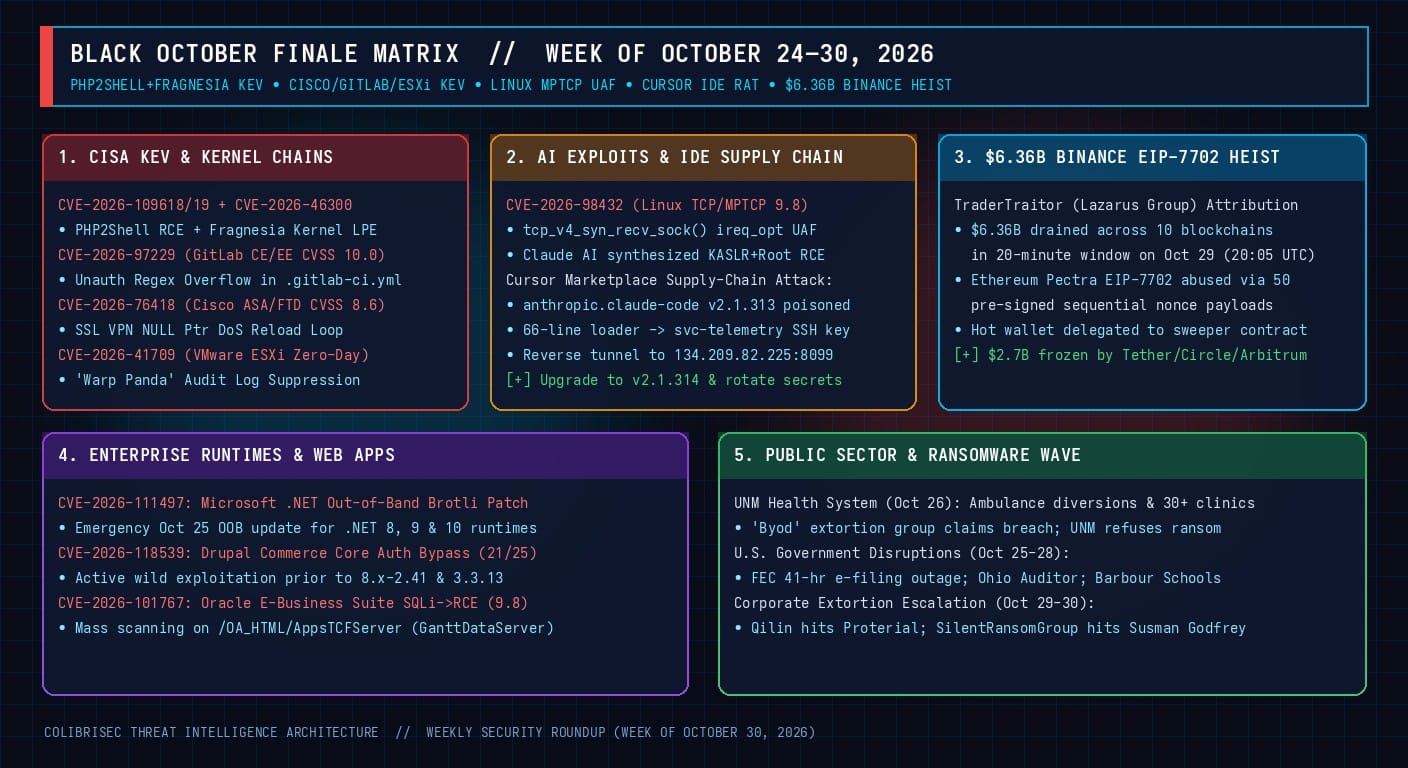
Key Threat Disclosures & Incidents at a Glance
1. Active In-the-Wild Chaining: PHP2Shell (CVE-2026-109618/19) + Linux Kernel "Fragnesia" (CVE-2026-46300)
What began in mid-October as a standalone runtime disclosure escalated this week into a full-scale infrastructure takeover campaign. On October 26, CISA added both PHP2Shell vulnerabilities—CVE-2026-109618 and CVE-2026-109619 (CVSS 9.2)—to the Known Exploited Vulnerabilities (KEV) catalog. Within 48 hours, threat intelligence teams at Palo Alto Networks Unit 42, Wiz, and Dream revealed that a sophisticated China-nexus threat actor began deploying custom exploit binaries on October 25 that chain PHP2Shell directly with CVE-2026-46300 (CVSS 7.8, dubbed "Fragnesia"), a local privilege escalation flaw in the Linux kernel’s XFRM ESP-in-TCP and socket buffer coalescing logic (skb_try_coalesce()). Because skb_try_coalesce() fails to preserve the SKBFL_SHARED_FRAG flag on page-cache-backed fragments, in-place ESP decryption allows an unprivileged www-data or nobody web shell to overwrite read-only host page cache structures (such as /etc/passwd or shared libraries) and immediately escalate to root. Telemetry confirmed at least 25 high-value firewall management interfaces and enterprise servers across the U.S. (including government-affiliated networks), Japan, Taiwan, and South Korea were rooted via this chain to extract Active Directory credentials, prompting CISA to add CVE-2026-46300 to the KEV catalog on October 28.
2. CISA KEV Zero-Days & Critical Mandates: Cisco ASA/FTD (CVE-2026-76418), GitLab 10.0 (CVE-2026-97229) & VMware ESXi "Warp Panda" (CVE-2026-41709)
Alongside the PHP2Shell and Fragnesia directives, CISA and major infrastructure vendors issued urgent remediation mandates for three high-impact vulnerabilities exploited in the wild during the final week of October:
- Cisco Secure Firewall ASA & FTD Zero-Day (CVE-2026-76418, CVSS 8.6): Disclosed by Cisco on October 28 and immediately added to CISA KEV, this unchecked return value to NULL pointer dereference (CWE-690) affects Remote Access SSL VPN services configured with secondary authentication on a tunnel group. Unauthenticated attackers are actively sending crafted SSL VPN requests to force enterprise firewalls into continuous reload loops, severing corporate VPN connectivity.
- GitLab CE/EE CVSS 10.0 Unauthenticated RCE (CVE-2026-97229): Added to CISA KEV following active exploitation, this critical integer overflow/wraparound vulnerability (CWE-190) in GitLab Community and Enterprise Edition (19.2 prior to
19.2.8, 19.3 prior to19.3.5, and 19.4 prior to19.4.2) allows unauthenticated attackers to execute arbitrary code on the underlying GitLab host via crafted regular expressions inside CI/CD pipeline configurations (.gitlab-ci.yml). - VMware ESXi "Warp Panda" Zero-Day (CVE-2026-41709): Added to CISA KEV on October 28 after joint CrowdStrike and CISA disclosures revealed that China-nexus espionage group Warp Panda exploited this ESXi insufficient logging vulnerability (CWE-778) as a zero-day against U.S. law firms, technology vendors, and manufacturers. While carrying a low base CVSS score (2.7) because it requires administrative privileges, Warp Panda weaponized it after pivoting from edge devices to vCenter/ESXi to suppress hypervisor audit trails while deploying custom backdoors—including BRICKSTORM, Junction, and GuestConduit.
3. Linux Kernel TCP/MPTCP Race Use-After-Free (CVE-2026-98432, CVSS 9.8) & <1-Hour AI Exploit Synthesis
In one of the most consequential operating-system disclosures of the year, kernel maintainers and AI safety researchers detailed CVE-2026-98432 (CVSS 9.8 Critical), a remote Use-After-Free (UAF) race condition in the Linux kernel’s IPv4 TCP connection setup code (tcp_v4_syn_recv_sock()). Introduced historically around Linux 4.4 and exposed by modern lockless SYN processing, tcp_v4_syn_recv_sock() transfers ownership of the IP options pointer (ireq->ireq_opt) directly to the child socket without copying it, while concurrent CPUs processing retransmitted SYNs or request socket migrations free the structure via a plain kfree() rather than waiting for an RCU grace period (kfree_rcu()). The vulnerability is acutely exploitable over the network against hosts running Multipath TCP (MPTCP) listeners—a risk vastly amplified by the fact that modern runtimes like Go 1.24+ enable MPTCP by default on listening sockets. Crucially, Anthropic researchers demonstrated that their Claude model autonomously analyzed the vulnerability, constructed a remote KASLR pointer leak, and synthesized a working root code-execution exploit chain in under 60 minutes.
4. Cursor IDE Marketplace Supply-Chain Compromise: Trojanized Claude Code v2.1.313
On Thursday, October 29, 2026, between 02:27 AM PT and 01:35 PM PT (an 11-hour exposure window), a supply-chain attack hit the Cursor IDE extension marketplace and Open-VSX ecosystem. An unauthorized build of the official Anthropic Claude Code extension—anthropic.claude-code version 2.1.313 (which Cursor confirmed was neither built nor released by Anthropic)—was served to approximately 5,000 developers with extension auto-updates enabled before being replaced by clean version 2.1.314. Forensics by StepSecurity and Cursor revealed that a 66-line malicious JavaScript loader was stitched into extension.js. Upon activation across macOS, Linux, and Windows workstations, the payload appended an attacker-controlled SSH public key labeled svc-telemetry into ~/.ssh/authorized_keys, registered 60-second persistence jobs (macOS LaunchAgents, Linux crontab, and Windows schtasks), attempted to open a reverse SSH tunnel, and exfiltrated host telemetry alongside environment variables matching KEY, TOKEN, SECRET, PASS, AWS, or GCP over plain HTTP POST to 134.209.82.225:8099.
5. The $6.36 Billion Binance Multi-Chain Heist: TraderTraitor Weaponizes Ethereum Pectra EIP-7702
At approximately 20:05 UTC on October 29, 2026, cryptocurrency exchange Binance suffered the largest cyber-enabled financial heist on record, with attackers draining roughly $6.36 billion from hot wallets across 10 blockchains inside a 20-minute window. Blockchain intelligence firms TRM Labs and Chainalysis attributed the operation with high confidence to North Korea’s state-sponsored TraderTraitor (Lazarus Group) unit. While Binance’s preliminary report noted that attackers pivoted from a compromised DevOps engineer’s laptop into internal service containers without extracting raw private keys, on-chain forensics demonstrated how the attackers subverted the hot-wallet signing pipeline. On Ethereum, TraderTraitor weaponized EIP-7702 (Transaction Type 0x04, introduced in the Pectra upgrade to let Externally Owned Accounts temporarily delegate code execution to a smart contract). The attackers generated a batch of 50 pre-signed EIP-7702 authorization tuples with sequential nonces in advance so that one would match the live transaction count of Binance’s hot wallet—instantly transforming the custodial EOA into an automated attacker-controlled sweeper contract. Rapid coordination by Tether, Circle, Ripple, and the Arbitrum Security Council successfully froze $2.7 billion on-chain, while Binance pledged to cover all remaining losses via corporate reserves and its SAFU fund.
6. Enterprise Application Wave: Microsoft .NET OOB Brotli (CVE-2026-111497), Drupal Commerce Core (CVE-2026-118539) & Oracle EBS (CVE-2026-101767)
Enterprise application teams faced three urgent patching emergencies between October 25 and October 30:
- Microsoft .NET Out-of-Band Brotli Update (CVE-2026-111497): Following the polyglot HTTP2Shell / Broccoli2Shell disclosures in Google’s native Brotli decoder (
c/dec/decode.c), Microsoft took the rare step on October 25 of issuing an emergency out-of-band (OOB) security update across .NET 8, .NET 9, and .NET 10 runtimes and NuGet packages to prevent unauthenticated heap buffer overflows during Brotli decompression. - Drupal Commerce Core Active Auth Bypass (CVE-2026-118539 / SA-CONTRIB-2026-254): On October 28, the Drupal Security Team warned that threat actors are actively exploiting a "Highly Critical" (21/25 risk score) missing authorization vulnerability (CWE-862) in Drupal Commerce Core (versions
2.x < 8.x-2.41and3.x < 3.3.13), allowing unauthenticated forceful browsing to read and modify non-public shopping cart routes, order entities, and payment states. - Oracle E-Business Suite SQLi-to-RCE Mass Scanning (CVE-2026-101767, CVSS 9.8): Discovered by Horizon3.ai and patched in Oracle’s October 20 CPU, this unauthenticated SQL injection flaw in the Oracle EBS (12.2.3–12.2.15) Thin Client Framework servlet (
/OA_HTML/AppsTCFServer/GanttDataServer) executes SQL as the privilegedAPPSdatabase user and chains to OS command execution. Threat intelligence honeypots recorded aggressive global mass scanning targeting this endpoint throughout the week.
7. U.S. Public Sector & Healthcare Disruptions: UNM Health ("Byod"), FEC 41-Hour Outage, Ohio Auditor & Barbour County Schools
With U.S. midterm elections just days away, public-sector, election-transparency, and healthcare networks experienced a concentrated wave of disruptive cyberattacks between October 25 and October 28:
- University of New Mexico Health System (UNM Health): On Monday morning, October 26, a cyberattack forced New Mexico’s only Level-I trauma center to divert ambulances for two hours and suspend outpatient surgeries and appointments across more than 30 clinics. The emerging extortion group "Byod" claimed responsibility on its leak portal—and bizarrely offered to hand over hospital decryption keys and pay $2,500 to inconvenienced patients after realizing it had disrupted acute patient care. UNM leadership confirmed core servers were protected, refused any ransom or negotiation, restored clinical operations on October 27, and warned patients against secondary "compensation" phishing scams.
- Federal Election Commission (FEC) 41-Hour E-Filing Outage: Late on October 26, intrusion attempts forced the FEC to take its electronic campaign-finance filing system offline for roughly 41 hours right in the final week before the U.S. midterm elections—temporarily halting mandatory 24-hour and 48-hour last-minute campaign spending disclosures (though actual ballot and voting infrastructure is entirely separate and unaffected).
- Ohio Auditor of State & Barbour County Schools (WV): On Sunday, October 25, Ohio State Auditor Keith Faber announced that threat-monitoring sensors quarantined an overseas cyberattack targeting the office’s web servers, prompting a precautionary shutdown of web portals (confirmed not to be ransomware, with citizen data intact). On October 28, Barbour County Schools in West Virginia disabled district-wide internet connectivity to contain an active cyber incident alongside forensic specialists.
8. Corporate & Legal Extortion Surge: SilentRansomGroup Hits Susman Godfrey LLP & Qilin Hits Proterial
Rounding out the week on October 28–30, ransomware and data-extortion syndicates escalated attacks against legal, manufacturing, and academic targets. On October 30, SilentRansomGroup (SRG)—also tracked as Luna Moth or Chatty Spider, notorious for IT helpdesk callback phishing and deploying legitimate RMM tools (Syncro, SuperOps, Atera, AnyDesk) for pure data exfiltration—listed elite U.S. trial and litigation law firm Susman Godfrey LLP on its extortion portal alongside additional U.S. corporate targets. On October 29, the Qilin ransomware group added Japanese high-performance materials manufacturer Proterial, Ltd. (formerly Hitachi Metals, a critical supplier to aerospace, automotive, and electronics supply chains) to its leak site. Meanwhile, Rhysida and N0n listed international academic institutions including INTI International University and Colleges.
Dedicated Technical Deep Dives in This Weekly Series
- Weaponized in the Wild: How Threat Actors Chain PHP2Shell (CVE-2026-109618/19) with Linux Kernel "Fragnesia" (CVE-2026-46300) for Root Takeover: Kernel-level analysis of how PHP2Shell (CVE-2026-109618/19) web shells trigger
skb_try_coalesce()shared-fragment corruption in Linux XFRM ESP-in-TCP (CVE-2026-46300) to overwrite read-only page cache and root enterprise firewalls. - CISA KEV Zero-Day Directives: Cisco ASA/FTD SSL VPN DoS (CVE-2026-76418), GitLab CVSS 10.0 RCE (CVE-2026-97229) & VMware ESXi "Warp Panda" Log Suppression (CVE-2026-41709): Dissecting Cisco ASA/FTD SSL VPN secondary-authentication NULL pointer crashes, GitLab 19.x
.gitlab-ci.ymlregex integer wraparound, and CrowdStrike’s telemetry on Warp Panda’s ESXi audit-log blinding (BRICKSTORM, Junction & GuestConduit). - CVE-2026-98432 (CVSS 9.8): Inside the Linux Kernel TCP/MPTCP Race Use-After-Free & How Claude Synthesized a Remote Root Exploit in Under 60 Minutes: Code-level walkthrough of
tcp_v4_syn_recv_sock()uncopiedireq_optownership, why Go 1.24+ default MPTCP listeners expand the remote attack surface, and how Claude built a working KASLR-bypassing root exploit in under an hour. - Cursor Marketplace Supply-Chain Compromise: Dissecting the Trojanized Claude Code v2.1.313 Extension, svc-telemetry SSH Key & 134.209.82.225 C2: Deobfuscating the 66-line JavaScript loader injected into
anthropic.claude-codev2.1.313, hunting thesvc-telemetrySSH key across developer laptops, and blocking C2 traffic to134.209.82.225:8099. - Anatomy of the $6.36 Billion Binance Multi-Chain Heist: How TraderTraitor Weaponized Ethereum Pectra EIP-7702 Pre-Signed Nonce Tuples: On-chain and cryptographic breakdown of TraderTraitor’s $6.36B sweep across 10 blockchains, how 50 pre-signed EIP-7702 (
0x04) authorization tuples hijacked Binance’s EOA hot wallet, and how $2.7B was frozen. - Enterprise Stack Under Siege: Microsoft .NET Out-of-Band Brotli Patch (CVE-2026-111497), Drupal Commerce Core Auth Bypass (CVE-2026-118539) & Oracle EBS SQLi (CVE-2026-101767): Remediating Microsoft’s emergency October 25 .NET 8/9/10 Brotli buffer overflow, patching Drupal Commerce Core’s actively exploited route access bypass (SA-CONTRIB-2026-254), and blocking Oracle EBS
/OA_HTML/AppsTCFServerSQLi probes. - U.S. Public Sector & Healthcare Cyber Crisis: UNM Health Level-I Trauma Diversion ("Byod"), FEC 41-Hour Pre-Midterm Outage & Ohio Auditor Intrusion: Incident response lessons from UNM Health’s Level-I trauma diversion and "Byod" extortion refusal, the FEC’s 41-hour campaign-finance filing outage ahead of the U.S. midterms, and the Ohio Auditor web server quarantine.
- Corporate & Legal Extortion Wave: SilentRansomGroup Targets Susman Godfrey LLP, Qilin Hits Proterial (Hitachi Metals) & Rhysida Academic Breaches: Analyzing SilentRansomGroup’s vishing/RMM intrusion model against Susman Godfrey LLP, Qilin’s manufacturing supply-chain extortion of Proterial, and why law firms face dual APT (Warp Panda) and extortion (SRG) targeting.
- CISO Defense Blueprint for the "Black October" Finale: Kernel MPTCP/Fragnesia Shields, IDE Extension Governance, ESXi Audit Heartbeats & EIP-7702 Custody Controls: Production engineering controls:
sysctlandnftablesrules for Linux MPTCP/Fragnesia, IDE extension allowlisting andauthorized_keysFIM, ESXi immutable syslog heartbeats, and HSM policy blocks for EIP-7702 (0x04).
Mandatory Friday Action Checklist for CISOs & SecOps Teams
- Break the PHP2Shell + Fragnesia Root Chain (CISA KEV Oct 26 & 28): Upgrade PHP to 8.5.12, 8.4.27, 8.3.36, or 8.2.35 (and set
session.upload_progress.enabled = 0), patch all Linux kernels for CVE-2026-46300 (Fragnesia), and immediately audit internet-facing firewall management interfaces and web servers for unexpected root processes or modified page-cache binaries. - Remediate Cisco ASA/FTD, GitLab 10.0 & VMware ESXi KEV Zero-Days: Upgrade Cisco ASA (9.20.4.50 / 9.24.1.27+) and FTD (7.4.9 / 7.6.7+) to stop CVE-2026-76418 SSL VPN crash loops; upgrade GitLab CE/EE immediately to 19.4.2, 19.3.5, or 19.2.8 (CVE-2026-97229); and apply Broadcom’s ESXi patch for CVE-2026-41709 while alerting on any gap in hypervisor
hostd/vpxasyslog delivery. - Neutralize Linux Kernel TCP/MPTCP UAF (CVE-2026-98432): Deploy vendor kernel packages containing the
kfree_rcu()fix forireq_opt. Until hosts can reboot, disable Multipath TCP (sysctl -w net.mptcp.enabled=0) and request migration (sysctl -w net.ipv4.tcp_migrate_req=0), especially on servers running Go 1.24+ binaries. - Sweep Developer Workstations for Cursor Claude Code v2.1.313 Compromise: Verify all Cursor IDE instances are updated to
anthropic.claude-codev2.1.314+. Search every developer machine’s~/.ssh/authorized_keysfor thesvc-telemetrypublic key, inspect macOSLaunchAgents/ Linuxcrontab/ Windowsschtasks, block egress to134.209.82.225:8099, and rotate all workstation cloud/API secrets. - Patch .NET OOB Brotli, Drupal Commerce Core & Oracle EBS: Apply Microsoft’s October 25 out-of-band .NET 8/9/10 runtime updates (CVE-2026-111497), upgrade Drupal Commerce Core to 8.x-2.41 or 3.3.13+ (CVE-2026-118539), and patch Oracle E-Business Suite (CVE-2026-101767) while blocking external access to
/OA_HTML/AppsTCFServer. - Enforce EIP-7702 Custody Controls & Block Unauthorized RMM Tools: For Web3 and institutional treasury teams, update MPC/HSM signing policies to explicitly reject Ethereum Transaction Type
0x04(EIP-7702 SetCode) on custodial EOAs. For legal, healthcare, and public-sector networks, enforce WDAC/AppLocker blocks against unapproved RMM tools (Syncro, SuperOps, Atera, AnyDesk) abused by SilentRansomGroup.
Reference Citations & Primary Advisories
- CISA Known Exploited Vulnerabilities (KEV) Catalog (October 26–30, 2026): Additions of CVE-2026-109618 & CVE-2026-109619 (PHP2Shell), CVE-2026-46300 (Linux Kernel "Fragnesia"), CVE-2026-76418 (Cisco Secure Firewall ASA/FTD), CVE-2026-97229 (GitLab CE/EE), and CVE-2026-41709 (Broadcom VMware ESXi).
- Palo Alto Networks Unit 42, Wiz & Dream Threat Intelligence Reports (October 25–29, 2026): In-the-Wild Chaining of PHP2Shell RCE and Linux Kernel Fragnesia LPE Against Enterprise Firewalls and Government-Affiliated Servers.
- CrowdStrike Threat Intelligence & Broadcom VMware Security Advisory: Warp Panda Zero-Day Exploitation of VMware ESXi CVE-2026-41709 for Audit Trail Suppression and BRICKSTORM / GuestConduit Deployment.
- Linux Kernel Security Advisory & Anthropic Frontier Red-Team Report: CVE-2026-98432 (CVSS 9.8) IPv4 TCP/MPTCP ireq_opt Race Use-After-Free and Autonomous Exploit Synthesis.
- Cursor Security Incident Disclosure & StepSecurity Forensic Analysis (October 29–30, 2026): Supply-Chain Compromise of anthropic.claude-code v2.1.313 on Open-VSX / Cursor Marketplace (svc-telemetry SSH Backdoor & 134.209.82.225 C2).
- TRM Labs, Chainalysis & Binance Security Advisories (October 29–30, 2026): On-Chain Forensics of the $6.36 Billion Multi-Chain Hot Wallet Exploit, TraderTraitor Attribution, and Ethereum Pectra EIP-7702 Pre-Signed Nonce Abuse.
- Microsoft Out-of-Band Security Update, Drupal Security Advisory SA-CONTRIB-2026-254 & Horizon3.ai Research: CVE-2026-111497 (.NET Brotli), CVE-2026-118539 (Drupal Commerce Core), and CVE-2026-101767 (Oracle E-Business Suite TCF SQLi).
- Public Sector & Healthcare Incident Disclosures (October 25–30, 2026): University of New Mexico Health System (UNM Health) Cyber Incident Updates, Federal Election Commission (FEC) Electronic Filing Outage Statement, and Ohio Auditor of State Security Notice.

