
Weaponized in the Wild: How Threat Actors Chain PHP2Shell (CVE-2026-109618/19) with Linux Kernel "Fragnesia" (CVE-2026-46300) for Root Takeover

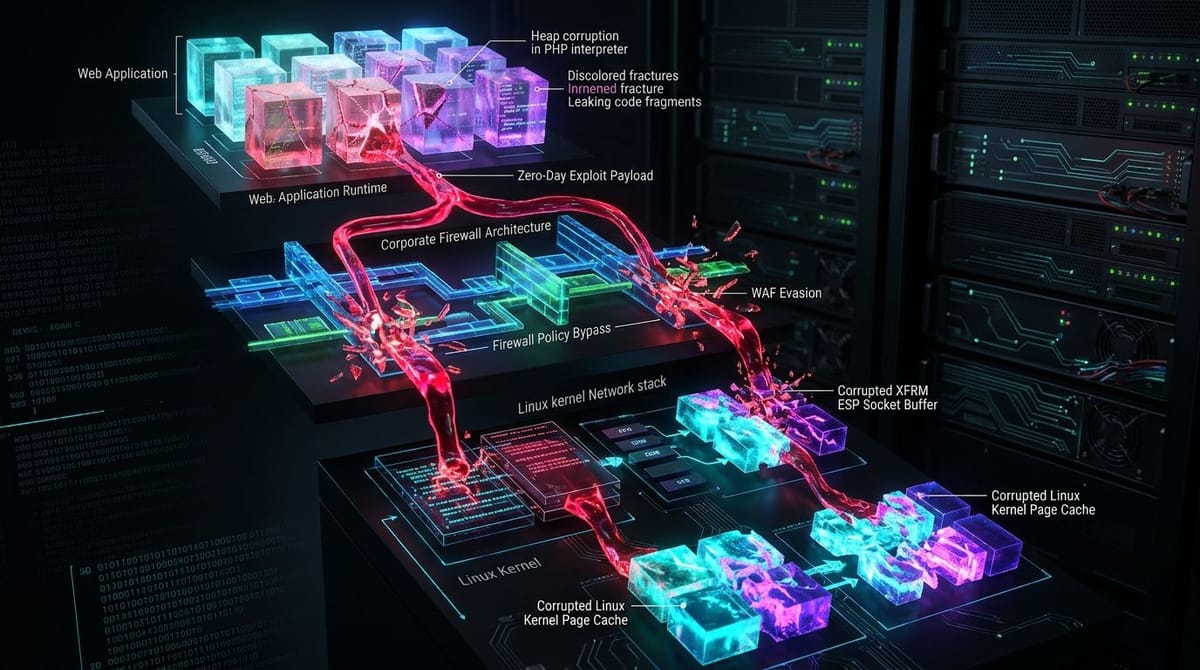
CVE-2026-109618, CVE-2026-109619 & CVE-2026-46300 (CWE-416 (Use After Free) & CWE-665 / Page-Cache Shared Fragment Corruption)
Severity: CRITICAL (ACTIVE CISA KEV RCE-TO-ROOT CHAIN) (CVSS 9.2 (PHP2Shell) & 7.8 (Fragnesia))
Threat Actor: China-Nexus Intrusion Cluster (Tracked by Palo Alto Unit 42, Wiz & Dream)
Status: Actively Chained in the Wild Since Oct 25, 2026; Added to CISA KEV Oct 26 & Oct 28, 2026
Affected Systems: PHP 5.4–8.5 Web & Appliance Management Planes + Unpatched Linux Kernels (XFRM ESP-in-TCP)
Fixed In: PHP 8.5.12 / 8.4.27 / 8.3.36 / 8.2.35 + Vendor Linux Kernel Updates for CVE-2026-46300
When the pre-authentication PHP2Shell vulnerabilities (CVE-2026-109618 and CVE-2026-109619) were disclosed earlier in "Black October," defenders initially focused on web application containers running as low-privileged users such as www-data or nobody. This week, that containment assumption shattered. Threat intelligence reports from Palo Alto Networks Unit 42, Wiz, and Dream revealed that beginning around October 25, 2026, a sophisticated China-nexus threat actor deployed custom multi-stage exploit kits that chain PHP2Shell directly with CVE-2026-46300 (widely tracked as "Fragnesia")—a high-severity Linux kernel local privilege escalation (LPE) bug in socket buffer coalescing and XFRM ESP-in-TCP processing. By combining pre-auth PHP heap corruption with kernel page-cache overwriting, attackers achieved full root takeover on at least 25 internet-exposed firewall management interfaces and government-affiliated servers across the United States, Japan, Taiwan, and South Korea, prompting CISA to add PHP2Shell to the KEV catalog on October 26 and Fragnesia on October 28.
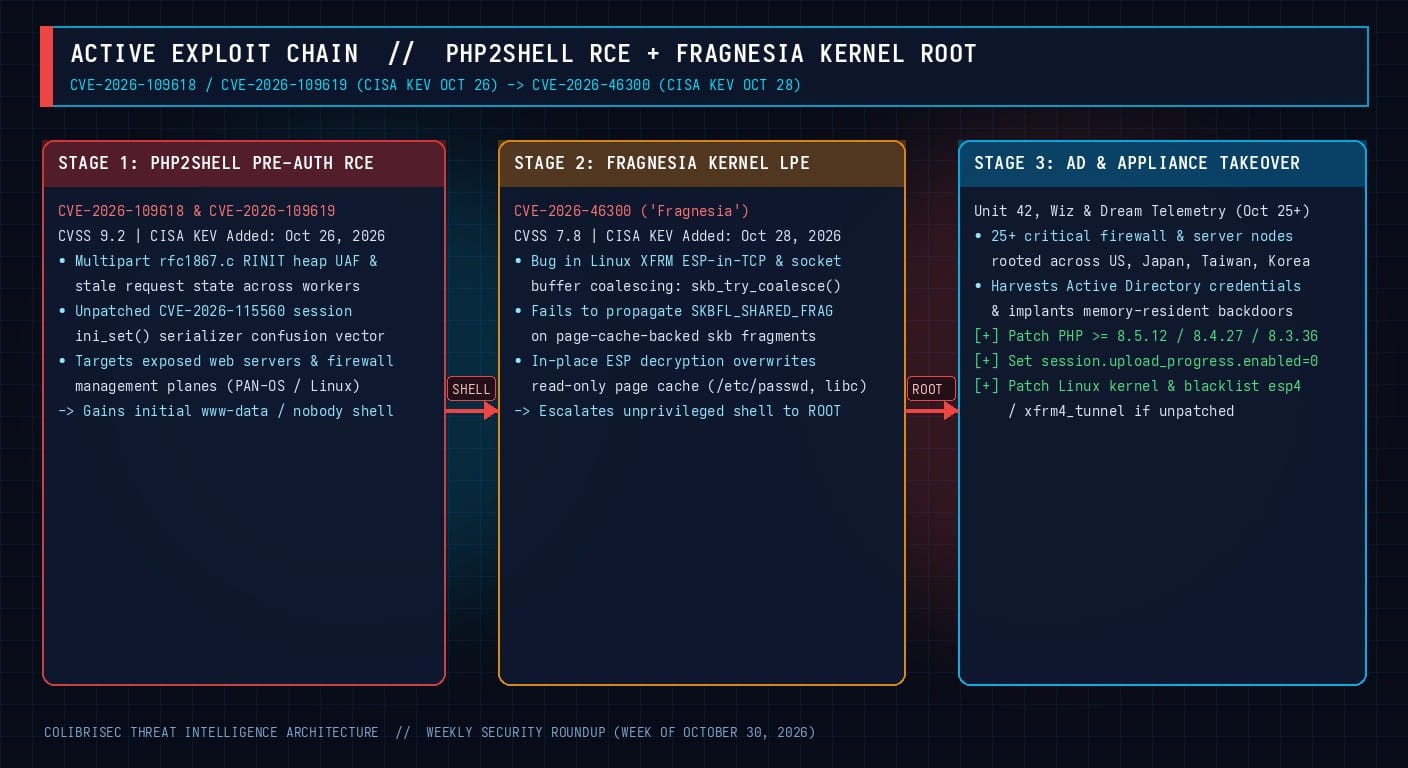
Stage 1: Initial Entry via PHP2Shell (CVE-2026-109618 & CVE-2026-109619)
Both CVE-2026-109618 and CVE-2026-109619 (CVSS 9.2) exploit memory management flaws in PHP’s RFC 1867 multipart upload handler (main/rfc1867.c) and session upload progress tracking (ext/session/session.c). Because PHP executes multipart boundary parsing and PHP_SESSION_UPLOAD_PROGRESS population during the request initialization phase (RINIT)—before any PHP script or framework authentication check runs—any web server or network appliance management UI powered by Apache mod_php, php-fpm, php-cgi, FrankenPHP, or LiteSpeed is exposed if session.upload_progress.enabled = 1 (the default).
In the active campaign analyzed by Dream and Unit 42, the attackers specifically targeted exposed enterprise management interfaces (including Linux-based firewall and appliance management planes) by sending a crafted multipart POST sequence that triggers a Zend HashTable resize mid-stream. This leaves a dangling zval* pointer inside php_session_rfc1867_callback, allowing the attacker to hijack control flow and spawn an in-memory, unprivileged shell running under the web server UID.
Stage 2: Escalating to Root via Linux Kernel "Fragnesia" (CVE-2026-46300)
Landing as an unprivileged web user on a hardened firewall appliance or Linux bastion is normally restricted by read-only root filesystems, mandatory access controls, and strict file permissions. To break out of the web worker context immediately upon landing, the attackers executed a compiled binary exploit for CVE-2026-46300 ("Fragnesia").
Root Cause: Missing SKBFL_SHARED_FRAG Propagation in XFRM ESP-in-TCP
Part of the page-cache corruption vulnerability family alongside Dirty Pipe, Dirty Frag, and Copy-Fail, CVE-2026-46300 resides in the Linux kernel’s networking subsystem—specifically at the intersection of socket buffer (sk_buff) fragment coalescing (skb_try_coalesce()) and XFRM ESP-in-TCP (Encapsulating Security Payload over TCP) cryptographic processing.
- Splicing a Read-Only File into a Socket: An unprivileged local process opens a sensitive root-owned, read-only file (such as
/etc/passwd,/bin/su, or a system shared library likelibc.so.6) withO_RDONLYand uses thesplice()system call to attach pages from the kernel’s global page cache directly into a pipe and subsequently into a socket buffer’s fragment array (skb_shinfo(skb)->frags[]). - The
SKBFL_SHARED_FRAGInvariant Violation: Normally, kernel networking code marks page-cache-backed fragments withSKBFL_SHARED_FRAGso that downstream protocol handlers know they must allocate a private copy (Copy-on-Write) before modifying packet bytes. However, during specific socket buffer coalescing paths inskb_try_coalesce()paired with local XFRM ESP-in-TCP loopback sockets, the shared fragment flag is improperly cleared or ignored. - In-Place Cryptographic Overwrite of the Page Cache: When the kernel’s XFRM ESP-in-TCP engine decrypts a specially crafted local loopback frame, it performs in-place decryption directly inside the coalesced fragment page—unwittingly writing attacker-controlled plaintext bytes straight into the host’s read-only page cache!
/* Conceptual illustration of the CVE-2026-46300 ("Fragnesia") invariant bug */
bool skb_try_coalesce(struct sk_buff *to, struct sk_buff *from,
                      bool *fragstolen, int *delta_truesize)
{
    /* ... */
    /* BUG: When coalescing fragments from a spliced page-cache skb into 'to',
     * if SKBFL_SHARED_FRAG is not preserved across the XFRM ESP-in-TCP path,
     * esp_input() treats the page-cache page as writable in-place buffer memory!
     */
    if (skb_has_shared_frag(from))
        to->azawa_shared_frag_missing = 1; // Vulnerable kernels failed to propagate this state
}
By crafting the ESP ciphertext such that its decrypted output equals a trojanized root entry (or ELF shellcode stub), the attacker modifies the in-memory page cache of a privileged system binary without ever touching disk write permissions—instantly elevating the PHP2Shell web worker to UID 0 (root) and escaping container boundaries where page caches are shared with the host kernel.
Detection Telemetry & Forensic Hunting
# 1. Check if vulnerable XFRM ESP-in-TCP kernel modules are currently loaded in memory
lsmod | grep -E "(esp4|esp6|xfrm4_tunnel|xfrm6_tunnel|espintcp)"

# 2. Detect page-cache vs. on-disk integrity mismatch (classic indicator of DirtyPipe / Fragnesia)
# Compare MD5 of in-memory cached /etc/passwd and /usr/bin/sudo against dropped-cache disk reads:
md5sum /etc/passwd /usr/bin/sudo > /tmp/cache_hashes.txt
sync; echo 1 | sudo tee /proc/sys/vm/drop_caches
md5sum -c /tmp/cache_hashes.txt

# 3. Audit PHP configurations for exposed session.upload_progress
php -i | grep "session.upload_progress.enabled"
Remediation & Mitigation Playbook
- Patch PHP & Disable Upload Progress: Upgrade PHP immediately to 8.5.12, 8.4.27, 8.3.36, or 8.2.35 and enforce
session.upload_progress.enabled = 0inphp.ini(which also blocks the unpatched CVE-2026-115560 session serializer confusion flaw). - Apply Linux Kernel Updates for CVE-2026-46300: Update Ubuntu, RHEL, Debian, AlmaLinux, and appliance kernels to the vendor-patched releases addressing CVE-2026-46300 and reboot affected nodes.
- Blacklist Unused XFRM ESP-in-TCP Modules: On web servers that do not terminate IPsec ESP-in-TCP tunnels directly in the kernel, prevent unprivileged namespace loading by adding
install esp4 /bin/trueandinstall esp6 /bin/trueto/etc/modprobe.d/disable-fragnesia.confand settingsysctl -w user.max_user_namespaces=0where supported.

