
CISO Defense Blueprint for the "Black October" Finale: Kernel MPTCP/Fragnesia Shields, IDE Extension Governance, ESXi Audit Heartbeats & EIP-7702 Custody Controls

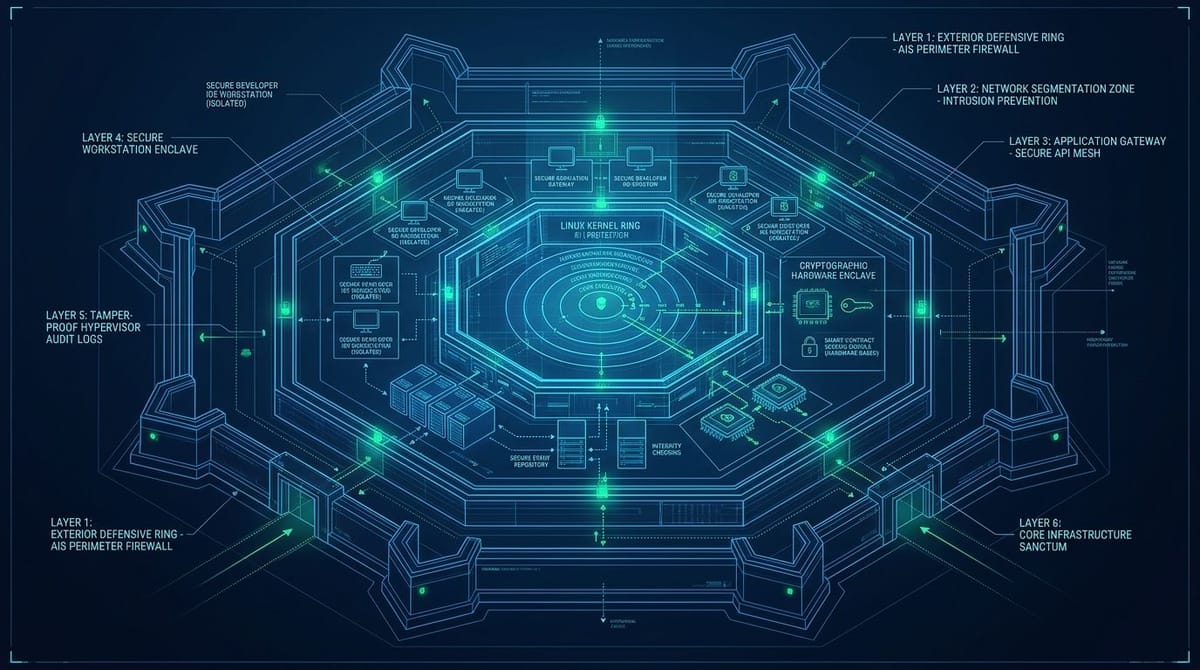
As "Black October" comes to a close on October 30, 2026, one strategic lesson stands above all others: traditional patch-cycle SLAs can no longer keep pace with machine-speed vulnerability discovery and exploit chaining. In a single week where Anthropic’s Claude autonomously synthesized a remote Linux kernel KASLR bypass and root exploit for CVE-2026-98432 in under 60 minutes, China-nexus actors chained PHP2Shell with Fragnesia (CVE-2026-46300) to root firewalls, Warp Panda blinded VMware ESXi audit logs via CVE-2026-41709, a trojanized Cursor IDE extension planted SSH backdoors on 5,000 developer laptops, and TraderTraitor drained $6.36 billion from Binance using pre-signed EIP-7702 tuples, reactive patching alone is insufficient. Below is ColibriSec’s comprehensive engineering blueprint to harden your architecture against the defining attack classes of late October 2026.
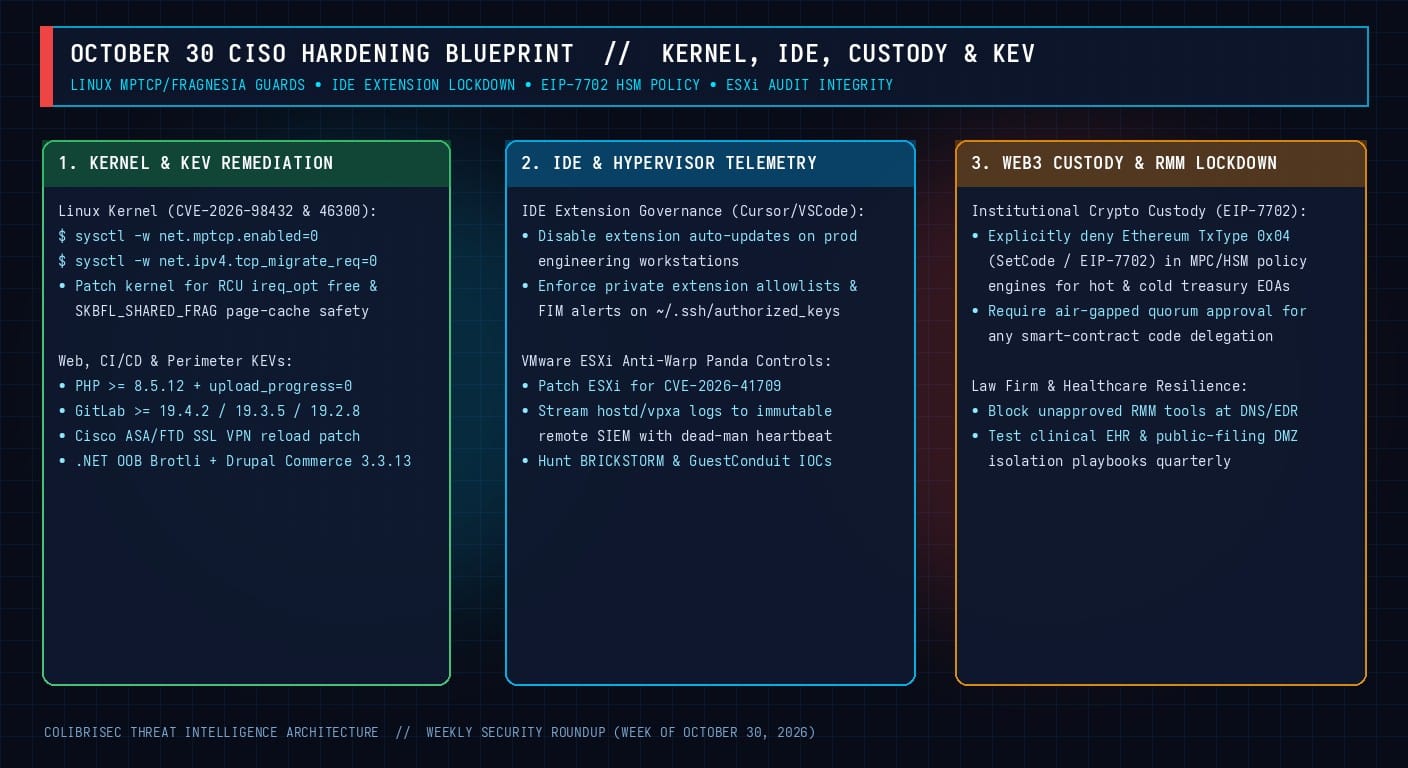
Pillar 1: Linux Kernel & Runtime Attack-Surface Reduction (CVE-2026-98432 & CVE-2026-46300)
Both of this week’s headline Linux kernel vulnerabilities—the remote TCP/MPTCP race Use-After-Free (CVE-2026-98432) and the local page-cache privilege escalation flaw Fragnesia (CVE-2026-46300)—rely on kernel networking features (Multipath TCP and XFRM ESP-in-TCP) that 99% of general-purpose application servers do not actually use, yet leave enabled by default.
#!/usr/bin/env bash
# ColibriSec Linux Kernel Hardening Script for CVE-2026-98432 (MPTCP UAF) & CVE-2026-46300 (Fragnesia)
set -euo pipefail

# 1. Disable Multipath TCP and lockless TCP request migration system-wide
cat <<'EOF' > /etc/sysctl.d/99-colibrisec-kernel-net-hardening.conf
net.mptcp.enabled = 0
net.ipv4.tcp_migrate_req = 0
user.max_user_namespaces = 0
EOF
sysctl --system

# 2. Prevent unprivileged auto-loading of XFRM ESP-in-TCP modules (CVE-2026-46300)
cat <<'EOF' > /etc/modprobe.d/colibrisec-blacklist-esp.conf
install esp4 /bin/true
install esp6 /bin/true
install espintcp /bin/true
EOF

# 3. Disable PHP multipart session upload progress globally (CVE-2026-109618/19 & CVE-2026-115560)
for ini_dir in /etc/php/*/fpm/conf.d /etc/php/*/apache2/conf.d /etc/php/*/cli/conf.d; do
  if [ -d "$ini_dir" ]; then
    echo "session.upload_progress.enabled = 0" > "$ini_dir/99-colibrisec-disable-upload-progress.ini"
  fi
done
Additionally, for Go 1.24+ microservices where net.Listen attempts to enable MPTCP by default, set the environment variable GODEBUG=multipathtcp=0 across your Kubernetes PodSpecs and systemd unit files.
Pillar 2: Developer Workstation & IDE Extension Governance (Countering the Cursor v2.1.313 Attack)
The compromise of anthropic.claude-code v2.1.313 on the Cursor marketplace proved that automatic background updates of IDE extensions represent a direct, unmonitored code-execution channel onto engineering laptops holding production cloud credentials.
- Disable Automatic Extension Updates via MDM: Configure managed VS Code and Cursor
settings.jsonpolicies via Jamf, Intune, or Kandji with"extensions.autoUpdate": falseand"extensions.autoCheckUpdates": false, routing extension updates through an internal VSIX vetting proxy with a 72-hour quarantine delay. - Real-Time File Integrity Monitoring (FIM) on
~/.ssh/authorized_keys: Deploy an osquery, Santa, or eBPF rule on every developer workstation that alerts immediately if any process (especiallyCursor,Code,node, orpython) writes to~/.ssh/authorized_keysor~/Library/LaunchAgents/. - Eliminate Long-Lived Plaintext Environment Secrets: Replace static
AWS_SECRET_ACCESS_KEYandANTHROPIC_API_KEYexports in~/.zshrcor.envfiles with hardware-biometric-gated secret injectors (such as 1Password CLI biometric sockets or short-lived AWS SSO OIDC tokens) so that an extension scrapingprocess.envcaptures no reusable credentials.
Pillar 3: Hypervisor Audit Integrity Against "Warp Panda" (CVE-2026-41709)
To defeat state-sponsored threat actors like Warp Panda that exploit ESXi logging vulnerabilities (CVE-2026-41709) to blind defenders while deploying BRICKSTORM and GuestConduit:
- Enforce ESXi Lockdown Mode & ExecInstalledOnly: Enable Strict Lockdown Mode on all ESXi hosts and enforce
VMkernel.Boot.execInstalledOnly = TRUEso that unsigned binaries dropped into/tmpor/scratchcannot execute. - Dead-Man Telemetry Heartbeats on Remote Syslog: Stream ESXi
hostd,vpxa, andshelllogs over TLS to an immutable SIEM collector, and trigger a Priority-1 SOC alert if any hypervisor stops emitting audit logs while its network interface remains up.
Pillar 4: Institutional Web3 Custody Hardening for Ethereum EIP-7702
Following the $6.36 billion Binance heist, every exchange, custodian, and institutional treasury operating on EVM chains must immediately audit its MPC/HSM signing policies:
- Explicitly Deny Transaction Type
0x04and Magic Byte0x05: Custodial hot and cold wallets are Externally Owned Accounts (EOAs) that should never delegate their code execution via EIP-7702. Configure HSM firmware and MPC policy engines to cryptographically reject any signing payload prefixed with the EIP-7702 magic byte (0x05) or any transaction envelope withTxType == 0x04. - Isolate DevOps Planes from Signing Enclaves: Enforce hardware-attested, air-gapped policy verification between container orchestration clusters and signing enclaves, ensuring that no compromised DevOps workstation can submit batch sequential-nonce signing requests.

