
Enterprise Stack Under Siege: Microsoft .NET Out-of-Band Brotli Patch (CVE-2026-111497), Drupal Commerce Core Auth Bypass (CVE-2026-118539) & Oracle EBS SQLi (CVE-2026-101767)


CVE-2026-111497 (.NET OOB), CVE-2026-118539 (Drupal) & CVE-2026-101767 (Oracle EBS) (CWE-787 (Out-of-Bounds Write), CWE-862 (Missing Authorization) & CWE-89 (SQL Injection))
Severity: CRITICAL (OUT-OF-BAND PATCH & ACTIVE WILD EXPLOITATION) (CVSS 9.8 (Brotli & Oracle EBS) | 21/25 Highly Critical (Drupal SA-CONTRIB-2026-254))
Threat Actor: Active E-Commerce Exploit Actors & Automated Oracle EBS Scanning Botnets
Status: Emergency Out-of-Band .NET Release Oct 25; Active Wild Exploitation of Drupal & Oracle EBS Scanning
Affected Systems: Microsoft .NET 8.0, 9.0, 10.0 | Drupal Commerce Core < 8.x-2.41 & < 3.3.13 | Oracle EBS 12.2.3–12.2.15
Fixed In: Oct 25 .NET OOB Runtime Update | Drupal Commerce 8.x-2.41 & 3.3.13 | Oracle Oct 2026 CPU
While kernel and perimeter teams battled CISA KEV chains this week, enterprise application and e-commerce administrators faced a triple emergency across Microsoft .NET, Drupal Commerce, and Oracle E-Business Suite (EBS). On October 25, Microsoft took the rare step of shipping an emergency out-of-band (OOB) security update across .NET 8, .NET 9, and .NET 10 to patch CVE-2026-111497—the polyglot Brotli decompression buffer overflow (HTTP2Shell / Broccoli2Shell). On October 28, the Drupal Security Team issued an urgent warning (**SA-CONTRIB-2026-254**) that threat actors are actively exploiting CVE-2026-118539 (rated 21/25 Highly Critical) in the wild to bypass access controls in Drupal Commerce Core. Concurrently, threat intelligence sensors recorded massive global exploitation scanning targeting CVE-2026-101767 (CVSS 9.8), an unauthenticated SQL injection-to-RCE vulnerability in Oracle E-Business Suite.
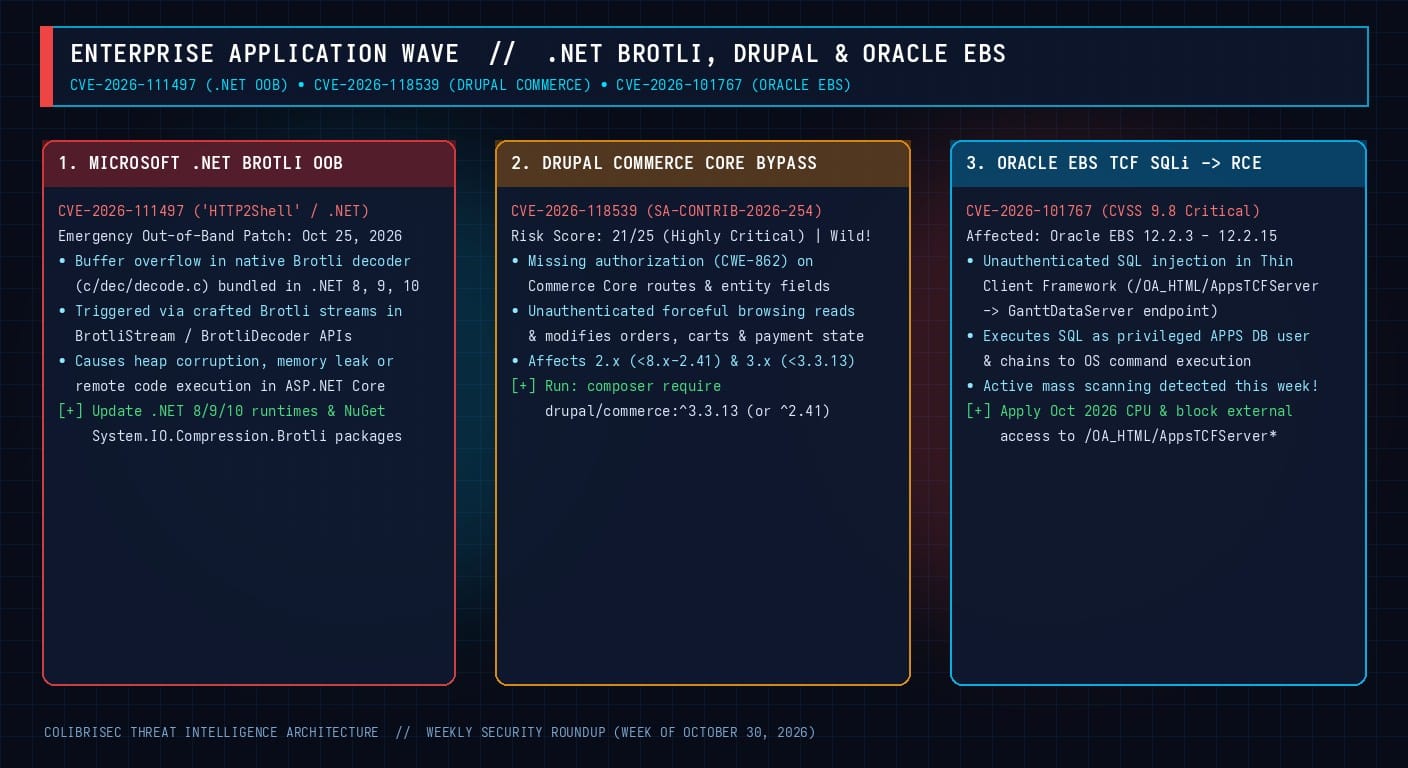
1. Microsoft .NET Emergency Out-of-Band Brotli Update (CVE-2026-111497)
Tracked across ecosystems as Node2Shell, HTTP2Shell, and Broccoli2Shell, CVE-2026-111497 is an out-of-bounds write / buffer overflow in Google’s reference C Brotli decompression library (c/dec/decode.c, versions 1.0.3 through 1.2.0). Because the .NET runtime embeds native Brotli C routines inside System.IO.Compression.Brotli (powering BrotliStream, BrotliDecoder, ASP.NET Core request decompression middleware, and HttpClient.AutomaticDecompression), any .NET service that decompresses untrusted Brotli payloads is exposed to native heap corruption, process memory disclosure, or Remote Code Execution.
Recognizing that organizations had already applied the October 13 Patch Tuesday updates and would otherwise remain exposed until November, Microsoft published an out-of-band security advisory and refreshed runtime installers/NuGet packages on October 25, 2026 covering .NET 8.0, .NET 9.0, and .NET 10.0 on Windows, Linux, and macOS. Note that self-contained .NET deployments (compiled with --self-contained true) bundle the vulnerable native library inside the application artifact and must be recompiled and redeployed against the updated SDK!
2. Actively Exploited in the Wild: Drupal Commerce Core Auth Bypass (CVE-2026-118539)
On October 28, 2026, the Drupal Security Team published advisory SA-CONTRIB-2026-254 for CVE-2026-118539, assigning it a severity score of 21 out of 25 (Highly Critical) and confirming that active exploitation is underway in the wild against online stores running Drupal Commerce Core.
Root Cause: Missing Route & Entity Field Access Checks (CWE-862)
In Drupal Commerce Core versions 2.x prior to 8.x-2.41 (0.0.0 through 2.40) and 3.x prior to 3.3.13 (3.0.0 through 3.3.12), specific checkout, cart, and order management routes and entity fields lacked strict authorization guards. Through unauthenticated forceful browsing, remote attackers can directly query and manipulate non-public order entities, read customer PII and billing records across active shopping carts, and tamper with order state transitions—causing direct financial loss to merchants.
# 1. Audit installed Drupal Commerce packages via Composer:
composer show "drupal/commerce*"

# 2. Upgrade immediately to the patched release for your branch:
# For Commerce 3.x:
composer require "drupal/commerce:^3.3.13" --with-all-dependencies
# For Commerce 2.x:
composer require "drupal/commerce:^2.41" --with-all-dependencies
drush updb -y && drush cr
3. Mass Scanning Alert: Oracle E-Business Suite SQLi-to-RCE (CVE-2026-101767)
Discovered by researchers at Horizon3.ai and patched in Oracle’s massive October 20 Critical Patch Update, CVE-2026-101767 (CVSS 9.8 Critical) affects Oracle E-Business Suite versions 12.2.3 through 12.2.15. This week, honeypot and perimeter telemetry from Defused and Aviatrix confirmed that threat actors have begun aggressive global mass scanning and exploitation probing against unpatched EBS instances.
The /OA_HTML/AppsTCFServer Vector
The vulnerability resides in the Thin Client Framework (TCF) servlet within the Application Object Library, exposed without authentication at /OA_HTML/AppsTCFServer (specifically when dispatching handlers such as GanttDataServer). Because the servlet connects to the underlying Oracle database under the highly privileged APPS schema owner and concatenates client-supplied parameters directly into SQL queries, an unauthenticated attacker can exfiltrate ERP financial/HR tables and invoke database-to-OS execution primitives (such as Java stored procedures or DBMS_SCHEDULER) to achieve full Remote Code Execution on the EBS host.
Detection & WAF Blocking Rules
# 1. Oracle EBS: Hunt Apache/OHS access logs for unauthenticated probes against AppsTCFServer
grep -iE "(AppsTCFServer|GanttDataServer)" $LOG_HOME/ora/10.1.3/Apache/access_log*

# 2. Nginx / WAF Virtual Patch for Oracle EBS: Block external access to TCF servlet
location ~* ^/OA_HTML/AppsTCFServer {
    deny all;
    return 403;
}

# 3. Audit Linux/Windows servers for .NET runtime patch levels (ensure Oct 25 OOB update is installed)
dotnet --list-runtimes
