
CISA KEV Zero-Day Directives: Cisco ASA/FTD SSL VPN DoS (CVE-2026-76418), GitLab CVSS 10.0 RCE (CVE-2026-97229) & VMware ESXi "Warp Panda" Log Suppression (CVE-2026-41709)


CVE-2026-76418, CVE-2026-97229 & CVE-2026-41709 (CWE-690 (NULL Pointer Deref), CWE-190 (Integer Overflow) & CWE-778 (Insufficient Logging))
Severity: CRITICAL (CISA KEV ZERO-DAY & RCE DIRECTIVES) (CVSS 8.6 (Cisco), 10.0 (GitLab) & 2.7 / Zero-Day KEV (VMware ESXi))
Threat Actor: Warp Panda (China-Nexus APT) & Opportunistic Perimeter/CI-CD Threat Actors
Status: Actively Exploited in the Wild; Added to CISA KEV Catalog Late October 2026
Affected Systems: Cisco Secure Firewall ASA/FTD | GitLab CE/EE 19.2–19.4 | Broadcom VMware ESXi
Fixed In: Cisco ASA 9.20.4.50 / FTD 7.4.9+ | GitLab 19.4.2 / 19.3.5 / 19.2.8 | Patched ESXi Builds
During the final week of October 2026, CISA expanded the Known Exploited Vulnerabilities (KEV) catalog with three wildly different—yet equally dangerous—vulnerabilities spanning the enterprise perimeter, the DevSecOps CI/CD control plane, and bare-metal virtualization hypervisors. On October 28, Cisco disclosed active zero-day exploitation of CVE-2026-76418 (CVSS 8.6), a Remote Access SSL VPN flaw that forces Cisco Secure Firewall ASA and FTD appliances into continuous reload loops. Simultaneously, CISA mandated urgent patching for CVE-2026-97229, a maximum-severity CVSS 10.0 unauthenticated Remote Code Execution flaw in GitLab CE/EE triggered by crafted regular expressions in CI/CD pipelines, and CVE-2026-41709, a VMware ESXi audit-log suppression zero-day weaponized by China-nexus espionage group Warp Panda to blind forensic defenders while implanting persistent hypervisor backdoors across U.S. law firms and enterprise networks.
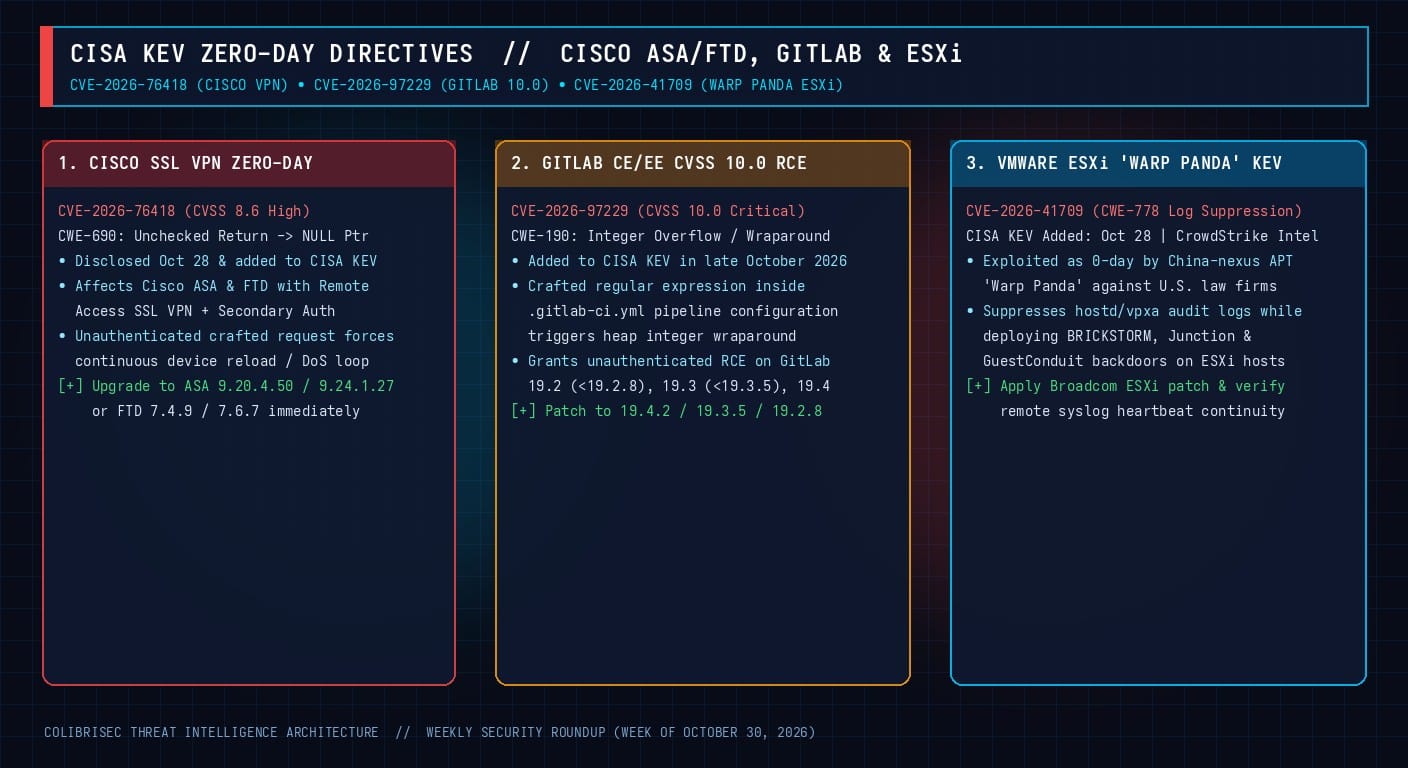
1. Cisco Secure Firewall ASA & FTD Zero-Day Reload Loop (CVE-2026-76418)
Disclosed by Cisco on October 28, 2026, after Cisco PSIRT confirmed active exploitation in the wild, CVE-2026-76418 (CVSS 8.6 High, CWE-690: Unchecked Return Value to NULL Pointer Dereference) targets the Remote Access SSL VPN subsystem on Cisco Secure Firewall Adaptive Security Appliance (ASA) and Secure Firewall Threat Defense (FTD) software.
Mechanics of the Secondary Authentication Crash
The vulnerability is exposed when an ASA or FTD appliance has Remote Access SSL VPN (AnyConnect / Cisco Secure Client webvpn) enabled alongside secondary authentication (such as dual-AAA RADIUS/Duo/LDAP prompts) configured on at least one tunnel group. When parsing a malformed, unauthenticated SSL VPN authentication handshake request where a secondary credential structure allocation returns NULL, the daemon dereferences the pointer without checking the return status—triggering a fatal watchdog crash and forcing the entire hardware or virtual firewall into a full system reload.
# Verify if your Cisco ASA / FTD configuration exposes CVE-2026-76418:
ciscoasa# show running-config webvpn
ciscoasa# show running-config tunnel-group | include secondary-authentication-server-group
Because an attacker can send a single unauthenticated packet every time the firewall finishes booting, threat actors are using CVE-2026-76418 both to sever remote-worker VPN connectivity and to blind inline IPS/firewall inspection during concurrent multi-vector intrusions. Cisco has released fixed releases including ASA 9.16.4.104, 9.18.4.96, 9.20.4.50, 9.22.3.200, 9.23.1.48, 9.24.1.27 and FTD 7.0.11, 7.2.13, 7.4.9, 7.6.7, and 7.7.14.
2. GitLab CE/EE CVSS 10.0 Unauthenticated RCE (CVE-2026-97229)
Added to the CISA KEV catalog following confirmed active exploitation, CVE-2026-97229 carries a maximum CVSS 10.0 Critical rating and affects GitLab Community Edition (CE) and Enterprise Edition (EE) across branches 19.2 (prior to 19.2.8), 19.3 (prior to 19.3.5), and 19.4 (prior to 19.4.2).
Root Cause: Integer Wraparound in CI/CD Regular Expression Evaluation
Categorized under CWE-190 (Integer Overflow or Wraparound), the flaw resides in how GitLab validates and compiles complex regular expression patterns (rules:if, only/except, and variable matching expressions) supplied inside CI/CD pipeline configuration files (.gitlab-ci.yml) or triggered via API pipeline validation endpoints. By crafting a deeply nested, quantifier-expanded regular expression that causes a 32-bit signed integer size calculation to wrap around into a small allocation size, an attacker triggers a heap buffer overwrite inside the native regex evaluation engine—achieving unauthenticated Remote Code Execution as the git service user on self-managed instances.
3. VMware ESXi "Warp Panda" Zero-Day (CVE-2026-41709): Why a CVSS 2.7 Bug Made CISA KEV
At first glance, CVE-2026-41709 in Broadcom’s VMware ESX / ESXi hypervisor looks benign: it is an Insufficient Logging vulnerability (CWE-778) carrying a base CVSS score of just 2.7 (Low) because it requires administrative privileges and does not grant initial code execution. Why, then, did CISA add it to the KEV catalog on October 28?
Joint threat intelligence from CrowdStrike (referencing researcher Ian Barton’s discovery) and CISA revealed that China-nexus cyber-espionage group Warp Panda actively exploited CVE-2026-41709 as a zero-day against U.S. law firms, technology companies, and manufacturing organizations. After gaining initial network access via edge appliances and pivoting to VMware vCenter/ESXi, Warp Panda triggered CVE-2026-41709 to selectively suppress hypervisor audit logs (/var/log/hostd.log, /var/log/vpxa.log, and /var/log/shell.log) while executing privileged commands to deploy three custom persistence implants:
- BRICKSTORM: A stealthy Go/C backdoor disguised as a native VMware daemon that multiplexes covert C2 traffic over legitimate HTTPS management sockets.
- Junction & GuestConduit: Hypervisor-to-guest VMCI/vsock bridging tools that allow Warp Panda to execute commands inside guest virtual machines (including Domain Controllers and document management servers) straight from the ESXi host kernel without traversing the network or triggering guest firewall logs.
Detection Telemetry & Forensic Triage
# 1. VMware ESXi: Hunt for unauthorized ELF binaries (BRICKSTORM / Junction) outside VIB packages
esxcli software acceptance get
find /bin /sbin /usr/lib /tmp /scratch -type f -perm /111 -mtime -90 -ls

# 2. VMware ESXi: Check for gaps or zeroed timestamps in hostd and shell audit logs
ls -lh /var/log/hostd.log /var/log/vpxa.log /var/log/shell.log /var/log/syslog.log

# 3. GitLab: Verify installed GitLab CE/EE version is patched (>= 19.4.2 / 19.3.5 / 19.2.8)
sudo gitlab-rake gitlab:env:info | grep -E "GitLab information|Version"
Remediation Steps
- Patch Cisco ASA & FTD Immediately: Upgrade to fixed Cisco ASA/FTD releases for CVE-2026-76418. If immediate maintenance windows are unavailable, review whether secondary authentication on public-facing SSL VPN tunnel groups can be consolidated into primary SAML/OIDC IdP authentication.
- Upgrade GitLab CE/EE & Disable Public Sign-Ups: Upgrade self-managed GitLab servers to 19.4.2, 19.3.5, or 19.2.8+ and ensure public repository creation and unauthenticated CI lint API endpoints are restricted.
- Patch ESXi & Enforce Remote Syslog Heartbeats: Apply Broadcom’s security patch for CVE-2026-41709 and configure SIEM correlation rules to alert immediately if any ESXi host stops emitting
hostd/vpxaevents for more than 120 seconds while still responding to ICMP/vCenter heartbeats.

