
Active Honeypot Root Exploitation & Switch Implants: OpenSSH musl "sshhole" (CVE-2026-123158) on Alpine & Zyxel GS1900 Zero-Day (CVE-2026-107441)


CVE-2026-123158 ("sshhole") & CVE-2026-107441 (CWE-287 Improper Authentication (OpenSSH/musl) & CWE-787 Out-of-Bounds Write (Zyxel))
Severity: CRITICAL (IN-THE-WILD ROOT EXPLOITATION WITHIN 9 HOURS OF DISCLOSURE) (CVSS 8.1 High (OpenSSH "sshhole") & 9.8 Binarly / 8.8 Zyxel (GS1900 Switches))
Threat Actor: Automated SSH Scanners (89.116.89[.]18) & Kapibala / Red Heron (Jitterly & Sixzut)
Status: Active Root Compromises Confirmed on Alpine Honeypots & 996 Zyxel Switches Globally
Affected Systems: OpenSSH < 10.6p2 on musl libc with UsePAM no (Alpine Linux 3.16–3.24); Zyxel GS1900 Switches <= 2.90 Patch 2
Fixed In: OpenSSH 10.6p2 (Alpine 3.21.10 / 3.22.8 / 3.23.8 / 3.24.4); Zyxel Firmware 2.90 Patch 3
If enterprise defenders needed proof of how fast modern exploit pipelines operate, the weekend of November 6–8, 2026 provided a textbook case study. Less than nine hours after security researcher Özgün Kültekin (sshhole.com) disclosed CVE-2026-123158 ("sshhole")—a 10-year-old interaction between OpenSSH and musl libc that allows unauthenticated attackers to log into password-disabled (*) accounts on Alpine Linux using a 257-to-1,024-byte password—threat intelligence researchers at Previdian confirmed that real Alpine Linux honeypots were actively compromised as root. Simultaneously, firmware security researchers at Binarly published full technical telemetry on how Chinese-speaking threat group Kapibala (Red Heron) weaponized CVE-2026-107441 to bypass Zyxel’s June patch across 996 Zyxel GS1900 switches in 48 countries and deploy two custom switch implants: Jitterly and Sixzut.
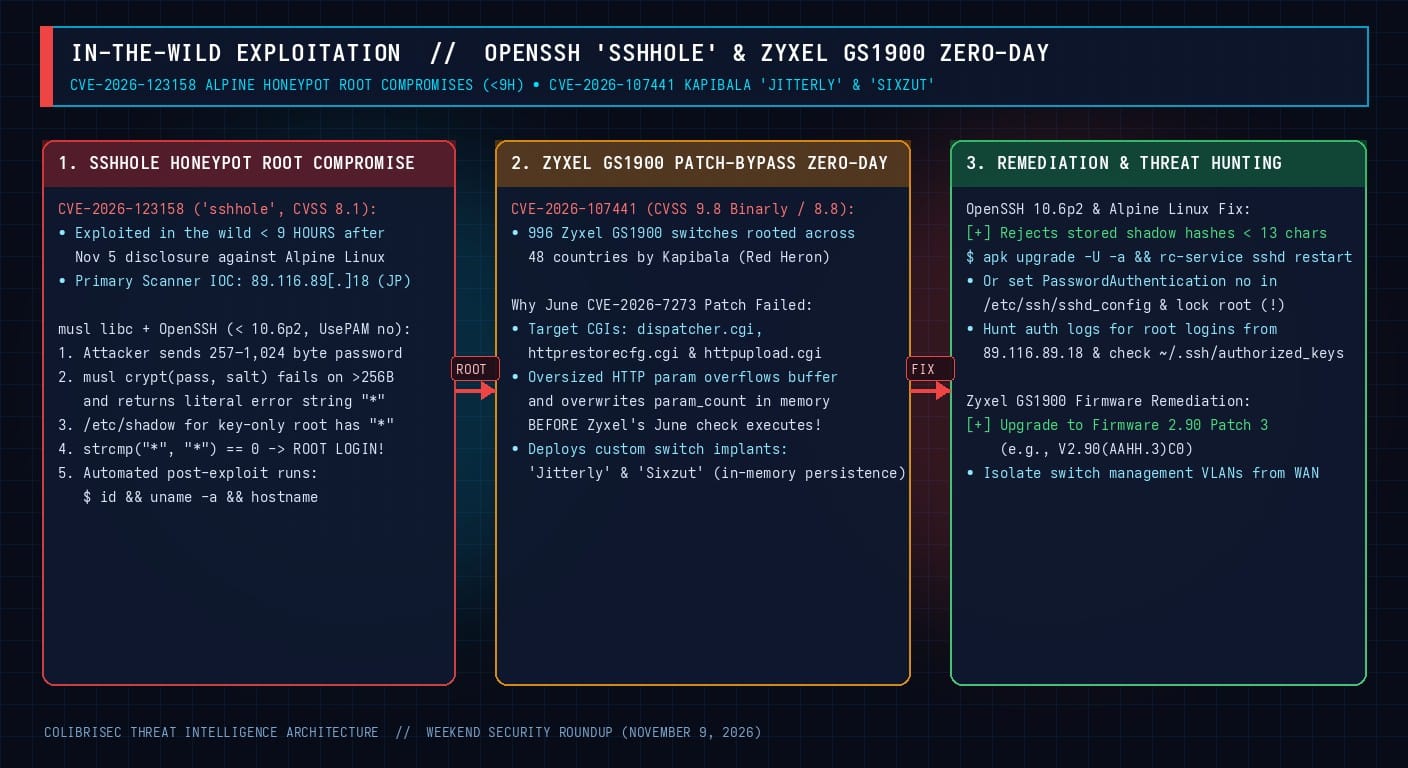
1. Sub-9-Hour Honeypot Root Compromises via OpenSSH "sshhole" (CVE-2026-123158)
Disclosed on November 5, 2026, CVE-2026-123158 (CVSS 8.1) stems from a subtle collision between OpenSSH’s auth-passwd.c password verification logic (when running without PAM, UsePAM no) and the crypt() implementation in musl libc (the standard C library in Alpine Linux, Void Linux musl, and OpenWrt):
- The
/etc/shadowPlaceholder: On Alpine Linux and container images whererootor service accounts are configured for SSH public-key authentication only (with no password set), the password hash field in/etc/shadowcontains a single asterisk:root:*:19800:0:99999:7:::. - The Timing-Mitigation Salt Donor: Since OpenSSH’s 2016 fix for timing attack
CVE-2016-6210, when a user attempts to log into an account whose shadow entry does not start with a valid hash prefix (such as*),sshdselects a valid password hash from an existing local account on the system (or a fallback salt) and runscrypt(password, salt)anyway so that the CPU time matches a real password check. musl libc’s 256-Byte Limit Returns"*": Inmusl libc,crypt()enforces a strict maximum password length of 256 bytes. When passed a password of 257 bytes or more (up to OpenSSH’sMAX_PASSWORD_LENof 1,024 bytes),musl’scrypt()fails and returns the literal failure token"*"(assuming that no real stored hash in/etc/shadowwould ever equal"*").- The Fatal Match: OpenSSH then executes
strcmp(encrypted_password, shadow_password)—which evaluatesstrcmp("*", "*") == 0and grants immediate, unauthenticatedrootlogin!
In-the-Wild Honeypot Telemetry (89.116.89[.]18)
Within less than nine hours of the advisory going live, honeypot sensors running unpatched Alpine Linux + OpenSSH recorded active exploitation waves originating from a Japan-hosted IP address (89.116.89[.]18). The attacker’s automated tooling connected to port 22, submitted randomly padded password strings ranging between 257 and 1,024 characters for root, achieved an authenticated session, and immediately executed non-interactive reconnaissance commands:
# Captured post-authentication command sequence on compromised Alpine honeypots:
id; uname -a; hostname
Follow-on waves checked for container runtime sockets (/var/run/docker.sock), cloud instance metadata endpoints (169.254.169.254), and wrote attacker-controlled Ed25519 keys into /root/.ssh/authorized_keys. OpenSSH 10.6p2 neutralizes the bug by explicitly rejecting any stored pw_passwd string shorter than 13 characters before calling strcmp().
2. Inside Kapibala’s Zyxel GS1900 Zero-Day (CVE-2026-107441) & The Jitterly / Sixzut Implants
Meanwhile, Binarly’s deep-dive analysis into the compromise of 996 Zyxel GS1900 series smart managed switches across 48 countries explained how threat actor Kapibala (Red Heron) bypassed Zyxel’s June 2026 security patch (CVE-2026-7273) for months using zero-day CVE-2026-107441 (CVSS 9.8 Binarly / 8.8 Zyxel).
Late Validation in dispatcher.cgi & Switch Malware Deployment
When Zyxel patched CVE-2026-7273 in June, engineers added a boundary check on the parsed HTTP parameter counter inside dispatcher.cgi, httprestorecfg.cgi, and httpupload.cgi. However, because the unbounded string copy into the parameter buffer ran before the parameter-count check—and because the integer counter sat directly adjacent to the buffer in memory—Kapibala sent oversized HTTP requests that overflowed the buffer, overwrote the parameter counter with a benign small integer to pass the June check, and hijacked control flow as root. Once inside the MIPS/ARM Linux environment of the GS1900 switches, the attackers deployed two lightweight ELF implants—tracked as Jitterly and Sixzut—designed to hook management authentication, siphon startup configuration files (containing RADIUS secrets, SNMP community strings, and VLAN topologies), and maintain stealthy reverse command channels.
Remediation & Threat Hunting Commands
# 1. Patch Alpine Linux OpenSSH to 10.6p2+ (CVE-2026-123158 "sshhole"):
apk upgrade -U -a && rc-service sshd restart
sshd -V   # Confirm OpenSSH_10.6p2 or patched Alpine package release

# 2. Immediate SSH Hardening Workaround (if binary upgrade requires rebuild):
sed -i 's/^#*PasswordAuthentication.*/PasswordAuthentication no/' /etc/ssh/sshd_config
passwd -l root   # Prefix /etc/shadow hash with '!' instead of bare '*'
rc-service sshd restart

# 3. Hunt Alpine / Container Logs for 89.116.89.18 & Unexpected Password Logins:
grep -E "Accepted password for root|89.116.89.18" /var/log/messages /var/log/auth.log 2>/dev/null

# 4. Zyxel GS1900 Switches (CVE-2026-107441):
# Upgrade all GS1900-8/8HP/10HP/16/24/24E/24EP/24HPv2/48/48HPv2 models to
# Firmware 2.90 Patch 3 (V2.90(AAHH.3)C0), reboot to purge in-memory Jitterly/Sixzut
# implants, and rotate all switch admin, RADIUS, TACACS+, and SNMP credentials.
