
Identity, Connected Cars & Parsers: Keycloak SAML Signature Bypass (CVE-2026-117691), Automotive ForgeRock OpenIDM Car Control & imgproxy (CVE-2026-123614)


CVE-2026-117691 (Keycloak), CVE-2026-123614 (imgproxy), CVE-2026-76506 (Cisco UCS) & ForgeRock OpenIDM Chain (CWE-347 Improper Signature Verification (Keycloak), CWE-190/CWE-122 Integer/Heap Overflow (imgproxy) & CWE-1392 Default Creds)
Severity: CRITICAL (FEDERATED SSO TAKEOVER, REMOTE VEHICLE CONTROL & HEAP BUFFER OVERFLOW) (CVSS 9.1 Critical (Keycloak SAML), 9.8 Critical (imgproxy ICO Overflow) & Full Production RCE (ForgeRock))
Threat Actor: Shubham Shah & Sam Curry (Automotive ForgeRock Research); Red Hat / Keycloak & imgproxy Advisories
Status: Disclosed & Patched Nov 4–8, 2026; Immediate WAF & Upgrade Actions Required
Affected Systems: Keycloak < 26.8.2 ( & Red Hat Build of Keycloak); Automotive ForgeRock OpenIDM / Apache Felix; imgproxy 4.0.0–4.0.15; Cisco UCS Central
Fixed In: Keycloak 26.8.2+; imgproxy 4.0.16+; Cisco UCS Central Nov 2026 Patch; Felix Console Lockdown
Identity providers, connected-vehicle telematics backends, and cloud media-processing pipelines suffered three high-impact vulnerability disclosures over the weekend of November 6–9, 2026. First, Red Hat and the Keycloak project disclosed CVE-2026-117691 (CVSS 9.1), a critical SAML HTTP-Redirect signature verification bypass where percent-encoding a single character in the query parameter name (e.g., %53AMLResponse) causes Keycloak to skip cryptographic signature validation while still accepting the forged assertion. Second, security researchers Shubham Shah and Sam Curry detailed how they chained a URL path-confusion WAF bypass with default admin:admin credentials on embedded Apache Felix OSGi consoles inside ForgeRock Identity Management (OpenIDM) to gain production RCE and remotely unlock doors, start engines, and track live GPS locations across two undisclosed automakers. Third, maintainers of the widely deployed Go/libvips image processor imgproxy disclosed CVE-2026-123614 (CVSS 9.8), an integer overflow in its ICO loader leading to a heap buffer overflow.
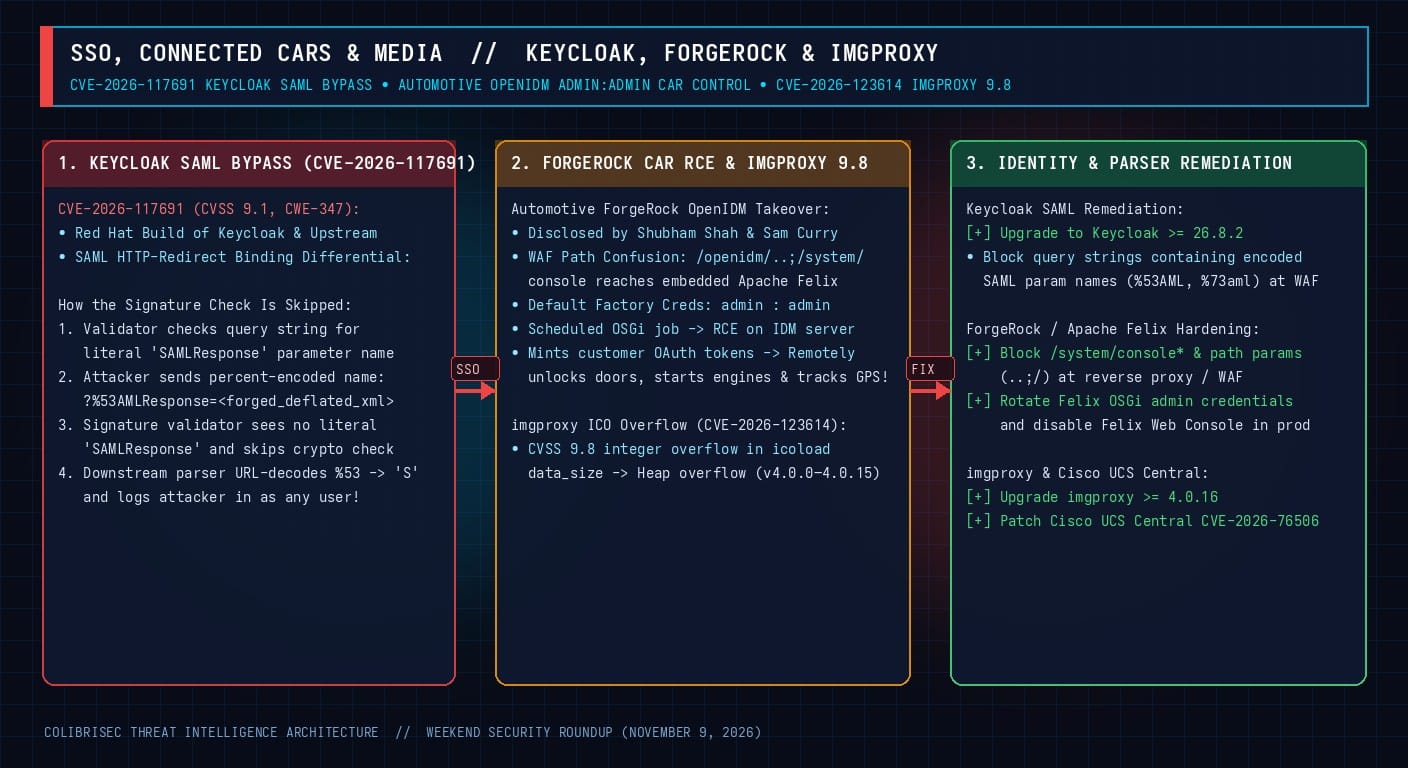
1. Keycloak SAML HTTP-Redirect Percent-Encoding Signature Bypass (CVE-2026-117691)
In the SAML 2.0 HTTP-Redirect Binding (unlike the HTTP-POST binding where the XML signature is embedded inside the XML document), the DEFLATE-compressed and Base64-encoded SAMLResponse or SAMLRequest is passed in the URL query string, and the cryptographic signature is passed alongside it in separate query parameters (SigAlg and Signature) calculated over the raw query string bytes: SAMLResponse=value&RelayState=value&SigAlg=value.
How %53AMLResponse Tricks the Validator (CWE-347)
Tracked as CVE-2026-117691 (CVSS 9.1 Critical, CWE-347), a parser differential existed between Keycloak’s raw query-string signature verification filter and its parameter extraction parser:
/* Conceptual representation of CVE-2026-117691 in Keycloak SAML HTTP-Redirect binding */
public void verifyRedirectSignature(URI requestUri, PublicKey idpKey) {
    String rawQuery = requestUri.getRawQuery();
    /* 1. Signature validator searches the raw query string for literal
     *    "SAMLResponse=" or "SAMLRequest=".
     *    If the attacker sends "?%53AMLResponse=<forged_deflated_xml>"
     *    (where %53 is URL-encoded 'S'), rawQuery does NOT match literal
     *    "SAMLResponse=", so the validator assumes no SAML message is present
     *    or skips signature verification! */
    if (!rawQuery.contains("SAMLResponse=") && !rawQuery.contains("SAMLRequest=")) {
        return; /* SIGNATURE CHECK SKIPPED! */
    }
    ...
}

/* 2. Moments later, the servlet/JAX-RS parameter map URL-decodes parameter names:
 *    "%53AMLResponse" -> "SAMLResponse"
 *    Keycloak inflates the unsigned, attacker-forged SAML assertion and logs the
 *    attacker into any federated account (including super-admins)! */
Any Keycloak deployment acting as a SAML Service Provider (Identity Broker) or IdP using HTTP-Redirect bindings prior to Keycloak 26.8.2 (and unpatched Red Hat Build of Keycloak releases) is vulnerable to unauthenticated account takeover.
2. Automotive ForgeRock OpenIDM WAF Bypass & admin:admin Remote Car Control
Published in November 2026 by researchers Shubham Shah and Sam Curry, this vulnerability chain targeted the customer identity and telematics platforms of two major automakers using ForgeRock Identity Management (OpenIDM) to authenticate mobile iOS/Android companion apps:
- Stage 1 — WAF Path-Confusion Bypass: Both automakers placed a Web Application Firewall (WAF) in front of their ForgeRock IDM servers to block external access to administrative endpoints such as
/system/console. However, by utilizing URL path-confusion tricks (such as semicolon path parameters or traversal normalizations like/openidm/..;/system/console) where the WAF saw a permitted/openidm/prefix while the backend Jetty/OSGi container normalized the path to/system/console, the researchers routed requests directly to the embedded Apache Felix Web Console. - Stage 2 — Default Factory Credentials (
admin:admin): Despite vendor hardening checklists explicitly warning administrators to disable or re-key the OSGi console before production deployment, both automakers left the Apache Felix console running with its default factory login:admin:admin. - Stage 3 — Scheduled Job RCE & Telematics Token Minting: Using the console access, the researchers deployed a scheduled task that executed arbitrary shell commands on the production identity servers. From there, they accessed OpenIDM’s master configuration credentials, queried the global customer directory, and minted valid OAuth/session tokens for arbitrary vehicle owners—granting full access to the connected-vehicle telematics APIs (remote door unlock, remote engine start/stop, horn/lights, and real-time GPS tracking).
3. imgproxy ICO Loader Heap Buffer Overflow (CVE-2026-123614) & Cisco UCS Central RCE (CVE-2026-76506)
imgproxyInteger-to-Heap Overflow (CVE-2026-123614, CVSS 9.8): Disclosed on November 8, 2026,imgproxyversions4.0.0through4.0.15suffer from an integer overflow inside the ICO image format loader (icoload). When parsing a crafted.icodirectory entry with a maliciousdata_sizefield, 32-bit integer arithmetic wraps around during buffer size calculation, allocating an undersized heap chunk and copying attacker-controlled image data out-of-bounds onto the heap (fixed inimgproxy 4.0.16).- Cisco UCS Central Software RCE (CVE-2026-76506): Patched on November 4, an authenticated path-traversal and insufficient input validation flaw in Cisco UCS Central Software’s web interface allowed low-privileged users to overwrite arbitrary files and execute arbitrary OS commands.
Remediation & WAF Rules
# 1. Nginx / Envoy WAF Rule to Block Keycloak Percent-Encoded SAML Bypass (CVE-2026-117691)
#    AND ForgeRock / Apache Felix Path-Confusion Bypasses:
if ($query_string ~* "(%[0-9a-f]{2})+.*(samlresponse|samlrequest)|saml.*(%[0-9a-f]{2})+") {
    return 403;
}
location ~* "(^/system/console|..;/|;jsessionid=|/felix)" {
    deny all;
    return 403;
}
# 2. Upgrade Keycloak to 26.8.2+ and imgproxy to 4.0.16+:
docker pull quay.io/keycloak/keycloak:26.8.2
docker pull darthsim/imgproxy:v4.0.16
