
Linux Kernel & APT Zero-Days: IPv4/TCP SYN Remote UAF RCE (CVE-2026-98432), UDP Socket LPE (CVE-2026-98276) & Debian/Ubuntu APT MitM (CVE-2026-109518)


CVE-2026-98432, CVE-2026-98276 & CVE-2026-109518 (CWE-416 / CWE-362 (Use-After-Free Race Condition) & CWE-59 / CWE-347 (Link & Verification Bypass))
Severity: CRITICAL (UNAUTHENTICATED REMOTE KERNEL UAF RCE, LOCAL ROOT LPE & APT PACKAGE MITM) (CVSS 9.8 Critical (CVE-2026-98432 TCP RCE), 7.8 High (CVE-2026-98276 UDP LPE) & 7.7 High (CVE-2026-109518 APT MitM))
Threat Actor: Kernel Security Researchers & Max Justicz (CVE-2026-109518 Discovery)
Status: Emergency Kernel & APT Advisories Issued Nov 4–8, 2026; Active Patch Rollouts Underway
Affected Systems: Linux Kernel IPv4 TCP/MPTCP & UDP Stacks (RHEL, Ubuntu, AWS EKS Fargate, AlmaLinux, CloudLinux); Debian/Ubuntu APT < 3.0.4
Fixed In: Distro Kernel Advisories (Nov 2026) & Debian/Ubuntu APT 3.0.4+ Security Updates
Between November 4 and November 8, 2026, Linux systems administrators across cloud providers and enterprise datacenters were hit with a triple wave of operating-system advisories affecting the Linux kernel’s networking stack and the Debian/Ubuntu package manager. At the network perimeter, Red Hat, AWS (including EKS Fargate), Ubuntu, and Sophos rushed out updates for CVE-2026-98432 (CVSS 9.8)—an unauthenticated remote Use-After-Free (UAF) race condition inside IPv4 TCP connection setup (tcp_v4_syn_recv_sock) triggered by crafted TCP SYN packets carrying IP options. Simultaneously, CloudLinux and AlmaLinux patched CVE-2026-98276 (CVSS 7.8), a local privilege escalation UAF in UDP socket timestamp ioctls (sock_gettstamp), while Debian and Ubuntu patched CVE-2026-109518 (CVSS 7.7), a clever Man-in-the-Middle (MitM) vulnerability discovered by researcher Max Justicz in APT that allows an on-path HTTP attacker to splice an unverified .deb package into a legitimate install and achieve root code execution.
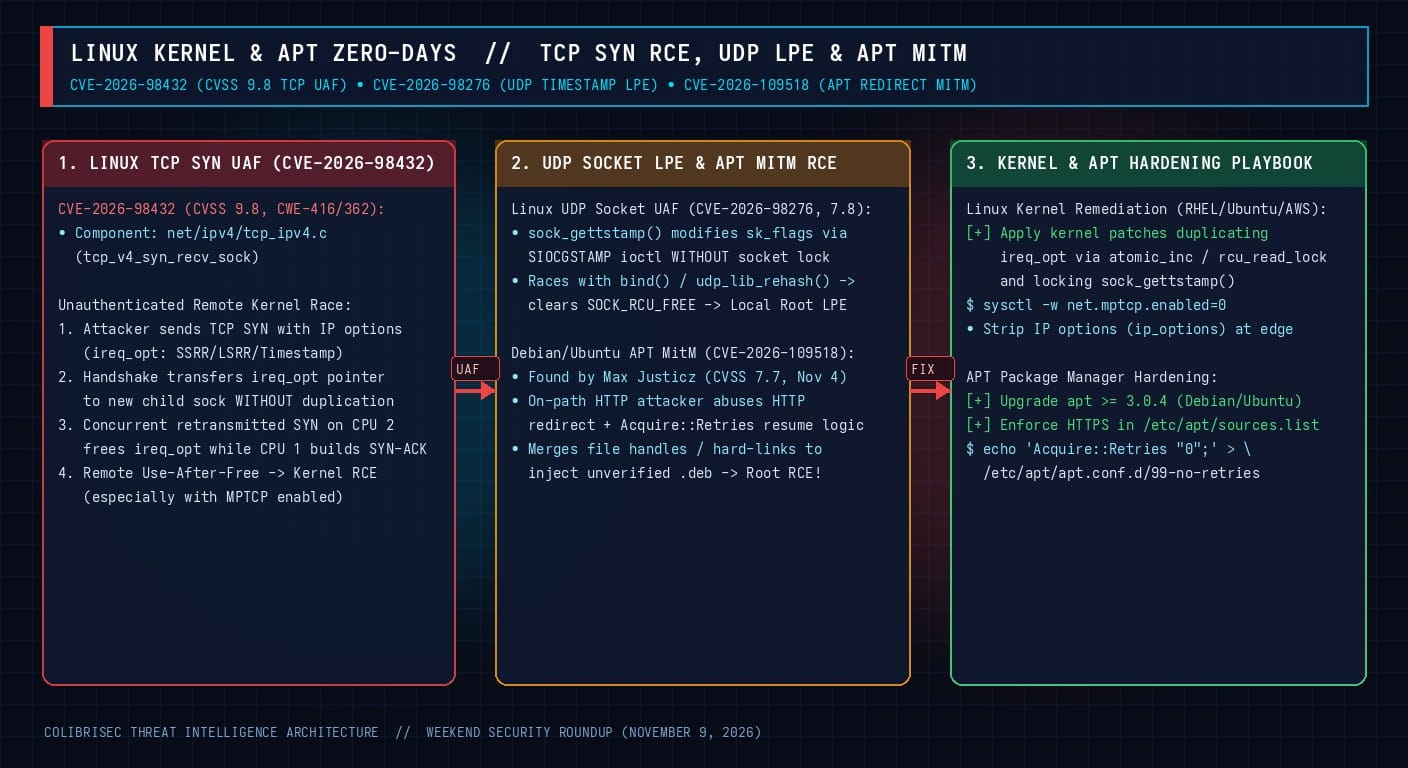
1. Linux Kernel IPv4/TCP tcp_v4_syn_recv_sock Remote UAF RCE (CVE-2026-98432)
CVE-2026-98432 (CVSS 9.8 Critical) resides in net/ipv4/tcp_ipv4.c inside tcp_v4_syn_recv_sock(), the kernel function invoked when a listening TCP socket completes a three-way handshake (or processes SYN cookies / Multipath TCP subflows) to instantiate a full child struct sock from a lightweight struct request_sock.
Mechanics of the ireq_opt Pointer Ownership Race
/* Simplified illustration of CVE-2026-98432 in net/ipv4/tcp_ipv4.c */
struct sock *tcp_v4_syn_recv_sock(const struct sock *sk, struct sk_buff *skb,
                                  struct request_sock *req, struct dst_entry *dst, ...) {
    struct inet_request_sock *ireq = inet_rsk(req);
    struct inet_sock *newinet;
    struct sock *newsk = tcp_create_openreq_child(sk, req, skb);
    if (!newsk)
        return NULL;

    newinet = inet_sk(newsk);
    /* BUG: Transfers ownership of ireq->ireq_opt (IP options parsed from SYN)
     * directly to newinet->inet_opt WITHOUT atomic refcount increment or kmalloc
     * duplication, while concurrent CPUs handling retransmitted SYNs or MPTCP
     * subflow joins can still access or free ireq->ireq_opt! */
    rcu_assign_pointer(newinet->inet_opt, rcu_dereference(ireq->ireq_opt));
    ...
}
When an unauthenticated remote attacker sends TCP SYN packets containing IPv4 options (such as Loose/Strict Source Route, Record Route, or IP Timestamp options) and races concurrent retransmitted SYN / ACK packets across multiple CPUs—especially on hosts with Multipath TCP (MPTCP) or specific socket migration features active—one CPU can free the ip_options_rcu buffer while another CPU reads or frees it again during SYN-ACK transmission or child socket teardown, yielding a remote kernel Use-After-Free in the kmalloc-* slab caches.
2. Linux Kernel UDP Socket Timestamp UAF LPE (CVE-2026-98276)
While CVE-2026-98432 is remote, CVE-2026-98276 (CVSS 7.8 High) provides local unprivileged users (or compromised container processes) a reliable path to kernel privilege escalation. In the Linux networking subsystem, modifying a socket’s flags (sk->sk_flags) requires holding the socket lock because sk_flags is a bitfield where non-atomic read-modify-write operations can clobber adjacent bits:
- The Locking Violation in
sock_gettstamp(): When a user process callsioctl(fd, SIOCGSTAMP, ...)orSIOCGSTAMPNSon a UDP socket to query packet arrival timestamps,sock_gettstamp()callssock_enable_timestamps(), which modifiessk->sk_flagswithout acquiringlock_sock(sk). - Clobbering
SOCK_RCU_FREEDuringbind(): If another thread concurrently callsbind()on the same UDP socket,udp_lib_rehash()sets theSOCK_RCU_FREEbit insk->sk_flagsto ensure the socket is not freed until an RCU grace period elapses. When the unlockedSIOCGSTAMPioctl races withudp_lib_rehash(), its stale write overwritessk->sk_flagsand clearsSOCK_RCU_FREE—causing the UDP socket to be freed immediately on close while in-flight RCU packet-receive paths still dereference the freedstruct sock!
3. Debian & Ubuntu APT Package Manager MitM Root RCE (CVE-2026-109518)
Discovered by security researcher Max Justicz (long known for uncovering critical package-manager parser bugs) and disclosed on November 4, 2026, CVE-2026-109518 (CVSS 7.7 High) affects APT (Advanced Package Tool) on Debian, Ubuntu, and derivative distributions when fetching packages over cleartext HTTP mirrors (which remains the default in many standard base images because APT relies on GPG Release signatures for integrity).
How HTTP Redirects + Acquire::Retries Splice an Unverified .deb
Normally, APT downloads a package into a partial staging directory, hashes the downloaded bytes, and verifies that the SHA-256 digest matches the GPG-signed Release / Packages manifest before handing the .deb to dpkg as root. However, Justicz discovered that when an on-path attacker intercepts an HTTP package request and combines crafted HTTP 301/302 redirects with interrupted responses that trigger APT’s automatic download-resume retry logic (governed by Acquire::Retries), APT improperly manages hard links and destination file handles across the retry boundary. By forcing a retry after verification state or file-handle binding has been confused, the MitM attacker can overwrite or substitute the verified package file with a malicious, attacker-controlled .deb archive that is then installed directly as root.
Remediation & Mitigation Commands
# 1. Patch Debian / Ubuntu APT & Apply Immediate Retry/HTTPS Mitigations (CVE-2026-109518):
sudo apt-get update && sudo apt-get install --only-upgrade apt
# Workaround / Defense-in-Depth: Disable HTTP resume retries and enforce HTTPS mirrors:
echo 'Acquire::Retries "0";' | sudo tee /etc/apt/apt.conf.d/99-disable-retries
sudo sed -i 's|http://|https://|g' /etc/apt/sources.list /etc/apt/sources.list.d/*.list 2>/dev/null

# 2. Mitigate Linux Kernel TCP SYN UAF (CVE-2026-98432) Pending Reboot:
# Disable Multipath TCP (MPTCP) if not required in production:
sudo sysctl -w net.mptcp.enabled=0
echo "net.mptcp.enabled = 0" | sudo tee /etc/sysctl.d/99-disable-mptcp.conf

# Drop incoming IPv4 packets carrying IP Options (ihl > 5) at nftables / iptables perimeter:
sudo iptables -I INPUT -p tcp --syn -m u32 --u32 "0>>24&0x0f=0x06:0x0f" -j DROP

# 3. Apply Distro Kernel Updates for CVE-2026-98432 & CVE-2026-98276:
# Ubuntu / Debian:
sudo apt-get update && sudo apt-get dist-upgrade
# RHEL / AlmaLinux / CloudLinux:
sudo dnf update kernel* && sudo reboot
