
Global Extortion, Taxpayer & Academic Breaches: Expedia "N0N" Claim, Philippines BIR 10M Probe, Iris Ohyama 7.7M, UChicago CS & Italian FM Tajani Leak

Beyond zero-day kernel and firewall vulnerabilities, the weekend of November 6–9, 2026 delivered a high-velocity wave of extortion claims, retail cloud breaches, government tax-record investigations, campus containment lockouts, and state-aligned doxxing. From extortion group N0N’s unverified listing of Expedia Group on November 9 and the Philippine government’s emergency probe into an alleged 10-million-record Bureau of Internal Revenue (BIR) leak, to Iris Ohyama’s 7.7-million-customer cloud breach, the University of Chicago Computer Science Department’s CNet ID lockout, and pro-Russian hackers leaking personal details of Italian Foreign Minister Antonio Tajani, here is what enterprise threat intelligence teams need to know.
1. Expedia Group & The "N0N" Extortion Claim: Triage of Unverified Mega-Bluffs
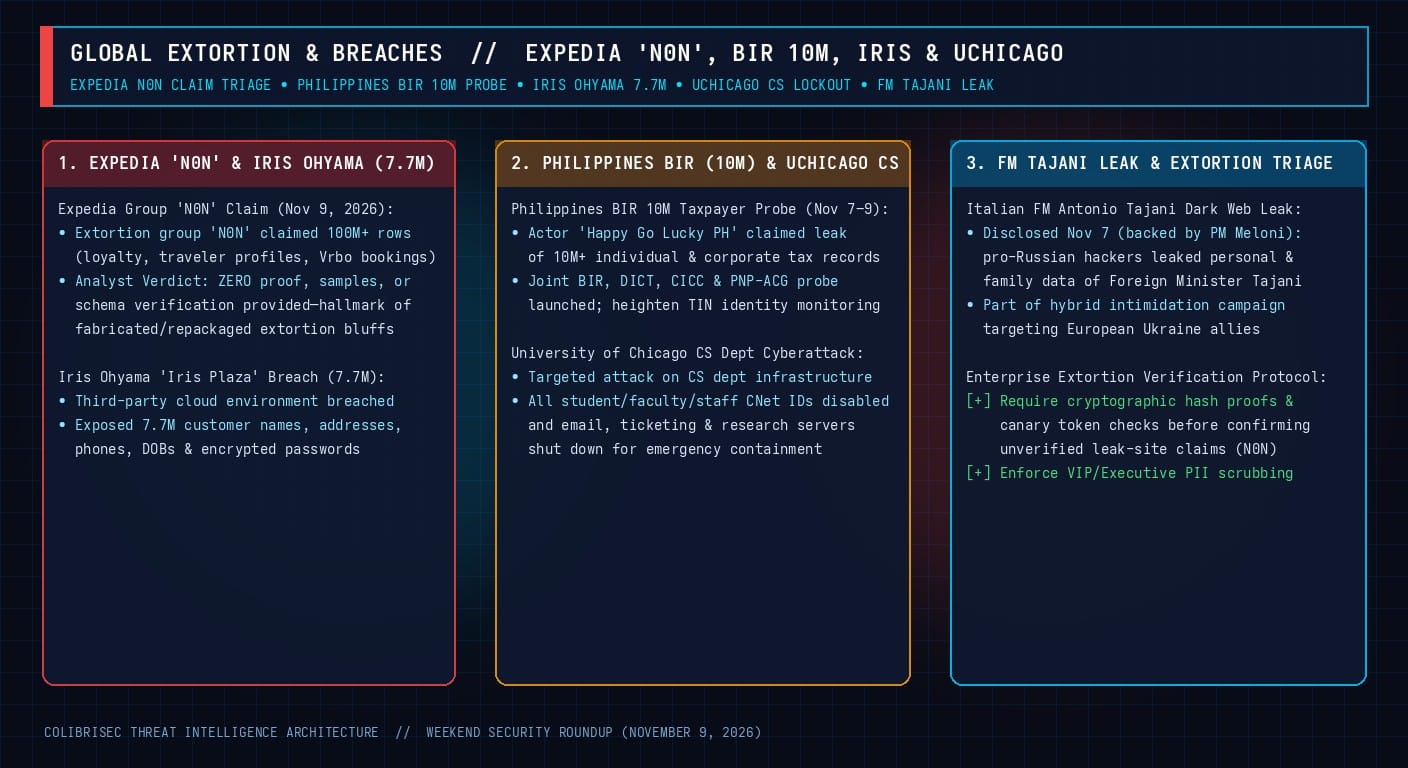
On November 9, 2026, an extortion group operating under the moniker N0N updated its dark web leak portal with an entry targeting global travel giant Expedia Group. In its post, N0N claimed to have exfiltrated hundreds of millions of sensitive records spanning customer loyalty program accounts, traveler profiles, credentials, booking extracts, and Vrbo vacation-rental reservation records.
However, threat intelligence analysts examining the listing immediately flagged a critical anomaly: N0N provided zero empirical proof, zero redacted data samples, zero database schemas, and zero cryptographic file trees to substantiate its headline numbers. In late 2026, newly branded extortion portals have increasingly resorted to fabricating or repackaging old credential-stuffing combolists under the names of Fortune 500 brands to generate media panic and pressure executives into paying for non-existent or recycled data. Security teams should treat unverified claims like N0N’s with strict forensic skepticism—demanding canary-record verification and log correlation before triggering public breach workflows—while reminding travelers to maintain unique passwords and MFA on loyalty portals.
2. Philippines Bureau of Internal Revenue (BIR) 10M Taxpayer Probe & Iris Ohyama’s 7.7M Cloud Breach
- Philippines BIR 10-Million Taxpayer Investigation (Nov 7–9, 2026): Over the weekend, the Philippines’ Bureau of Internal Revenue (BIR)—working jointly with the Department of Information and Communications Technology (DICT), the Cybercrime Investigation and Coordinating Center (CICC), and the Philippine National Police Anti-Cybercrime Group (PNP-ACG)—launched an urgent investigation after a threat actor using the handle "Happy Go Lucky PH" claimed on deep-web monitoring channels to have breached over 10 million individual and corporate taxpayer records. The BIR heightened security protocols across its e-services portals while forensic teams verify whether the posted dataset originates from core BIR databases, a regional contractor, or aggregated historical filings.
- Iris Ohyama "Iris Plaza" 7.7M Customer Cloud Breach: Japanese household goods and electronics manufacturer Iris Ohyama confirmed that an intrusion into an external third-party cloud environment powering its official online store, Iris Plaza, potentially exposed personal data belonging to approximately 7.7 million customers and members—including full names, physical addresses, telephone numbers, dates of birth, email addresses, and encrypted account passwords (while payment card details were processed externally and not stored in the affected environment).
3. University of Chicago CS Department CNet ID Lockout & Italian FM Antonio Tajani Dark Web Leak
- University of Chicago Computer Science Cyberattack: Following a series of targeted cyberattacks against the Department of Computer Science (CS) infrastructure at the University of Chicago, departmental tech staff and university IT leadership executed an aggressive containment protocol: temporarily disabling all student, faculty, and staff CNet IDs associated with the department and shutting down departmental email servers, support ticketing systems, coursework/research compute clusters, and departmental websites. Initial forensic updates indicated that rapid isolation prevented user data loss while credentials and servers are rebuilt.
- Pro-Russian Dark Web Leak Targeting Italian Foreign Minister Antonio Tajani (Nov 7): On Saturday, November 7, Italian Deputy Prime Minister and Foreign Minister Antonio Tajani announced that pro-Russian threat actors had published his personal contact data and information concerning his family on the dark web. Prime Minister Giorgia Meloni condemned the act as part of an ongoing hybrid intimidation campaign targeting Italian institutions over Rome’s steadfast military and diplomatic support for Ukraine.
Incident Response & Extortion Verification Checklist
# Enterprise Playbook for Evaluating Dark Web Extortion Claims & Third-Party Cloud Breaches:
1. Demand Cryptographic Proof: Never validate a dark web leak claim (e.g., N0N) based on
   row-count assertions alone. Require exact schema headers, recent timestamped rows (within
   the last 7 days), and check for internal honeytokens / canary records.
2. Third-Party Cloud E-Commerce Isolation (Iris Ohyama Lesson): Audit external agencies and
   SaaS e-commerce operators hosting brand storefronts; enforce short-lived PII retention
   and Argon2id password hashing.
3. Departmental Blast-Radius Segmentation (UChicago Lesson): Separate academic/research compute
   cluster identities from central campus SSO so a departmental server intrusion does not
   require locking out primary enterprise/campus directory IDs.
