
U.S. Bankruptcy Noticing Center Outage: BAE Systems Contractor Cyberattack Halts Federal Judiciary Notice Distribution

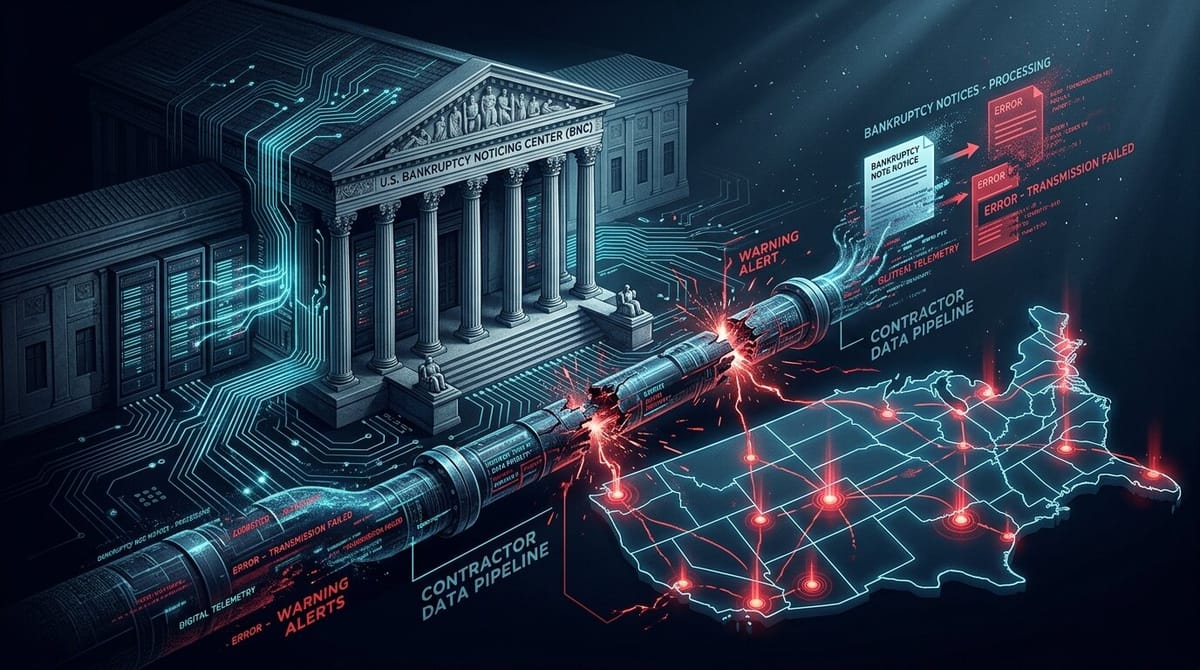
A single contractor compromise has paralyzed a foundational pillar of the United States federal court system. Entering the weekend of October 16–19, 2026, federal bankruptcy courts across the nation issued emergency administrative orders after the Administrative Office of the U.S. Courts (AOUSC) confirmed that the U.S. Bankruptcy Noticing Center (BNC) was knocked offline by a cybersecurity incident at its operator, defense and technology contractor BAE Systems IT. The attack severed the automated legal notice distribution pipeline serving all 94 federal judicial districts.
Architectural Single Point of Failure: How the BNC Pipeline Works
While individual U.S. Bankruptcy Courts manage their dockets via the federal judiciary’s Case Management/Electronic Case Files (CM/ECF) system, courts do not print or mail millions of statutory notices (such as § 341 meeting of creditors notices, discharge orders, and bar date warnings) locally. Instead, every night, all 94 bankruptcy courts batch-transmit encrypted notice payloads to the centralized Bankruptcy Noticing Center (BNC) operated under federal contract by BAE Systems.
[94 U.S. Federal Bankruptcy Courts (CM/ECF Enclaves)]
                         |
                         | Nightly Automated Batch Extracts (XML / PostScript / PDF)
                         v
       ====== [ X - SEVERED FORENSIC BOUNDARY ] ======
                         |
     [BAE Systems IT - Bankruptcy Noticing Center (BNC)]
       |- bnc.uscourts.gov (OFFLINE)
       |- bankruptcynotices.uscourts.gov (OFFLINE)
       |- notices.uscourts.gov (OFFLINE)
       |- National Creditor Registration Service / EBN (OFFLINE)
       |- High-Speed Physical Print & USPS Mail Sortation Facilities (HALTED)
When BAE Systems detected the cyberattack within the BNC operational enclave (with disruptions beginning October 9 and formally confirmed as a cyberattack by the AOUSC on October 15), the contractor severed all external connectivity to contain the intrusion. This immediately took down four critical judicial portals—bnc.uscourts.gov, bankruptcynotices.uscourts.gov, notices.uscourts.gov, and the National Creditor Registration Service—and halted both Electronic Bankruptcy Noticing (EBN) via EDI/XML and physical USPS mail production.
Legal & Operational Fallout Across Federal Districts
In federal bankruptcy law, statutory notice windows are strictly enforced: creditors must receive timely notice to file proofs of claim, object to reorganization plans, or contest motions to lift the automatic stay under 11 U.S.C. § 362. Because the BNC outage prevented court clerks from certifying that statutory notices were transmitted, bankruptcy courts from New York and Delaware to Texas and California were forced to issue standing orders instructing debtors' counsel to perform manual service via first-class mail or extending statutory objection deadlines.
Assessing the PII & Data Exposure Risk
While BAE Systems and the AOUSC emphasized that the core judicial CM/ECF network remained segregated from the contractor's BNC enclave, bankruptcy notices routinely contain sensitive debtor and creditor data, including full names, residential and corporate addresses, partial or redacted Social Security / Tax ID numbers, and financial claim amounts. Forensic investigators are currently auditing whether the threat actor exfiltrated staged print/EDI queues prior to containment.
Supply-Chain Resilience Lessons for Government & Enterprise
- Eliminate Single-Vendor Bottlenecks for Statutory Workflows: Critical government and financial noticing pipelines must architect active-passive multi-vendor failover (e.g., secondary cloud print/EDI clearinghouses) capable of ingesting standard CM/ECF XML batches within 24 hours of a primary contractor outage.
- Unidirectional Pull vs. Push Batch Architecture: Government enclaves should never grant contractor networks inbound session initiation privileges. Batch data transfers must utilize ephemeral, Zero-Trust storage buckets where the contractor pulls encrypted, time-bound payloads that are automatically purged post-processing.
- Strict Data Minimization in Notice Payloads: Ensure that outbound noticing batches strip all unredacted tax identifiers and sensitive attachment metadata before crossing into third-party print/mailing contractor environments.

