Enterprise Hardening Blueprint: Entra ID Service Principal Governance, Memory-Resident Malware Hunting & Management Plane Isolation

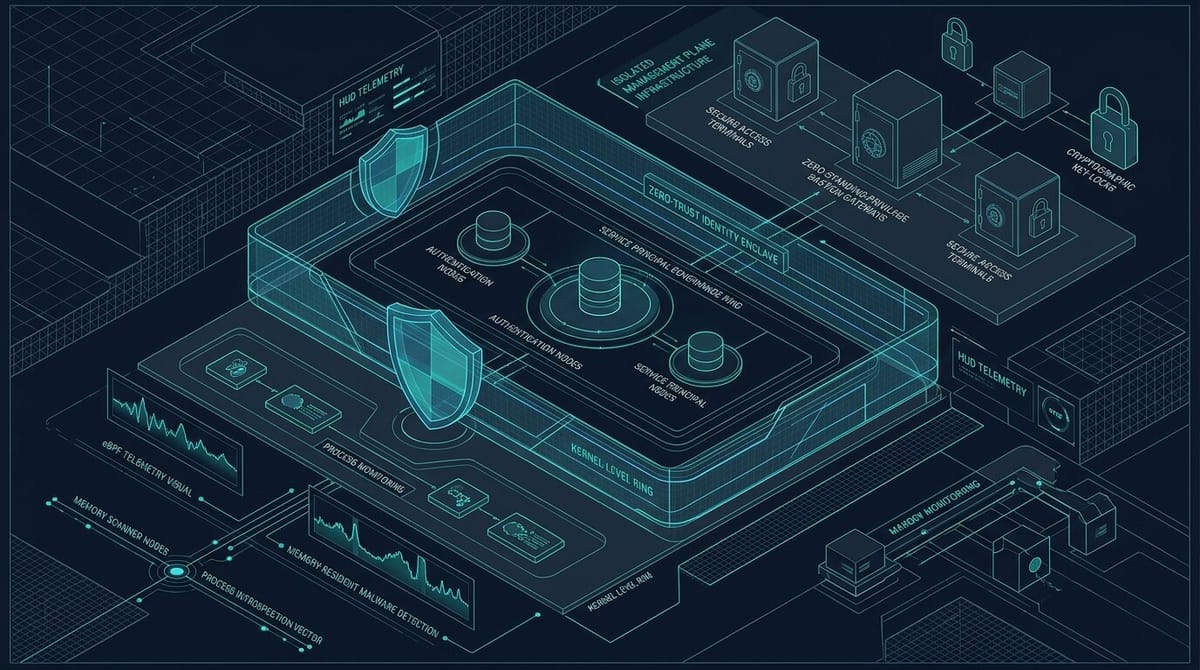
The disclosures of the October 16–19, 2026 weekend demonstrate that traditional perimeter-and-EDR security models are blind to three rapidly converging attack surfaces: pre-consented multi-tenant OAuth service principals, diskless memory-resident implants on network appliances, and high-velocity AI API token siphoning. This engineering blueprint provides concrete, copy-pasteable configurations to close these architectural gaps immediately.
1. Hardening Microsoft Entra ID Against Vendor Service Principal Compromise
In the ConnectWise Cloud Backup (SkyKick) breach, attackers bypassed user MFA across hundreds of tenants because app-only OAuth tokens (client_credentials) do not evaluate user Conditional Access rules. To neutralize compromised third-party vendor secrets, organizations must deploy Conditional Access for Workload Identities combined with automated Microsoft Graph permission auditing:
# PowerShell (Microsoft.Graph): Audit all third-party multi-tenant Service Principals
# holding dangerous read/write application scopes (Mail, Files, Directory, RoleManagement)
Connect-MgGraph -Scopes "Application.Read.All", "Directory.Read.All"

$HighRiskPermissions = @(
    "Directory.ReadWrite.All",
    "RoleManagement.ReadWrite.Directory",
    "Mail.ReadWrite",
    "full_access_as_app",
    "Files.ReadWrite.All",
    "Sites.FullControl.All"
)

$ServicePrincipals = Get-MgServicePrincipal -All | Where-Object {
    $_.AppOwnerOrganizationId -ne (Get-MgOrganization).Id -and
    $_.AppOwnerOrganizationId -ne "f8cdef31-a31e-4b4a-93e4-5f571e91255a" # Exclude 1st-party Microsoft
}

foreach ($sp in $ServicePrincipals) {
    $grants = Get-MgServicePrincipalAppRoleAssignment -ServicePrincipalId $sp.Id
    foreach ($grant in $grants) {
        # Flag external vendor Service Principals for immediate IP Named Location lockdown
        Write-Output "[AUDIT] External SP: $($sp.DisplayName) | AppId: $($sp.AppId) | RoleId: $($grant.AppRoleId)"
    }
}
Once external vendor Service Principals are cataloged, create a Workload Identity Conditional Access Policy that blocks token issuance for those Service Principals unless the request originates from the vendor’s verified static egress IP ranges (Named Locations).
2. eBPF Kernel Telemetry to Catch Diskless Daemon Injection (PEERSTITCH & BARECLAW)
Both UNC5820’s PEERSTITCH (injected into FortiOS iked and miglogd) and Armory Castle’s BARECLAW operate in volatile memory to evade disk-based file integrity monitoring. On Linux-based appliances and perimeter bastions where eBPF (Extended Berkeley Packet Filter) is supported, deploy the following bpftrace / Tetragon runtime guard to alert on any cross-process memory modification via ptrace, process_vm_writev, or /proc/$PID/mem writes:
// bpftrace script: detect_daemon_memory_injection.bt
// Alerts immediately if any process attempts to inject shellcode into running daemons
tracepoint:syscalls:sys_enter_ptrace
/args->request == 4 || args->request == 5/ // PTRACE_POKETEXT / PTRACE_POKEDATA
{
    printf("[CRITICAL ALERT] PTRACE Memory Injection: pid=%d (%s) -> target_pid=%d\n",
           pid, comm, args->pid);
}

tracepoint:syscalls:sys_enter_process_vm_writev
{
    printf("[CRITICAL ALERT] Cross-Process VM Write: pid=%d (%s) -> target_pid=%d\n",
           pid, comm, args->pid);
}

tracepoint:syscalls:sys_enter_openat
/strcontains(str(args->filename), "/proc/") && strcontains(str(args->filename), "/mem")/
{
    if (args->flags & 1 || args->flags & 2) { // O_WRONLY or O_RDWR
        printf("[CRITICAL ALERT] Direct /proc/pid/mem Write Attempt by pid=%d (%s) on %s\n",
               pid, comm, str(args->filename));
    }
}
3. Eliminating IPC Spoofing & WAF Management Plane Exposure
To prevent origin-validation bypasses like BeyondTrust CVE-2026-102764 and WAF statistics command injection like SiteGuard CVE-2026-106931, enforce two strict reverse-proxy rules at the upstream network edge:
# Upstream Nginx Edge Hardening for Enterprise Appliances
server {
    listen 443 ssl http2;
    server_name support.enterprise.example;

    # 1. Strip all internal IPC / Origin headers from external requests (Mitigates CVE-2026-102764)
    proxy_set_header X-Bt-Internal-Origin "";
    proxy_set_header X-Bt-Component-Auth "";
    proxy_set_header X-Forwarded-Host $host;

    # 2. Block external access to WAF statistics & appliance admin URIs (Mitigates CVE-2026-106931)
    location ~* ^/(siteguard/stats| siteguard/manager|php/utils/|api/v1/admin) {
        allow 10.250.1.0/24; # Dedicated PAW / Bastion Subnet Only
        deny all;
    }

    # 3. Block Drupal Render Array '#' (%23) callback injection attempts (Mitigates CVE-2026-108097)
    if ($query_string ~* "(%23|#)(pre_render|post_render|lazy_builder)") {
        return 403;
    }
}
4. Defending Against AI API Key Siphoning & Distillation Attacks
Following the OpenCode Console breach, engineering teams should prohibit developers from storing raw OpenAI, Anthropic, or Google Gemini bearer keys in third-party cloud tools. Instead, issue short-lived virtual keys backed by a self-hosted LiteLLM / Envoy AI Proxy with automatic circuit-breakers against distillation workloads:
# litellm_config.yaml: Anti-Distillation Rate Limiting & Virtual Key Governance
general_settings:
  master_key: os.environ/LITELLM_MASTER_KEY
  alerting: ["slack", "pagerduty"]

router_settings:
  routing_strategy: simple-shuffle

litellm_settings:
  # Automatically revoke/block any virtual key exceeding $20/hour or 150,000 TPM
  max_budget: 20.0
  budget_duration: 1h
  default_team_settings:
    tpm_limit: 150000
    rpm_limit: 120