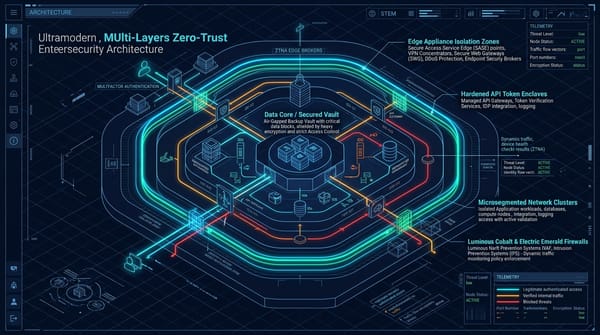
Enterprise Hardening Blueprint: Securing SAML Gateways, Partner API Pipelines & Supply Chain Enclaves
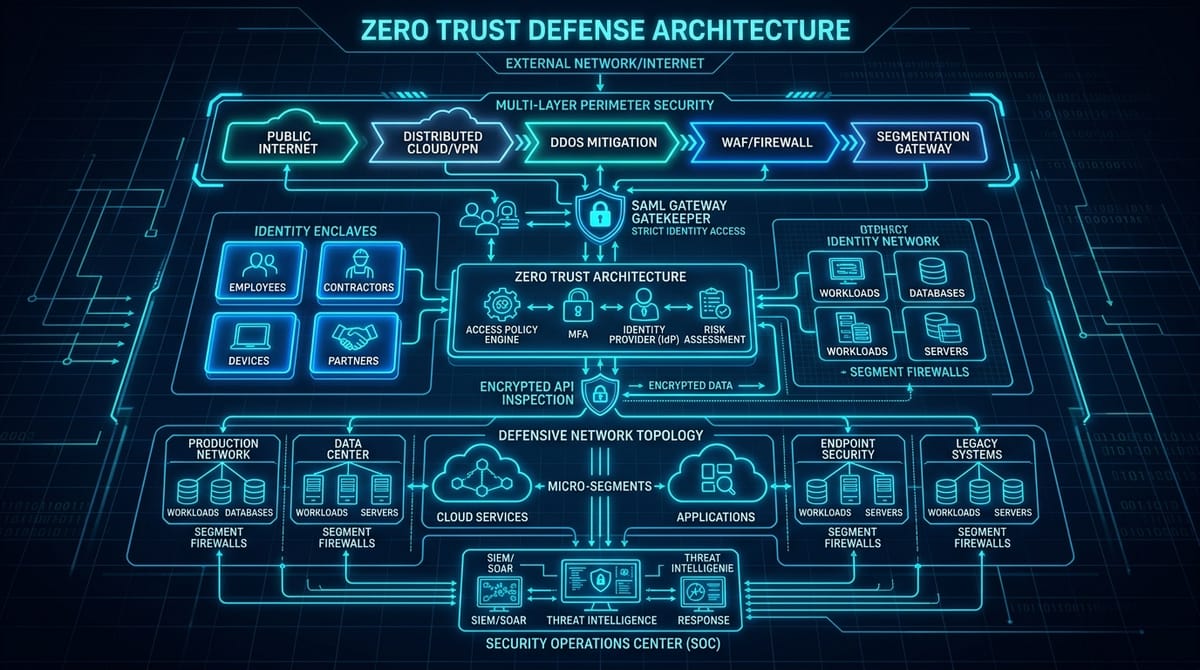
The weekend disclosures of October 3–5, 2026—spanning the Citrix NetScaler SAML memory overflow zero-day (CVE-2026-88779), the 8.8M Denmark CPR partner API scraping catastrophe, AI-discovered PRNG exploitation in Rejetto HFS (CVE-2026-61500), and automated banking credential stuffing—demonstrate that traditional perimeter concepts have fundamentally collapsed. Today's security teams must engineer defense-in-depth architectures capable of mitigating edge appliance memory flaws, containing partner API blast radiuses, and stopping AI-accelerated botnet reconnaissance.
Core Architectural Hardening Pillars
1. Citrix NetScaler SAML & Packet Engine Hardening
To neutralize memory corruption flaws like CVE-2026-88779 on perimeter NetScaler appliances:
- Apply CTX697174 Firmware: Immediately update all NetScaler ADC and Gateway appliances to 14.1-73.41 or 13.1-64.28.
- Deploy Global Deny List Signatures: Enforce WAF rules rejecting HTTP POST requests to SAML assertion endpoints where the payload body exceeds 32 KB or contains deeply nested XML entity expansions.
Automate Core Dump Alerting: Configure SIEM monitors to alert instantly if nsppe produces a core dump in /var/core/, indicating attempted exploitation:
# Monitor NetScaler packet engine health via shell audit
find /var/core/ -name "nsppe*.core" -mtime -1
2. Partner API Security & Scrape-Proofing (CPR Defense)
The Denmark CPR breach proved that having valid partner credentials is often all an attacker needs to harvest millions of records. Defend external B2B APIs with these controls:
Defensive Partner API Pipeline:
Partner Request ──► [mTLS & Hardware Cert] ──► [Volumetric Token Quota Engine]
                                                        │ (Max 500 req/hr)
                                                        ▼
                                             [Behavioral Entropy Engine]
                                             (Flags sequential PII scraping)
                                                        │
                                                        ▼
                                             [Core Database Enclave]
                                             (Returns masked PII by default)
- Enforce Hard Query Ceilings: Limit commercial partner API accounts to strictly defined volumetric quotas (e.g., maximum 500 queries per hour). Any surge exceeding 200% of baseline must trigger an immediate automated freeze.
- Entropy-Based Scraping Detection: Detect sequential querying across numerical ID sequences or contiguous zip codes. Legitimate business searches exhibit random, client-driven distribution.
- Cryptographic Pseudonymization: Return masked identifiers (e.g.,
******-1234) unless an explicit high-privilege justification token is provided.
3. Cryptographic Randomness & Codebase Auditing
As demonstrated by CVE-2026-61500 in Rejetto HFS, relying on non-cryptographic PRNGs for security tokens is catastrophic:
- Automated Static Analysis (SAST): Implement CI/CD linter rules (e.g., Semgrep / CodeQL) that fail builds if
Math.random()or weak random generators are referenced near session, cookie, or encryption functions.
Ban Math.random() in Security Contexts: Mandate the use of cryptographically secure pseudo-random number generators (CSPRNG):
// SECURE: Cryptographically secure token generation
import crypto from 'node:crypto';
const token = crypto.randomBytes(32).toString('hex');
4. Anti-Bot Defense Against AI-Driven Credential Stuffing
To defend financial portals against the high-frequency AI residential proxy attacks observed in South Korea:
- Client Biometric Dynamics: Analyze micro-interactions (mouse trajectory curvature, touch pressure, accelerometer fluctuations) that AI-driven headless browsers cannot easily simulate.
- Residential IP Reputation Scoring: Integrate real-time threat intelligence feeds that calculate proxy risk scores for domestic residential ASN subnets.
- Eliminate Passwords with FIDO2: Accelerate migration to passkeys, rendering credential stuffing entirely ineffective.
Enterprise Verification Matrix
| System Layer | Threat Vector | Architectural Control | Verification Command / Check |
|---|---|---|---|
| Citrix NetScaler | SAML Buffer Overflow (CVE-2026-88779) | CTX697174 Hotfix & SAML Payload Filtering | grep -E 'samlAction|samlIdPProfile' /nsconfig/ns.conf |
| Partner B2B APIs | Automated Bulk Scraping (CPR Breach) | Volumetric Quota & Behavioral Entropy Engine | Audit API gateway throttling rules and query alert thresholds |
| Web Applications | PRNG Key Recovery (CVE-2026-61500) | CSPRNG Enforcement (crypto.randomBytes) |
semgrep --config "p/javascript" --error |
| Authentication Gateways | AI-Driven Residential Credential Stuffing | FIDO2 Passkeys & Biometric Dynamics | Check MFA enrollment percentages and failed login anomaly graphs |
| IAM Core Systems | Legacy Export Endpoint Abuse (DTUBasen) | Mandatory MFA Step-Up & Data Minimization | Review database export permissions and alumni record retention policies |