Operation QUICSILVER: Stealth QUICAgent Go Backdoor Targeting Diplomatic Infrastructure

Analysis of Operation QUICSILVER, an advanced cyber espionage campaign deploying custom Go backdoors communicating over encrypted QUIC protocol tunnels.

Operation QUICSILVER: Stealth QUICAgent Go Backdoor Targeting Diplomatic Infrastructure
📌
Security Roundup Series: Weekend of August 24, 2026 • 5 min read deep dive

A sophisticated cyber espionage campaign dubbed 'Operation QUICSILVER' is targeting government and diplomatic entities, deploying custom Go-based 'QUICAgent' backdoors communicating over encrypted QUIC UDP tunnels.

🏛️
Incident Overview: Threat Actor / Attribution: China-nexus Cyber Espionage Group

Multi-Stage Infection Chain

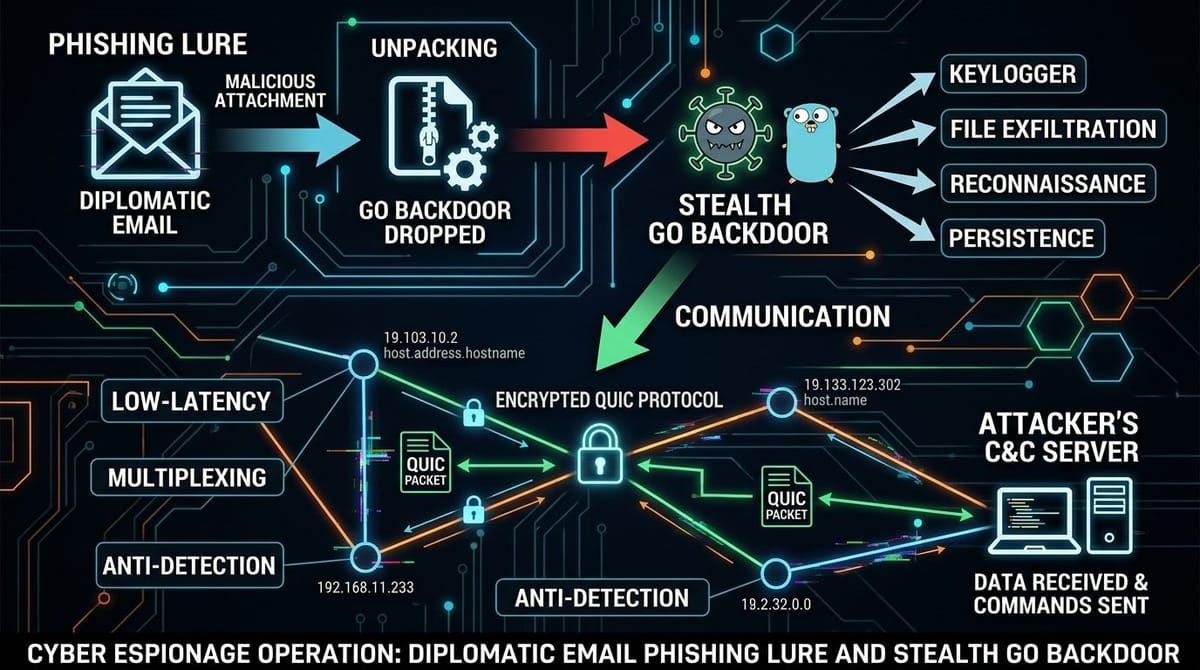
The attackers distribute spear-phishing emails containing malicious Virtual Hard Disk (.vhd) files disguised as formal diplomatic invitations. When mounted by the victim, an embedded LNK file executes the legitimate Windows ftp.exe utility to download and reassemble obfuscated payload chunks without triggering standard perimeter antivirus scanners.

The final payload, dubbed QUICAgent, is a custom Go backdoor. QUICAgent leverages the QUIC protocol over UDP port 443 for command-and-control, allowing the malware to bypass traditional HTTP/HTTPS proxy inspection and deep-packet inspection appliances.

C2 Architecture & Telemetry

🔍
Detection Telemetry: Monitor process executions of ftp.exe invoked with automated script parameters (-s:) by unprivileged user sessions. Hunt for outbound UDP/443 traffic establishing persistent QUIC streams towards dynamic Cloudflare Worker endpoints. Audit registry run keys and startup folder modifications containing compiled Go binaries.

Defensive Hardening

✅
Action Items: Block automatic mounting of ISO and VHD disk image formats on Windows endpoints via Attack Surface Reduction (ASR) rules. Implement strict application whitelisting and restrict child processes spawned by script hosts. Enforce threat intelligence feed blocking on identified QUICAgent C2 indicators.

Read more

Guía de Defensa para CISOs 6 de Noviembre de 2026 Xen XSA-523 Alpine OpenSSH sshhole LXD mTLS cPGuard y Cadena de Frío OT

Guía de Defensa para CISOs del 6 de Noviembre de 2026: Blindaje de Xen Dom0, OpenSSH musl en Alpine, LXD mTLS, Paneles cPGuard/CWP, Controladores OT de Cadena de Frío y AD CS

📌Security Roundup Series: Semana del 6 de Noviembre de 2026 • 9 min de lectura deep dive🚨Vulnerability Intelligence: CVE ID: CVE-2026-119977, CVE-2026-107441, XSA-523, CVE-2026-112816, CVE-2026-123158 y CVE-2026-58868 (Grant Copy en Hipervisor, Validación mTLS, Retorno de Error en musl crypt(a.plerdy.com), TOCTOU y Control de Acceso OT) Severity: MANUAL

By James Luther
Campaña Poisoned Source de APT29 en Plerdy, Kali365 y VoidProxy PhaaS, Teams AD CS y Brechas en Queens Library Myriad y mSecure

Campaña "Poisoned Source" de APT29 (Plerdy), PhaaS con Señuelos de IA (Kali365 y VoidProxy), Toma de Control AD CS vía Teams y Brechas Globales (Queens Library, Myriad Genetics, mSecure y Japón)

📌Security Roundup Series: Semana del 6 de Noviembre de 2026 • 9 min de lectura deep dive🏛️Incident Overview: Target / Organization: Sitios con Plerdy SEO (APT29), Empresas M365/Google (Kali365/VoidProxy), Queens Public Library, Myriad Genetics y mSecure Threat Actor / Attribution: APT29 (Midnight Blizzard), Operadores PhaaS Kali365 / VoidProxy, Brain Cipher Ransomware

By James Luther