
Windows Kernel AFD.sys Zero-Day (CVE-2026-68820): Lazarus Group's Use-After-Free Privilege Escalation Mechanics
Technical deep dive into the actively exploited CVE-2026-68820 Windows kernel afd.sys zero-day: pool spraying, token manipulation, and Lazarus evasion tradecraft.

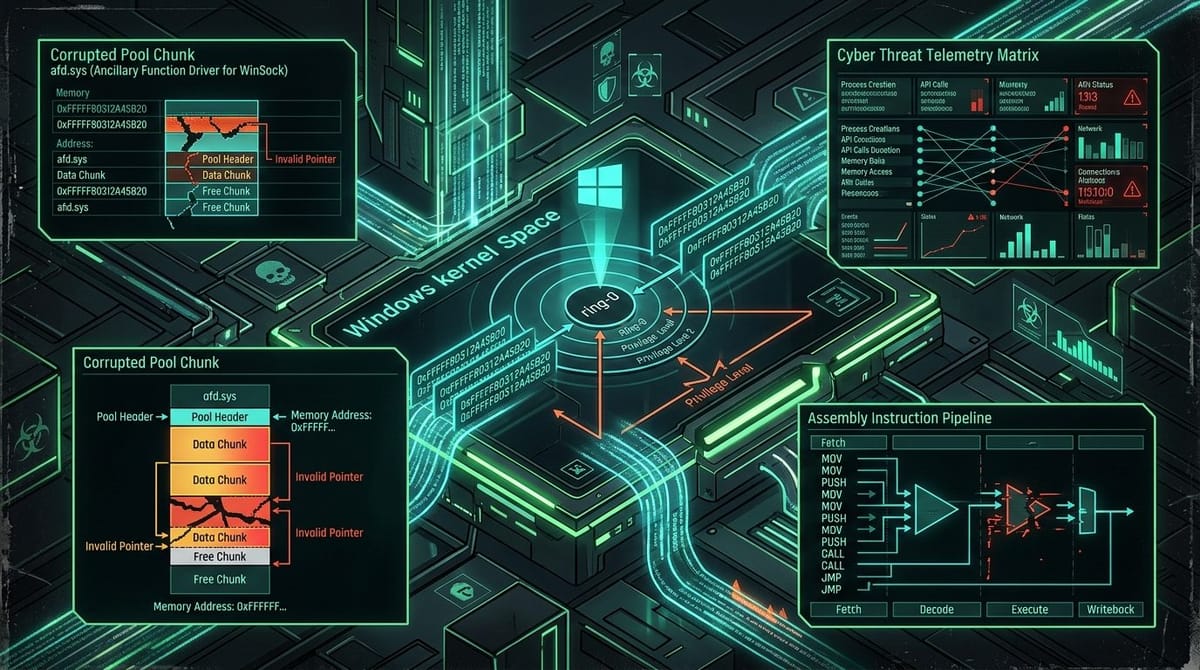
A high-severity Use-After-Free flaw in the Windows Ancillary Function Driver for WinSock (afd.sys), tracked as CVE-2026-68820, was weaponized as a zero-day by nation-state actors including the Lazarus Group to achieve Ring-0 kernel code execution and disable endpoint detection agents.
CVE-2026-68820 (CWE-416: Use-After-Free in Kernel Driver)
Severity: Important / High Impact (CVSS 7.8 (Local SYSTEM Escalation))
Status: 🚨 Active Nation-State Zero-Day Exploitation (Lazarus Group)
Affected Systems: Windows 11, Windows 10, and Windows Server 2022/2025 prior to August patches
Root Cause Mechanics in afd.sys
The flaw exists in how afd.sys handles asynchronous socket I/O completion objects during race conditions. An unprivileged local process allocates socket objects, triggers an abrupt closure, and reclaims the freed kernel memory pool with crafted memory buffers to overwrite function pointers and obtain a Ring-0 write-what-where primitive.
Lazarus Group Post-Exploitation Tradecraft
- Token Stealing: The exploit locates the
EPROCESSstructure of the current thread and substitutes its security token with theNT AUTHORITY\SYSTEMtoken from theSystemprocess (PID 4). - BYOVD & EDR Blinding: Once operating at Ring-0, Lazarus utilizes kernel read/write primitives to zero out notification routines registered by endpoint security drivers (
PspCreateProcessNotifyRoutine).
Detection & Hardening Recommendations
- Patch Immediately: Apply the Microsoft August 2026 Security Update across all endpoints and servers.
- Enable Virtualization-Based Security (VBS) & HVCI: Hypervisor-Protected Code Integrity prevents arbitrary kernel-mode code execution even in the presence of driver memory corruption.

