
CVE-2026-65400: Apple macOS Screen Sharing Authentication Bypass and Cryptominer Weaponization
How attackers exploit CVE-2026-65400 in macOS Screen Sharing to bypass authentication checks and establish unauthorized remote desktop control.

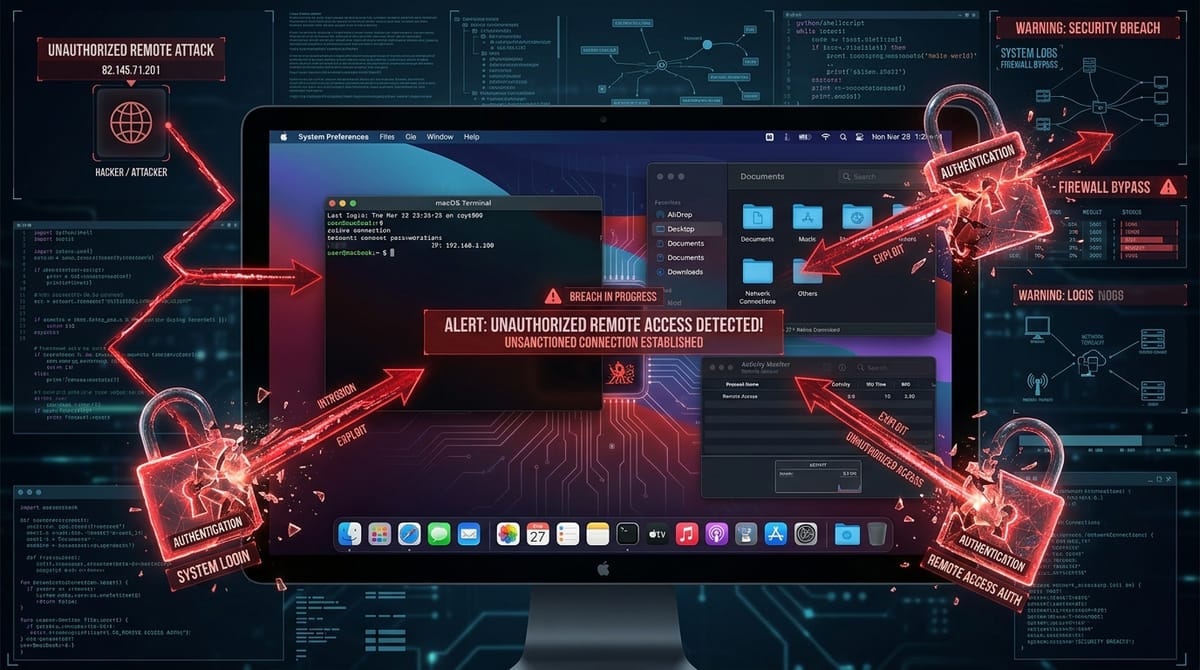
An improper authentication vulnerability in Apple macOS Screen Sharing allows remote threat actors to bypass credential checks, gain desktop GUI control, and deploy persistence mechanisms including cryptocurrency miners.
CVE-2026-65400 (CWE-287: Improper Authentication)
Severity: Critical (CVSS 9.8)
Status: ⚠️ CISA KEV Catalog Added (Active Weaponization)
Affected Systems: macOS Sonoma prior to 14.6.1, macOS Ventura prior to 13.6.9
Fixed In: macOS Sonoma 14.6.1 / macOS Ventura 13.6.9
Vulnerability Mechanics
The macOS Screen Sharing service (operating over VNC/RFB protocol on TCP port 5900) handles remote desktop access. A logical flaw in the authentication handshake verification routine permitted incoming network clients to complete the authentication state machine without validating credentials against the Directory Services PAM stack.
Attackers scanning for exposed port 5900 listeners could establish unauthorized interactive desktop sessions, drop persistence scripts in ~/Library/LaunchAgents, and execute background cryptomining binaries.
Endpoint Detection & IOCs
screensharingd connection events establishing sessions without corresponding opendirectoryd successful auth logs.
Check for newly created LaunchAgents or LaunchDaemons invoking hidden binaries in /tmp or /var/tmp.
Monitor network firewall logs for unapproved inbound TCP 5900 traffic.

