
CVE-2026-33824: Windows IKE Extension Service Double-Free Remote Code Execution
Technical root-cause analysis of CVE-2026-33824, a CVSS 9.8 double-free vulnerability in the Windows IKE service enabling unauthenticated remote code execution.

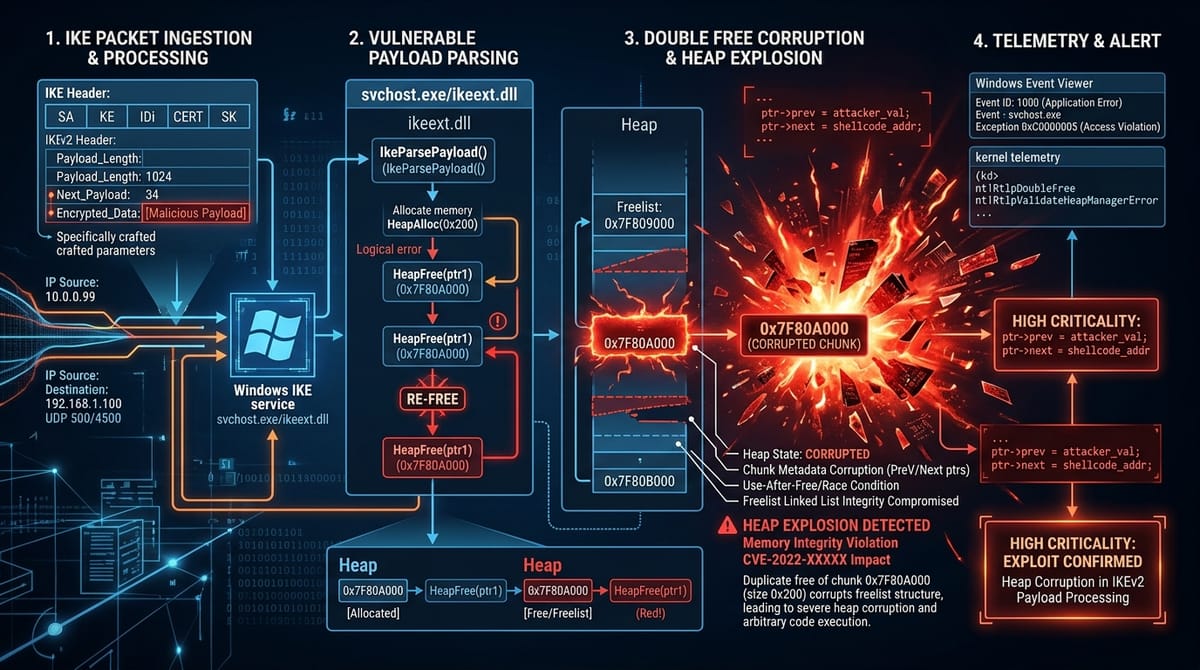
A critical CVSS 9.8 double-free memory corruption flaw in the Windows Internet Key Exchange (IKE) service extension exposes servers and VPN concentrators to unauthenticated pre-handshake remote code execution.
CVE-2026-33824 (CWE-415: Double Free)
Severity: Critical (CVSS 9.8)
Status: ⚠️ CISA KEV Catalog Added (High Exploit Probability)
Affected Systems: Windows Server 2016, 2019, 2022, 2025 and Windows 10/11 running IKE/IPsec services
Fixed In: August 2026 Windows Security Cumulative Update
Protocol Mechanics & Memory Flaw
The Windows IKE service (ikeext.dll within svchost.exe) manages security associations for IPsec VPN connections. When parsing encrypted or malformed vendor extension payloads during Phase 1 SA negotiations over UDP ports 500 and 4500, a memory pointer handling error causes the engine to release an allocated packet buffer twice.
This double-free condition corrupts heap free-lists within the process heap. By carefully staging heap memory with spray payloads, an unauthenticated attacker can achieve reliable remote code execution with NT AUTHORITY\SYSTEM privileges over the network.
Detection & Telemetry
svchost.exe hosting the IKE and AuthIP IPsec Keying Modules service.
Inspect UDP 500 and 4500 packet streams for malformed IKEv2 vendor payload headers with invalid length offsets.

