
CVE-2026-59285: Spring for GraphQL Critical Remote Code Execution — Parser Deserialization Deep Dive
Technical teardown of CVE-2026-59285 in Spring for GraphQL: parser evaluation failure, mutation exploit payload analysis, and dependency upgrade guidance.

📌
Security Roundup Series: Weekend Edition • August 31, 2026 • 5 min read deep dive
A critical remote code execution vulnerability in Spring for GraphQL (CVE-2026-59285), part of the massive 91-advisory August Spring batch, allows unauthenticated remote attackers to execute arbitrary code via crafted GraphQL query parsing payloads.
🚨
Vulnerability Intelligence:
CVE ID:
CVE-2026-59285 (CWE-94 / CWE-502: Improper Control of Generation of Code / Deserialization of Untrusted Data)
Severity: Critical (CVSS 9.8)
Status: 🚨 High Impact Enterprise Vulnerability / Active Research Weaponization
Affected Systems: Spring for GraphQL 1.2.x prior to 1.2.8, 1.3.x prior to 1.3.3
Root Cause Analysis & Query Parser Dynamics
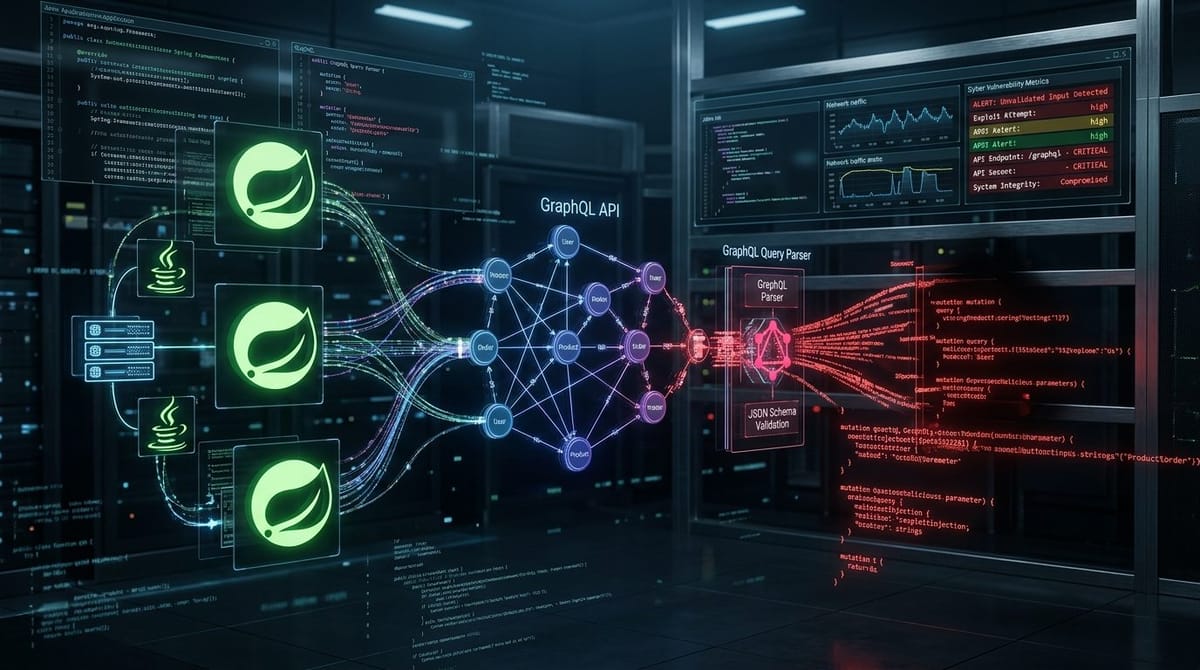
The flaw resides in Spring for GraphQL's argument resolution layer when handling complex nested input types. When processing custom type coercions within GraphQL operations, unvalidated expression language evaluation occurs during schema introspection, allowing remote attackers to invoke arbitrary Java methods on the host JVM.
Exploitation Flow
- Introspection Query Injection: Attackers send a GraphQL mutation containing nested argument payloads with embedded Java expression references.
- Parser Coercion Trigger: The argument resolver fails to sanitize the input before passing it to the internal evaluation context.
- Arbitrary Execution: The JVM evaluates the payload, providing an unauthenticated remote shell under the identity of the application process.
Immediate Remediation
- Update Maven/Gradle Dependencies: Bump
spring-graphqlto 1.3.3 or 1.2.8. - Disable GraphQL Schema Introspection in Production: Restrict public access to the GraphQL schema explorer and introspection queries on exposed perimeters.
🧭
More Deep Dives from this Roundup:
CVE-2026-59285: Spring for GraphQL Critical RCE Analysis
SonicWall SMA 1000 Chained SSRF & Root RCE by UTA0533
CVE-2026-59270: Spring Security LDAP Directory Authentication Bypass
SonicWall Email Security Appliance Code Injection & Root Execution
RansomHub Healthcare Extortion Wave & Dual-Ransom Tactics
← Return to Weekly Overview: Full Roundup

