CVE-2026-21589: Atlassian Data Center Path Traversal Flaw Under Active In-the-Wild Exploitation

CVE-2026-21589 (CWE-22 (Improper Limitation of a Pathname to a Restricted Directory))
Severity: CRITICAL (CVSS 9.3)
Status: Actively Exploited in the Wild (PoC Public Since Oct 6, 2026)
Affected Systems: Bamboo Data Center, Bitbucket Data Center, Confluence Data Center, Crowd Data Center, Crucible, Fisheye, Jira Software Data Center, Jira Service Management Data Center
Fixed In: Confluence 9.2.1/8.5.17, Jira 9.12.14/10.1.1, Bitbucket 8.19.9/9.4.1, Crowd 5.2.5/5.3.3
Between October 6 and October 8, 2026, security researchers and telemetry providers observed widespread automated exploitation targeting CVE-2026-21589 (CVSSv4 9.3), a critical arbitrary file access vulnerability affecting on-premises and Data Center deployments across Atlassian's entire core product suite. The flaw allows unauthenticated remote attackers to retrieve arbitrary files from the server's web root and accessible application directories, paving the way for credential theft, database compromise, and full infrastructure takeover.
Technical Root Cause Analysis
The vulnerability originates in the Atlassian Web Resource Manager library (atlassian-plugins-webresource*.jar), specifically within the component handling dynamic static resource batching and plugin URI resolution. Under normal operations, the framework prevents path traversal by normalizing incoming request paths and rejecting strings containing ../ or URL-encoded equivalents.
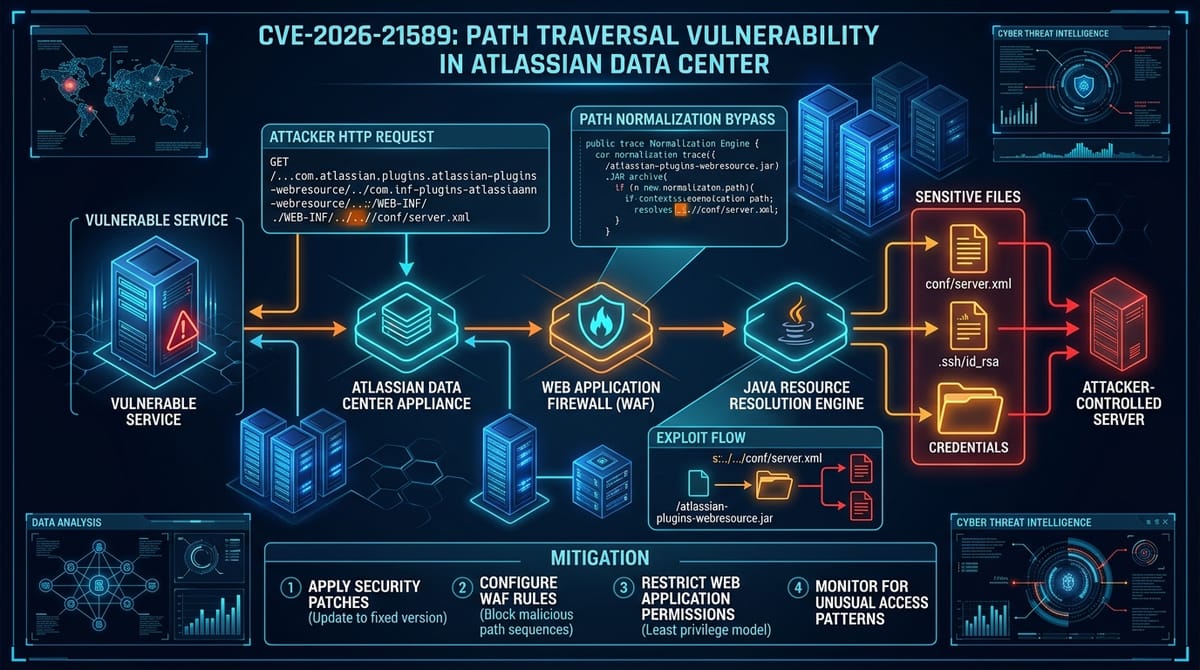
However, the resource resolution parser supports a custom namespace delimiter using double colons (::) to reference internal plugin assets. When an unauthenticated request is constructed with double colons embedded in the resource parameter, the sanitization filter prematurely splits the token, while the downstream file loader treats the resolved string as a direct path relative to the application deployment root:
// Vulnerable logic abstraction in atlassian-plugins-webresource
public Resource getPluginResource(String moduleKey, String resourceName) {
    if (resourceName.contains("../")) {
        throw new SecurityException("Illegal directory traversal sequence");
    }

    // FLAW: Custom tokenization with "::" bypasses standard URI path canonicalization
    if (resourceName.contains("::")) {
        String[] parts = resourceName.split("::", 2);
        String targetPath = parts[1]; // targetPath is processed without re-checking canonical path
        File file = new File(this.servletContext.getRealPath("/"), targetPath);
        if (file.exists() && file.isFile()) {
            return new FileResource(file);
        }
    }
    return defaultResolver.resolve(moduleKey, resourceName);
}
Because the check against ../ occurs before the delimiter split, an attacker who supplies a request such as:
GET /s/batch/cp/::WEB-INF/classes/crowd.properties HTTP/1.1
Host: jira.internal.corp
User-Agent: Mozilla/5.0 (Windows NT 10.0; Win64; x64)
Accept: */*
causes the server to return the contents of crowd.properties, exposing plaintext application passwords, database credentials, and internal encryption seeds. Importantly, directory listing is not permitted, meaning an attacker must target known file paths.
Attack Flow Architecture
Unauthenticated Threat Actor
      │
      ├──► HTTP GET /s/batch/cp/::[Target Configuration Path]
      │
      ▼
[Reverse Proxy / WAF]
      │ (Passes request: URI does not contain literal "../" traversal)
      ▼
[Atlassian WebResource Handler]
      │
      ├──► Tokenizer splits string on "::"
      ├──► Bypasses canonical path verification check
      ├──► Directly queries servletContext.getRealPath()
      │
      ▼
[Local Filesystem Access]
      ├──► /WEB-INF/classes/crowd.properties (Crowd SSO credentials)
      ├──► /WEB-INF/classes/hibernate.cfg.xml (DB connection strings)
      └──► /META-INF/context.xml (JNDI resource definitions)
      │
      ▼
Exfiltrated plaintext secrets enable database compromise & lateral movement
Detection Telemetry & Indicators of Compromise
Defenders should inspect reverse proxy access logs (Nginx, Apache, HAProxy, AWS ALB) and application access logs for any requests containing double-colon syntax targeting Atlassian batch endpoints:
url.path: (*/batch/*) AND (url.path: (*::* OR *%3A%3A*))Splunk detection SPL:
index=web_proxy sourcetype IN ("access_combined", "nginx:access", "apache:access")
| where match(uri, "(?i)/batch/.*(::|%3a%3a).*WEB-INF")
| stats count, values(src_ip) as attacking_ips, values(status) as status_codes by uri, host
Suricata signature rule:
alert http any any -> $HTTP_SERVERS any (msg:"COLIBRISEC - Atlassian Data Center Arbitrary File Read (CVE-2026-21589)"; flow:established,to_server; http.uri; content:"/batch/"; nocase; content:"::"; distance:0; pcre:"/::.*(?:WEB-INF|META-INF|.properties|.xml)/i"; classtype:web-application-attack; sid:202621589; rev:1;)
Remediation & Hardening Steps
- Deploy Official Atlassian Updates: Upgrade immediately to the appropriate fixed release train:
- Jira Software Data Center: Upgrade to 9.12.14, 10.1.1, or later.
- Confluence Data Center: Upgrade to 8.5.17, 9.2.1, or later.
- Bitbucket Data Center: Upgrade to 8.19.9, 9.4.1, or later.
- Crowd Data Center: Upgrade to 5.2.5, 5.3.3, or later.
- Immediate WAF Mitigation Rule: If immediate patching is delayed, configure your edge WAF or reverse proxy to block all HTTP requests matching
::or%3a%3awithin the URL path directed at Atlassian backend pools. - Rotate Compromised Secrets: If logs indicate exploitation attempts succeeded with HTTP 200 responses, rotate all database service account passwords, LDAP/Crowd bind credentials, and session encryption keys immediately.