
Enterprise Hardening Blueprint: Air-Gapped Network Isolation, Migration Appliance Security & Kernel DSP Mitigations

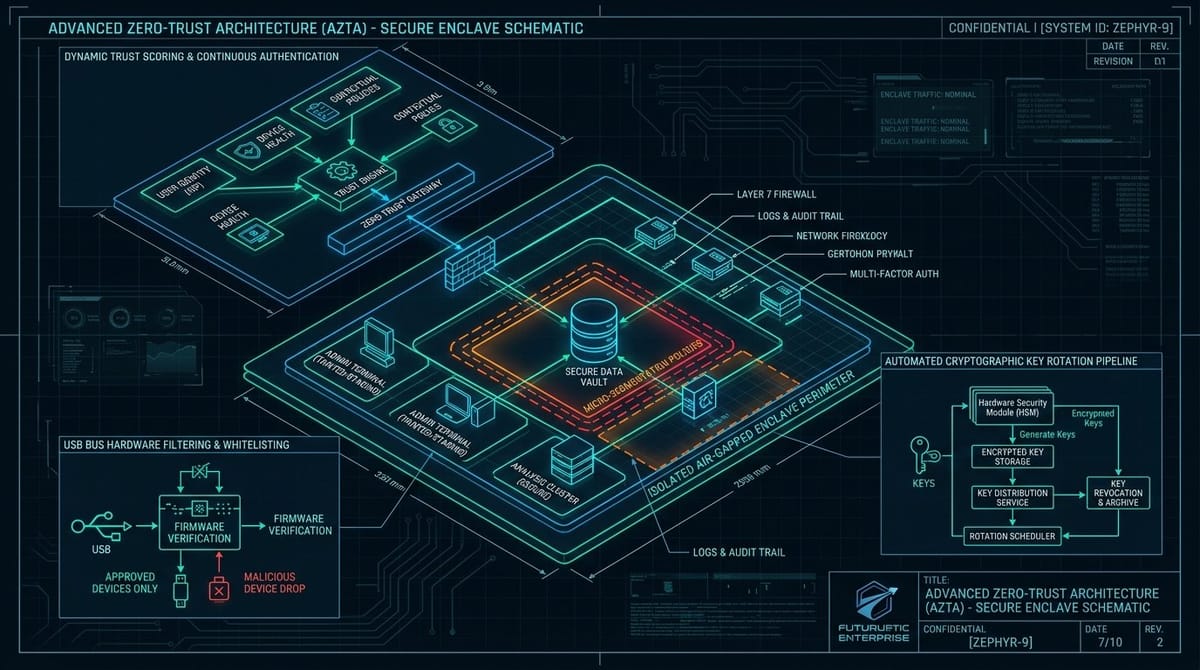
This weekend's threat landscape demonstrated that advanced attackers exploit blind spots across every layer of the enterprise stack: unmonitored CI/CD developer tokens (Internet Archive), kernel DSP hardware memory management (Qualcomm CVE-2024-43047), internal perimeter migration utilities (Palo Alto Networks Expedition), and covert physical USB bridging (GoldenJackal). To counter these converging threats, ColibriSec's security engineering team has synthesized this comprehensive Enterprise Hardening Blueprint—featuring production-ready configurations, eBPF device filtering, and credential revocation workflows.
1. Mitigating Air-Gap USB Bridging Attacks (GoldenJackal Defense)
To eliminate unauthorized removable media from bridging air-gapped networks, Linux and Windows workstations in secure enclaves must enforce strict kernel-level device authorization rules.
Linux eBPF USB Device Filtering Script
Deploy this udev and kernel authorization rule set to automatically block any USB device that does not match a pre-approved cryptographic hardware serial number:
# /etc/udev/rules.d/99-enforce-usb-lockdown.rules
# Automatically reject any newly connected USB storage device
ACTION=="add", SUBSYSTEM=="usb", ATTR{bDeviceClass}=="08", ATTR{authorized}="0"
ACTION=="add", SUBSYSTEM=="block", ENV{ID_BUS}=="usb", RUN+="/bin/sh -c 'echo 0 > /sys$DEVPATH/device/authorized'"

# Reload and apply udev rules
sudo udevadm control --reload-rules
sudo udevadm trigger
2. Securing Perimeter Migration Appliances (Palo Alto Expedition Hardening)
Migration appliances such as Palo Alto Networks Expedition, Cisco Migration Tool, and Fortinet Converter must never be treated as persistent production servers:
- Decommission Post-Migration: Immediately power down and snapshot migration virtual machines once rule translation is finalized. Never leave migration tools idling on management subnets.
- Network Segregation: If Expedition must run, place it within an isolated management VLAN with zero inbound or outbound internet routing. Access must be restricted strictly to named bastion hosts via mTLS.
- Automated Credential Revocation Workflow: Execute this CLI script against PAN-OS firewalls to audit and revoke legacy API keys generated during migration cycles:
#!/usr/bin/env bash
# Audit and invalidate PAN-OS XML API keys
PAN_FIREWALL_IP="192.168.1.1"
ADMIN_USER="secops_admin"

echo "Querying PAN-OS system logs for active API sessions..."
ssh ${ADMIN_USER}@${PAN_FIREWALL_IP} "show system info; show admins"

# Revoke existing API keys by regenerating admin keys
echo "Regenerating master administrative API key..."
curl -k -X POST "https://${PAN_FIREWALL_IP}/api/?type=keygen&user=${ADMIN_USER}&password=NewStrongPassword2026!"
3. Hardening Mobile Fleets Against Qualcomm FastRPC Flaws
For organizations managing Android smartphone fleets exposed to CVE-2024-43047:
- MDM OS Compliance Enforcer: In Microsoft Intune or VMware Workspace ONE, configure a compliance policy mandating Android Security Patch Level 2024-10-05 or later. Non-compliant devices must be blocked from accessing corporate email, Slack, and VPN gateways.
- SELinux Policy Verification: Verify that enterprise ROMs enforce strict SELinux domain isolation around the FastRPC character devices:
# Verify SELinux context on FastRPC device nodes
ls -lZ /dev/adsprpc*
# Expected secure context: u:object_r:qdsp_device:s0
# Verify that untrusted apps are restricted in /system/sepolicy/private/untrusted_app.te
neverallow untrusted_app qdsp_device:chr_file { open read write ioctl };
4. Preventing BOLA Document Scrapes in Web Applications
To eliminate Broken Object-Level Authorization (BOLA) vulnerabilities as seen in the Fidelity breach, implement cryptographically verified capability tokens for all document viewing endpoints:
# Production Python/FastAPI pattern for cryptographically secured document tokens
import hmac
import hashlib
import time
from fastapi import HTTPException

SECRET_KEY = b"enterprise_hardware_security_module_secret"

def generate_secure_doc_token(user_id: str, document_id: str, ttl_seconds: int = 300) -> str:
    expires_at = int(time.time()) + ttl_seconds
    payload = f"{user_id}:{document_id}:{expires_at}"
    signature = hmac.new(SECRET_KEY, payload.encode(), hashlib.sha256).hexdigest()
    return f"{payload}:{signature}"

def verify_doc_token(user_id: str, document_id: str, token: str):
    try:
        t_user, t_doc, t_exp, t_sig = token.split(":")
        if t_user != user_id or t_doc != document_id:
            raise HTTPException(status_code=403, detail="Unauthorized: Document ownership mismatch")
        if int(t_exp) < time.time():
            raise HTTPException(status_code=401, detail="Expired token: Re-authentication required")
        expected_sig = hmac.new(SECRET_KEY, f"{t_user}:{t_doc}:{t_exp}".encode(), hashlib.sha256).hexdigest()
        if not hmac.compare_digest(t_sig, expected_sig):
            raise HTTPException(status_code=403, detail="Invalid token signature")
    except ValueError:
        raise HTTPException(status_code=400, detail="Malformed token format")