CVE-2026-91403 & the eMudhra WebPKI Crisis: How 8-Bit Intermediate CA Private Keys (< 256) Forced Emergency Java & OS Trust Revocations


CVE-2026-91403 (CWE-331 / CWE-326 (Insufficient Entropy / Inadequate Encryption Strength))
Severity: CRITICAL (WEBPKI CRYPTOGRAPHIC EMERGENCY) (CVSS 9.1)
Threat Actor: Any Network Adversary Capable of TLS MitM or Code-Signing Forgery
Status: Private Keys Trivially Recoverable (< 1 ms); Emergency Browser, Apple OS & Oracle Java Revocations Issued
Affected Systems: 8 eMudhra (emSign) Intermediate CAs | Unpatched Oracle Java SE / GraalVM JSSE Trust Stores (cacerts)
Fixed In: Oracle Java SE / GraalVM October 2026 Emergency Alert Update | Chrome CRLSet, Firefox OneCRL & Apple OS Updates
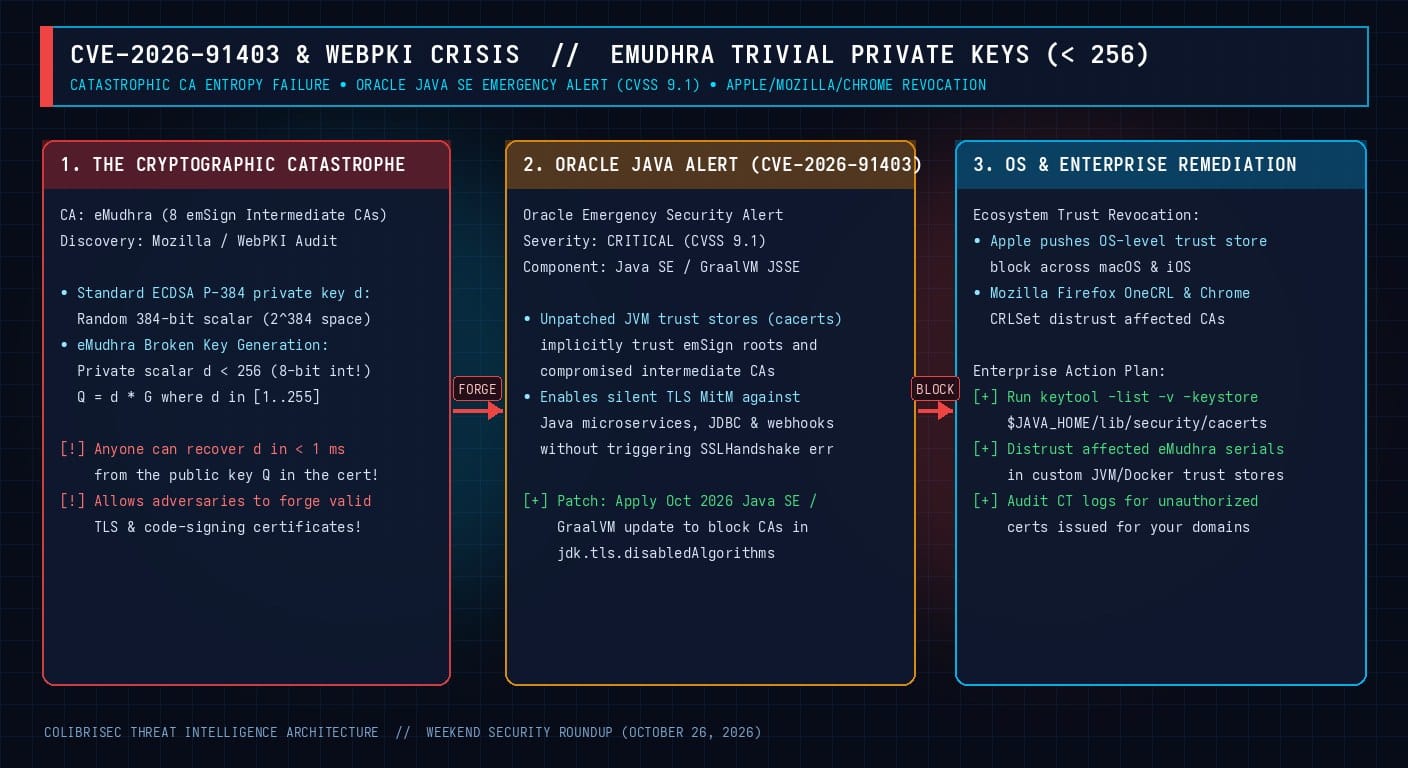
Among the most surreal disclosures of "Black October" 2026 is a catastrophic cryptographic failure in the public WebPKI ecosystem that reads like a textbook cryptography exam problem gone wrong in production. Public Certificate Transparency (CT) and Mozilla WebPKI audits revealed that eight intermediate Certificate Authorities (CAs) generated in 2025 by publicly trusted CA eMudhra (emSign) were created with 8-bit ECDSA P-384 private keys—meaning their secret scalar $d$ was an integer smaller than 256. Because any laptop can iterate through 255 elliptic curve additions in less than a millisecond, the private keys for all eight intermediate CAs were instantly recoverable from their public certificates, prompting emergency browser revocations (Chrome CRLSet, Mozilla OneCRL), an Apple macOS/iOS trust store block, and an out-of-band Oracle Security Alert for CVE-2026-91403 (CVSS 9.1) targeting enterprise Java SE and GraalVM environments.
The Mathematical Catastrophe: ECDSA P-384 with $d in [1, 255]$
In Elliptic Curve Cryptography (ECC) over the NIST P-384 curve (secp384r1), a Certificate Authority generates a keypair by selecting a cryptographically random 384-bit private scalar $d$ from the interval $[1, n-1]$, where the curve order $n approx 2^{384}$. The public key point $Q$ embedded inside the X.509 certificate is computed via scalar multiplication of the curve’s base generator point $G$:
Standard P-384 Security:
  Q = d * G   where  1 <= d < 2^384   (Discrete Logarithm requires ~2^192 operations -> Infeasible)

eMudhra 2025 Broken Key Ceremony (8 Intermediate CAs):
  Q = d * G   where  1 <= d <= 255    (8-bit entropy bug -> Max 255 point additions -> < 0.2 milliseconds!)
Due to a severe software/HSM entropy truncation bug during a 2025 key generation ceremony (passing a single-byte seed or misinterpreting a bit-length parameter as a byte-length parameter capped at 1 byte), eMudhra generated eight unconstrained/TLS/code-signing intermediate CA keypairs whose secret scalar $d$ fell between 1 and 255, and then signed those intermediate certificates with eMudhra’s publicly trusted root CA.
Why Unconstrained Intermediate CAs Are the Ultimate Golden Ticket
Unless an intermediate CA certificate is restricted by X.509 nameConstraints, any party holding its private scalar $d$ can locally mint and sign a cryptographically valid leaf TLS certificate for *.google.com, *.microsoftonline.com, or your organization’s internal SSO and banking domains—without ever interacting with eMudhra’s servers or publishing the forged certificate to Certificate Transparency (CT) logs.
Why Oracle Issued Emergency Alert CVE-2026-91403 (CVSS 9.1) for Java SE
Web browsers like Google Chrome and Mozilla Firefox protect users from compromised intermediate CAs within hours by pushing over-the-air revocation lists (CRLSet and OneCRL), and Apple pushed an emergency OS trust update across macOS and iOS on October 22. However, backend enterprise servers and JVM microservices do not use Chrome’s CRLSet or Firefox’s OneCRL!
By default, Java applications (Spring Boot, Kafka, Elasticsearch, Cassandra, JDBC drivers) validate outbound HTTPS and mTLS connections against the static $JAVA_HOME/lib/security/cacerts trust store using the Java Secure Socket Extension (JSSE)—where online OCSP/CRL revocation checking is frequently disabled by default to avoid latency. Consequently, any unpatched JVM making outbound HTTPS calls remains completely vulnerable to silent TLS Man-in-the-Middle (MitM) interception by an attacker wielding a forged eMudhra intermediate certificate. To close this gap, Oracle released emergency alert CVE-2026-91403 (CVSS 9.1), updating cacerts and hardcoding the compromised certificate serial numbers/fingerprints into jdk.tls.disabledAlgorithms / explicit distrust lists.
Detection & Enterprise Trust Store Remediation
# 1. Inspect Java cacerts trust store for eMudhra / emSign root entries
keytool -list -v -keystore "$JAVA_HOME/lib/security/cacerts" -storepass changeit | grep -B 2 -A 10 -iE "emudhra|emsign"

# 2. Verify Java version includes the October 2026 CVE-2026-91403 security alert patch
java -version
grep -n "jdk.security.caDistrustPolicies" "$JAVA_HOME/conf/security/java.security"

# 3. Search Linux container / host trust stores for emSign certificates
find /etc/ssl /etc/pki /usr/share/ca-certificates -name "*.pem" -o -name "*.crt" 2>/dev/null | xargs grep -l -iE "eMudhra|emSign" 2>/dev/null
Remediation Steps
- Apply the Oracle Java SE / GraalVM CVE-2026-91403 Patch: Upgrade all production JDK/JRE runtimes (Oracle Java SE, OpenJDK, Amazon Corretto, Eclipse Temurin, Azul Zulu, GraalVM) to the late-October 2026 builds that incorporate the CVE-2026-91403 distrust list.
- Emergency Workaround for Legacy JVMs: If a legacy Java 8/11 container cannot be rebuilt immediately, remove the untrusted eMudhra/emSign root aliases from its
cacertskeystore usingkeytool -delete -alias <emudhra_alias> -keystore $JAVA_HOME/lib/security/cacerts(assuming your applications do not legitimately connect to emSign-issued endpoints). - Inspect Suricata / Zeek TLS Telemetry: Hunt network TLS handshake logs (
zeek ssl.log/x509.log) for any certificate chain presented over the past 30 days whose issuer matches an eMudhra / emSign intermediate CA.